


Therapy
What Is a Breakthrough in Therapy? And How to Keep It Until Your Next Session

A breakthrough in therapy is a moment when something finally makes sense: you see a connection, a pattern or a feeling you couldn't name before. Researchers also use the word for sudden gains, a big drop in symptoms from one session to the next. Either way, it's a beginning, and what you do with it afterward matters.
In the movies, a breakthrough moment in therapy is loud. Someone shouts, someone sobs, the camera slowly zooms in and a cello starts playing at exactly the right second. Then the credits roll, and apparently everyone is fine now.
The real one is usually quieter. One sentence from your therapist that suddenly makes sense. A link you hadn't seen in years, like noticing you talk to your boss in the same careful voice you once used with your dad. You walk out, get in the car, and sit there a little longer than usual.
Can you remember the last time something clicked in a session? Can you still say what it was?
So what is a breakthrough in therapy, really?
Look up the meaning of a breakthrough in therapy and you'll find two things that often get mixed together. The first is insight: a new understanding of yourself, a link between your past and your present. The second comes from research, where "sudden gains" means a large drop in symptoms from one session to the next. They often show up together, but not always.
Insight in therapy isn't the same as knowing something from a book. You can "know" for years that criticism hits you hard. The breakthrough is the moment you feel it in one specific scene, like a photo in a darkroom tray: the picture was on the paper the whole time, and now it's coming through.
Fun fact: therapists from different schools argue about plenty, but in 2007 the American Psychological Association published a whole book on how each of them sees insight, edited by Louis Castonguay and Clara Hill.
Most breakthroughs arrive as a single sentence, which is why they're so easy to lose.
A breakthrough shows you where the work is. The work itself comes after.
What it looks like (and feels like) from the inside:
If you're wondering what a breakthrough in therapy feels like, it's usually less fireworks and more "huh."
- One thing your therapist said keeps replaying on the drive home, word for word.
- Halfway through a sentence you go "oh. Oh." Two things that lived in separate drawers for years turn out to be the same thing.
- Relief, lightness, a strange calm. Or the opposite: you feel like you ran a marathon sitting down, and being wiped out after a big session is common too.
- The tears came first, before you understood why. If that's you, here's whether crying counts as a breakthrough.
- And from the outside, a few days later: you answer your boss without apologizing first, or you don't text your ex at 1 a.m. Nobody claps. Your coworker just asks if you want the last donut.
That last one is what a breakthrough in therapy looks like once it leaves the room: the same situation, a slightly different you, usually on an ordinary Wednesday. That's where most of the signs show up. One moment still can't tell you whether therapy is working overall, though.
The feeling fades in days. The sentence is what you can keep.
What research turned up:
In 1999, Tang and DeRubeis reported in the Journal of Consulting and Clinical Psychology that in cognitive behavioral therapy for depression, a shift in thinking tended to show up in the session just before a sudden jump in mood, and they proposed three stages: preparation, a critical session, then an "upward spiral." So a breakthrough has a before.
In 2015, Lee and Harvey followed 30 adults with bipolar disorder and insomnia in a treatment trial (also in the Journal of Consulting and Clinical Psychology). At the start of each session, people listed what they remembered from the last one, and they recalled only about a fifth to a third of the points their therapist had noted. Those who remembered more points tended to do better on some of the sleep measures. It's a small, specific group and a correlation. Still, it suggests that even the important parts of a session leave fast, and that what stays may matter.
In 2020, Shalom and Aderka pooled 50 studies with more than 6,000 people in psychotherapy for a meta-analysis in Clinical Psychology Review. Sudden gains were linked to better outcomes at the end of treatment and afterward, across different therapies and problems. In studies where more of those gains reversed, though, the link with outcome was weaker.
And in 2022, Ladmanová, Řiháček and Timulak reviewed 17 studies in Psychotherapy Research where clients described helpful moments right after a session. One impact kept coming up in their own words: "gaining a new perspective on the self."
The honest caveat: not everyone has a breakthrough. Sudden gains happen to some people, and many others improve gradually, with no single moment to point to. That takes some pressure off: you don't have to wait for "the moment" for therapy to be worth it.
Breakthroughs help most when they stick. Sticking is the part you can work on.
How to keep it until your next session:
- Write the sentence down before you start the car. One sentence, in your own words, not a summary of the hour. The Lee and Harvey numbers show how little survives until next time. Try: "Today I realized that ___, and it shows up when ___." Future you will not remember "the thing about Dad." Future you needs the actual sentence.
- Ask your therapist to say it back. Before the session ends: "Can you say back what you think I just figured out? I want to make sure I keep it." A second version in someone else's words is easier to hold onto. If sessions blur together for you, here's how to remember what you talk about in therapy.
- Watch for it during the week. Treat the breakthrough like a hunch you get to test. When the old pattern shows up, jot down one line: where, with whom, and what you did differently or the same. Between therapy sessions is where an insight turns into change or evaporates, which is a big part of what to do between therapy sessions.
- Don't expect it to feel the same next week. The glow wears off, and sometimes the old behavior comes back right on schedule. That doesn't make the breakthrough fake. Bring the backslide in as material: "I understood something last week, and then I did the old thing anyway. Can we look at that?"
- Bring it back first thing next session. Not in the last five minutes with your hand on the door handle. Open with it: "I want to start with what clicked last time." The rest of your prep is in how to prepare for a therapy session. And if nothing has clicked in a long time, start with what to do when therapy feels stuck.
A breakthrough you can't repeat in your own words is just a nice afternoon.
Going without a breakthrough doesn't mean therapy isn't working, and nobody owes their therapist one. If a big session leaves you feeling worse for days, or like everything is falling apart, tell your therapist plainly. If you ever feel unsafe, call or text 988, or 911 in an emergency.
Where MindSync fits:
This is what MindSync's After therapy card is for. Log the sentence that clicked, the scene it connects to and the question you want to ask next time, while it still sounds the way it did in the room. Give it time, and Workspace holds the realizations worth keeping next to your agenda for next time, while the Therapy timeline lets you look back a month later and see which ones stuck. Then your Before therapy card, with up to three questions to bring, is waiting before your next session. Whether it was a breakthrough is for you and your therapist to decide.
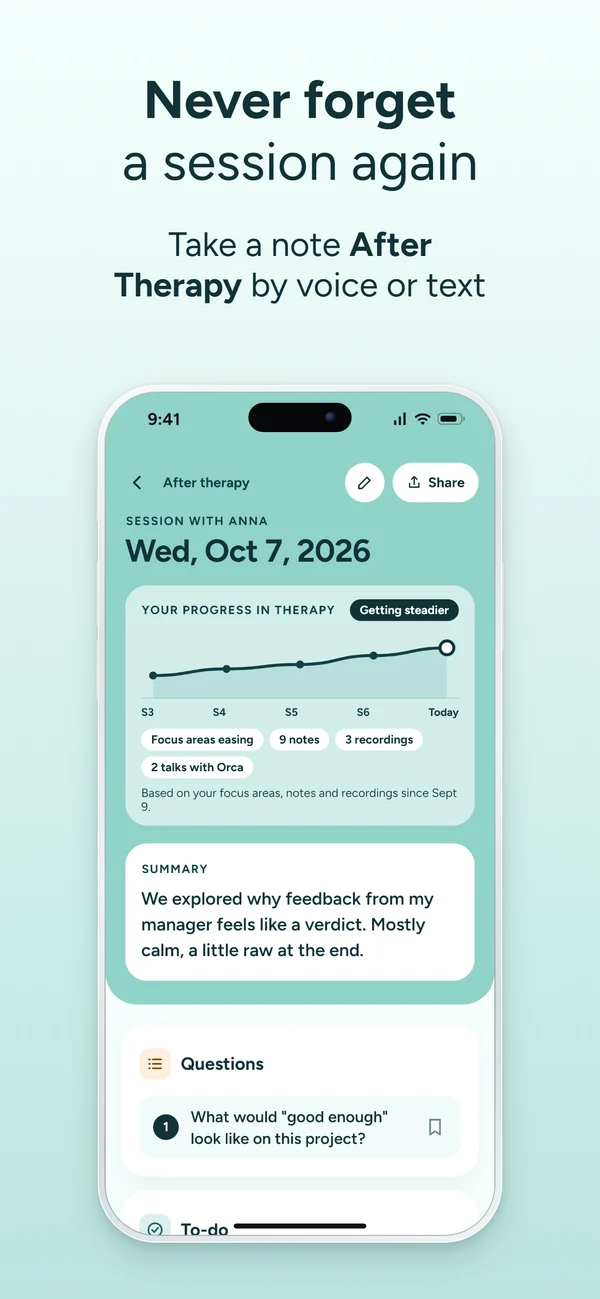
After therapy card
Write down the sentence that clicked, in your own words, right after the session. The card keeps it with your realizations. Try it free in MindSync →
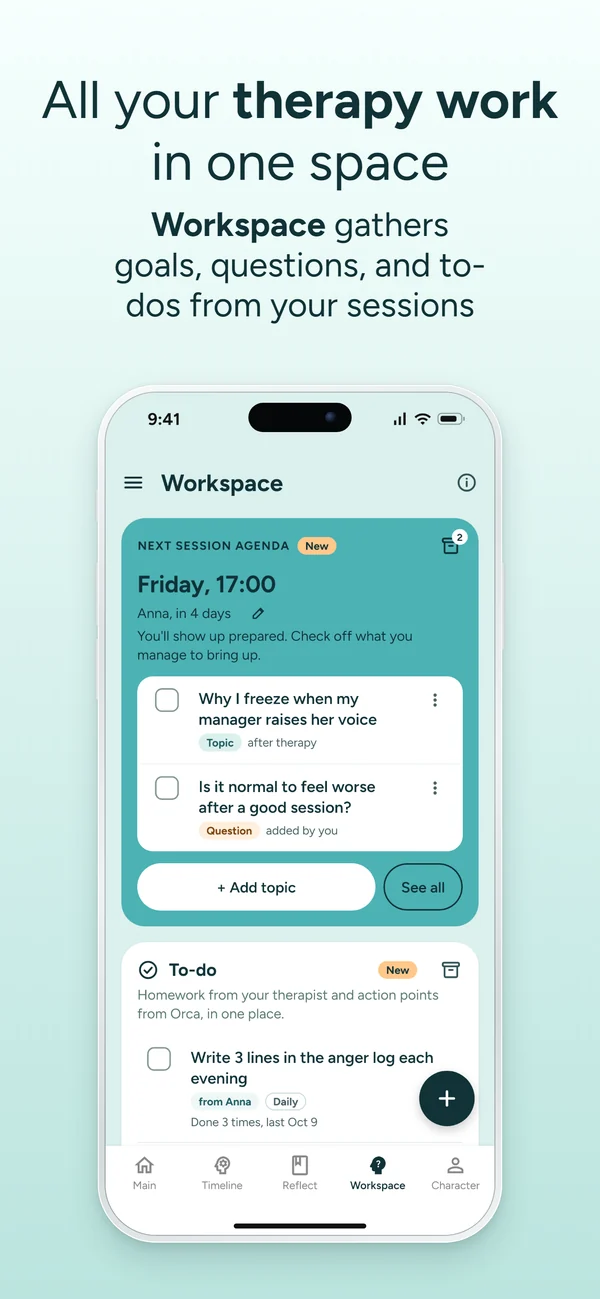
Workspace
Keep your realizations next to your agenda for next time, so a breakthrough is the first thing you bring back. Try it free in MindSync →
Write down what clicked in your last session, then keep it until the next one.


What's one thing you understood in therapy that you could still say out loud today, word for word?
Frequently asked questions
What is considered a breakthrough in therapy?
There's no official threshold. People usually use the word for a new understanding of themselves that changes how they see a problem, and researchers also use it for a sudden, large drop in symptoms from one session to the next. What counts in practice is whether you can say it again in your own words and notice it during the week.
What does a breakthrough in therapy feel like?
Usually quieter than people expect: a click, relief, a strange calm, sometimes tears or real tiredness. Many people only feel it on the way home or the next day, and it rarely looks like the movies. Write the sentence down while you still remember how it sounded.
What does a breakthrough in therapy look like?
From the outside, it usually shows up a few days later: you react differently in a situation that always ended the same way, or you catch a pattern while it's happening instead of afterward. In the session itself, it often looks like connecting two things you'd only ever talked about separately. Note the scene when it happens and bring it to your next session.
What happens before a breakthrough?
Often more than it seems. In a 1999 study of cognitive behavioral therapy for depression, Tang and DeRubeis found that a change in thinking tended to show up in the session just before a sudden gain, and they described a preparation stage leading up to it. Before that, there can be weeks that feel like standing still. Keep noting small shifts, because breakthroughs rarely come from nowhere.
Keep more from every session
MindSync keeps your sessions and the week between them in one place, so your progress stops slipping away. The trial is free, no credit card needed.


Get the app