
Therapy
How to Remember What You Talk About in Therapy

You walk out of the session lighter. Something moved. Six hours later a friend asks what you talked about, and you have nothing. A feeling, maybe one word. The hour that cost you money and nerve has already blurred at the edges. That blur has a mechanism, and a workaround that fits on half a page.
You are not the problem, the format is
Forgetting a session is not evidence that you were checked out. It is what happens when someone hands you a pile of emotionally loaded material in a room you walk out of 50 minutes later.
The hardest numbers on this come from medicine rather than psychotherapy. Roy Kessels reviewed the evidence in a 2003 paper in the Journal of the Royal Society of Medicine and reported that 40% to 80% of the medical information a practitioner gives is forgotten immediately, and that almost half of what patients do remember is recalled incorrectly. The more that gets said in one sitting, the smaller the share that survives.
One thing to be straight about: those studies watched doctors explain diagnoses and treatment plans, not therapists. Therapy is a conversation you help build, which probably helps retention. It also runs longer and hits harder than a discharge briefing, which probably does not.
One finding does come from inside the counseling room. Jack Martin and Karl Stelmaczonek asked counselors and clients, separately, which moments in their shared sessions had been important (1988, Journal of Counseling Psychology). The two sides named exactly the same moment in roughly a third of the cases where both reported one. Two people in the same room, both paying attention, and they already disagree about what the session was.
Why emotional sessions are the hardest to recall
The sessions you most want to keep are the ones your memory handles worst.
Mara Mather and Matthew Sutherland called this arousal-biased competition in a 2011 paper in Perspectives on Psychological Science. Their argument is that arousal amplifies whatever was already winning the competition for your attention, rather than improving or damaging memory across the board. The high-priority thing gets encoded more strongly. Whatever was competing with it gets encoded more weakly.
In practice that looks like this. You keep the moment your voice cracked. You lose the sentence your therapist said 30 seconds later, the one that explained what had just happened.
So the standard advice, pay closer attention, aims at the wrong target. Attention was not what failed. Selection was, and it happened without consulting you.
If what stays with you after a session is mostly physical, a body that will not come down, that is a separate problem with its own tools. If you leave sessions wired and cannot settle, start there instead.
Four things worth keeping from every session
Remembering what you talk about in therapy does not take the whole hour back. Most of the value sits in four items, and all four fit on half a page.
The sentence that landed
There is usually one line that made something click. Write it as close to your therapist's words as you can manage. Paraphrase drifts fast, and by next week your version will be smoother and more reasonable than what was actually said, which is exactly what makes it useless.
The question your therapist asked twice
Therapists circle back on purpose. A repeated question means you did not answer it, or that the answer was interesting. You almost never notice the repetition while it is happening. An hour later it is obvious.
What you agreed to try
Homework, an experiment, a conversation you said you would have. Write the specific version, not the category. "Say no to one thing this week" survives until Wednesday. "Work on boundaries" does not.
What you avoided saying
The thing you steered around, changed the subject on, or conveniently ran out of time for.
This is the most valuable line you will write and the one you are least likely to write. It is also the best opening for next time, which is where remembering the session and preparing the session so there is less to lose turn out to be the same job.
The 20-minute debrief
Do it before you get back to your day
The window matters more than the format. Once you are back on email, the session is competing with everything else for the same limited attention that already failed you in the room.
Pulling the session out of your head also beats reviewing it later. Henry Roediger and Jeffrey Karpicke showed in 2006 in Psychological Science that retrieving material from memory produces better long-term retention than restudying it, and that the gap widens as the delay grows. Rereading your notes on Friday counts as restudying. Writing the four things down from memory on Tuesday counts as retrieval, and that is the version that keeps the session reachable a month from now.
You rarely need the full 20 minutes. Five is usually enough, if it is the right five.
Speak it instead of writing it, if writing kills it
Plenty of people go blank in front of a blank page right after a session, especially a heavy one. Talking works. Say the four things out loud into your phone on the walk to the car and let the transcription do the typing. Nobody is grading the sentences.
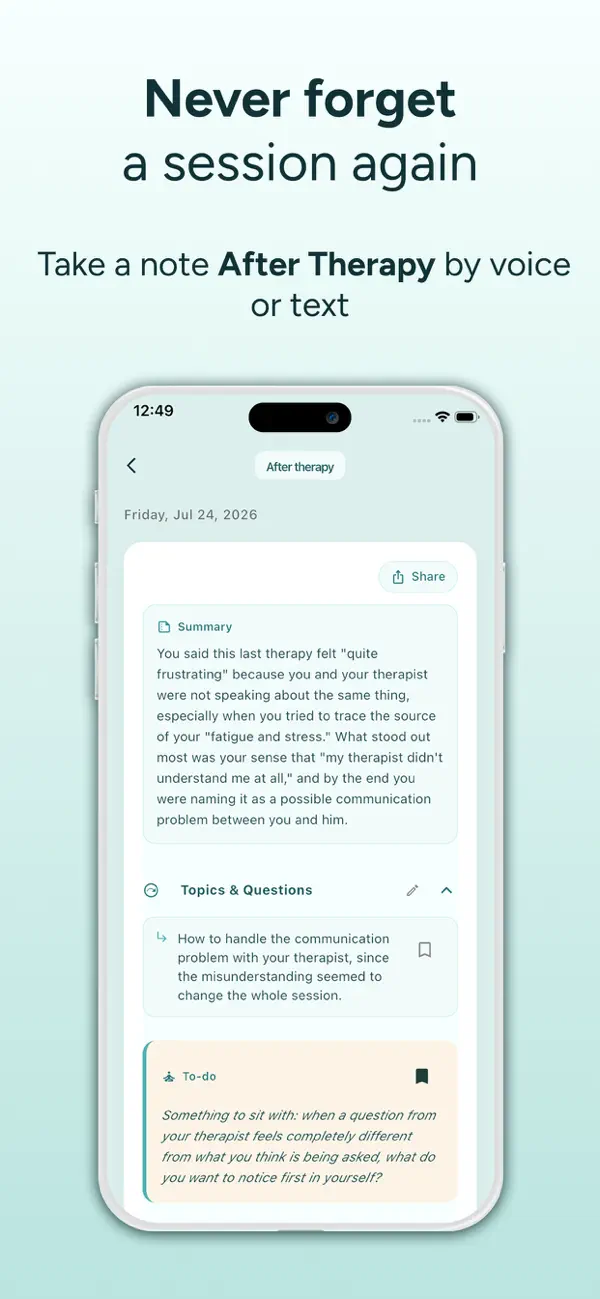
After-therapy debrief
Capture what mattered while it is still fresh, in text or out loud, and it stays on your timeline. Try it free in MindSync →
Recording your sessions: how to ask, and what to do with it
Ask first, always
Recording is the most reliable way to stop losing sessions, and it is the part most guides walk past. So, plainly: you ask, and you ask before you press anything.
Laws covering recorded conversations differ between US states and between countries, and nothing here is legal advice. The practical rule is simpler than the legal one and keeps you right either way. Raise it at the start of a session, say what it is for (you want to listen back, not build a case), say where the file will live, and take a no without negotiating. Many therapists already have a policy on this. Some have it written into the paperwork you signed.
A no is information too. Some therapists find that being recorded changes how they work in the room, and that is worth talking about rather than routing around.
What recording changes (and what it does not)
Where it does happen, people use it. Laura Shepherd, Paul Salkovskis and Martin Morris surveyed patients and therapists at a CBT center where recording was routine (2009, Behavioural and Cognitive Psychotherapy). Around 90% of the patients surveyed said they had listened back between sessions at least to some extent, and most had discussed the recordings with their therapist. Both sides named better memory for sessions as the main advantage. Therapists were more likely than patients to worry that listening back would be upsetting. It was a small study at one specialist clinic, 72 patients at the start of therapy and 31 still answering at the end, so read it as a signal rather than a settled number.
The pattern outside therapy points the same way. A scoping review by Maka Tsulukidze and colleagues in Patient Education and Counseling (2014) pooled 33 studies of recorded consultations and found that on average 72% of patients listened to theirs, with better recall and understanding among the benefits reported.
What a recording does not do is process the session for you. A 50-minute audio file you never open is worth about what the memory you never wrote down is worth. A transcript changes the math, because you can skim it and jump to the part you need. That is what session recording and summaries are for.
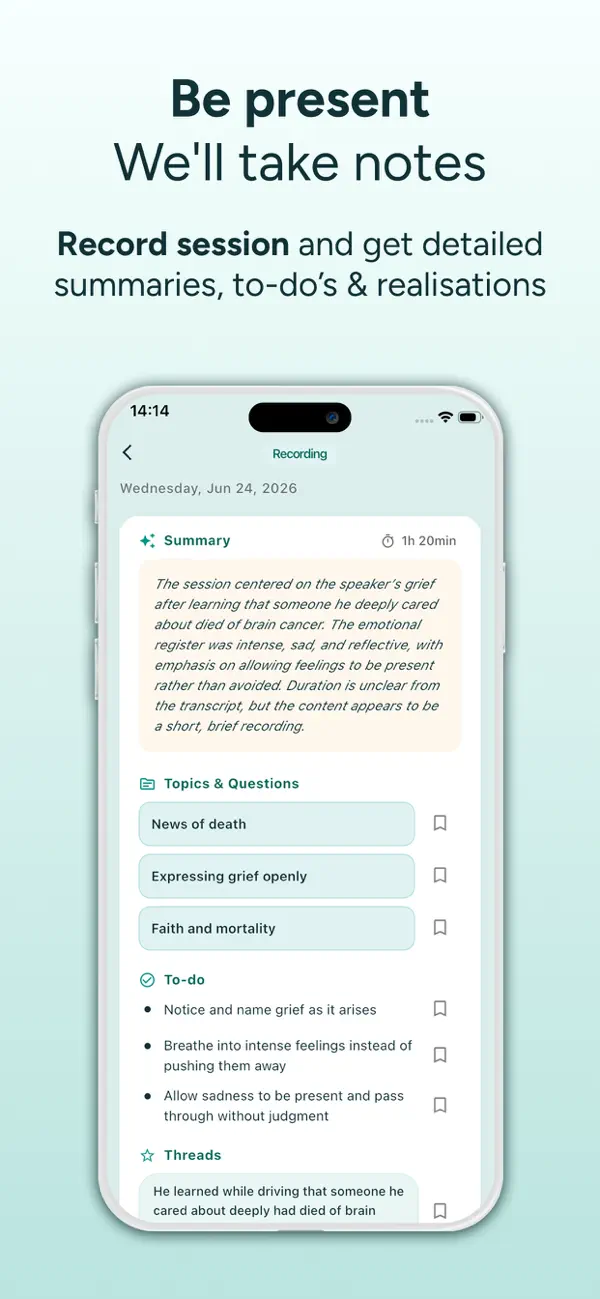
Session recording & summaries
With your therapist's permission, MindSync records the session and gives you the transcript, the key takeaways and the questions they asked. Try it free in MindSync →
Six sessions in, this stops being about any one session. One debrief is just a note. Stack up a dozen and you have a record you can look back through for the question that keeps coming back, and that is a different kind of information than any single session gives you. The rest of it is what you do with the days in between, which is a longer conversation about what to do between therapy sessions.
Keeping more from every session
- Session recording & summaries - The full record, not your best guess at it.
- After-therapy debrief - Five minutes after the session, while it is still warm.
- Therapy timeline - Every session, note and realization on one timeline you can filter back through months later.
Frequently asked questions
Why do I forget everything my therapist says?
Because a therapy hour delivers a lot of emotionally loaded information at once, and memory does not store it evenly. Research on medical consultations (Kessels, 2003, Journal of the Royal Society of Medicine) found that 40% to 80% of what a practitioner says is forgotten immediately. Emotional intensity narrows things further, keeping the peak and dropping the detail around it.
Is it normal to not remember a therapy session?
Yes, and it happens most after the sessions that hit hardest. Arousal strengthens memory for whatever dominated your attention and weakens memory for whatever was competing with it (Mather and Sutherland, 2011, Perspectives on Psychological Science). Losing the details of a heavy session tells you something about how memory works, not about whether the session counted.
Can I record my therapy session?
Ask your therapist first, every time. Recording laws differ between US states and between countries, and this is not legal advice, but the practical rule holds everywhere: no consent, no recording. Say what you want it for and where the file will be kept. Many therapists have a policy already, and some cover it in your intake paperwork.
Should I take notes during therapy or after?
After, in almost every case. Writing during the session pulls your attention out of the room and turns you into the stenographer of a conversation you are supposed to be having. A short debrief afterwards also works better as memory, since retrieving material beats reviewing it (Roediger and Karpicke, 2006, Psychological Science). Two words mid-session to hold a thought is fine.
What should I write down after a therapy session?
Four things. The sentence that landed, in your therapist's words if you can hold on to them. The question they asked twice. What you agreed to try, in specific terms rather than as a category. And what you avoided saying, which is usually the best opening for the next session. Half a page covers it.
Keep more from every session
MindSync keeps your sessions and the week between them in one place, so your progress stops slipping away. The trial is free, no credit card needed.


Get the app