
Therapy
What to Do Between Therapy Sessions: A Weekly System That Fits Real Life

Your session ends at the 50-minute mark. You walk out holding something that felt like a shift. Then the week starts: groceries, a bad meeting, a conversation you did not plan for. By Thursday the shift has gone quiet. One hour in the room, 167 hours outside it. This is a rhythm for the 167.
Why the week matters more than the hour
A weekly session is less than 1% of your week. That is arithmetic, not a research finding, but it explains why so much of therapy depends on what you do when nobody is watching.
The research on this sits under an unglamorous name: homework. Kazantzis, Whittington and Dattilio pooled 46 studies covering 1,072 people in a 2010 meta-analysis in Clinical Psychology: Science and Practice. Restricting the comparison to controlled studies that ran the same therapy with and without homework, the conditions with homework came out ahead at d = 0.48. Moderate. Produced entirely by what happens between appointments.
A later meta-analysis by Kazantzis and colleagues in Behavior Therapy (2016) looked at 17 studies and 2,312 clients, and found that how much homework people completed related to their outcome at the end of treatment, g = 0.79. The second number comes with a catch: it is correlational. People who are already improving may simply find the work easier to do, so it does not settle the direction of the arrow by itself.
Ryum and Kazantzis, writing in Clinical Psychology in Europe in 2024, make a point worth borrowing. Between-session work is not a CBT invention. It shows up in psychodynamic and humanistic approaches too, under other names. They also admit the evidence outside CBT is thin, which is more than most people writing about this will tell you.
The rhythm, not the checklist
Search for what to do between therapy sessions and you get the same list everywhere. Journal. Practice self-care. Sleep. Lean on your support system. None of it is wrong. All of it is shapeless. A list does not tell you what to do on Tuesday at 9pm when something lands and you have no idea whether it is worth keeping.
A rhythm does. Four moments, tied to where you actually are in the week:
- On session day, spend 20 minutes afterwards writing down what actually happened.
- Over the next 48 hours, capture whatever surfaces, two lines at a time, without analyzing it.
- Midweek, do one honest check-in on the two or three things you are working on.
- The day before your next session, spend 10 minutes turning seven days into an agenda.
Under an hour across the whole week, and most of it happens standing up.
Session day: 20 minutes after
The 20 minutes after a session is the most valuable slot in your week and the one most reliably spent answering email. You are still in the room, mentally. The language your therapist used is still yours to borrow. An hour later it will have compressed into a vague good feeling.
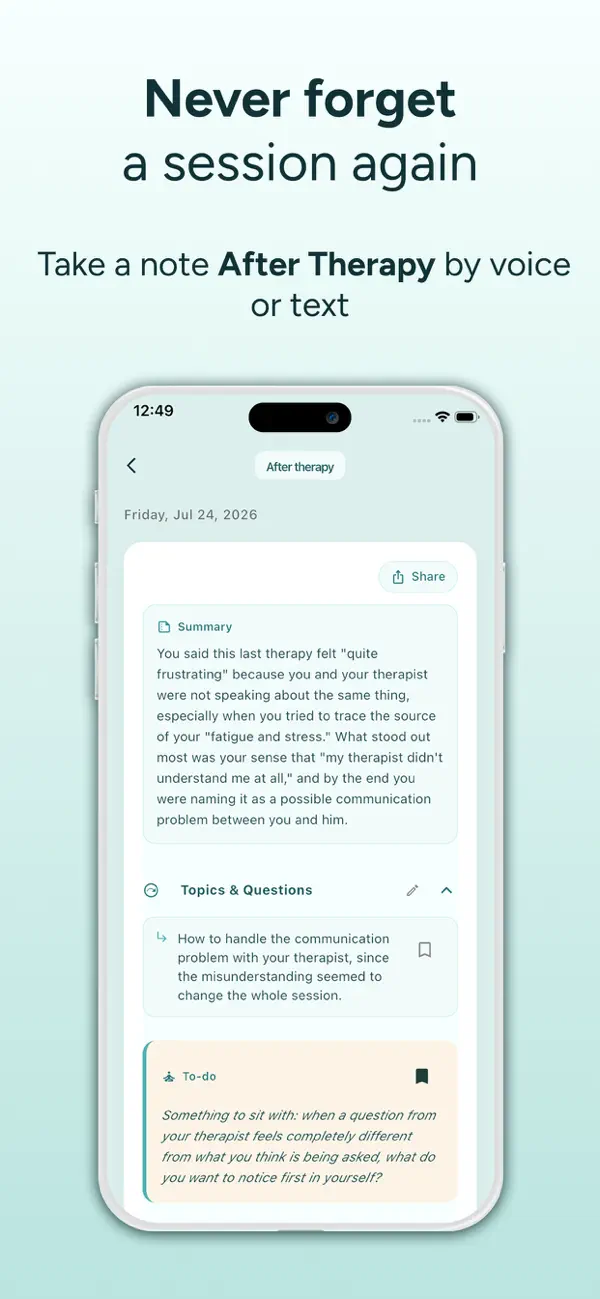
Write four things: the sentence that landed, what you agreed to try, what you avoided saying, and one question you did not ask. Four lines. If sitting down to write kills it, say them out loud instead. There is more on why sessions evaporate, and what to do about it, in remember what you talked about.
The next 48 hours: let it settle, capture what surfaces
Sessions have an afterlife. Something you said on Tuesday shows up on Wednesday afternoon in a supermarket queue, and it arrives with more force than it had in the room. That is the material. Not the neat insight you produced on cue, the one that ambushed you two days later.
Do not analyze it. Record it and move on: two lines, 10 seconds. What you write down on Wednesday will be closer to what actually happened than anything you rebuild from memory on Sunday night.
Sometimes what surfaces is not a thought at all. It is a body that will not settle after a session that went well. That is common, it has its own toolkit, and it gets its own article: regulate your nervous system between therapy sessions.
Between-session voice notes
Say it out loud in the 10 seconds you actually have, and the note is transcribed and waiting for you when you sit down later. Try it free in MindSync →
Midweek: one honest check-in
Wednesday or Thursday, pick a moment you already repeat: after you brush your teeth, before you close the laptop. Rate the two or three things you are actually working on in therapy. Sleep quality. How often you snapped at someone you love. Same scale, same time, under a minute.
Not "how was your day". A general mood score answers a question nobody was asking. Three specific markers, read back a month later, will tell you something a feeling cannot. And if you have tried this before and quietly abandoned it around day 17, that failure mode is well understood and fixable: see tracking that survives past week two. Over months, the same markers turn into the most honest answer available to how to know if therapy is working.
The day before: build the agenda
Ten minutes, the evening before. Read back what you captured. Pick one main topic and two backups, then write the first sentence you plan to say out loud, because the first sentence is the part that goes missing in the chair. The rest of the mechanics are in prepare for the next session.
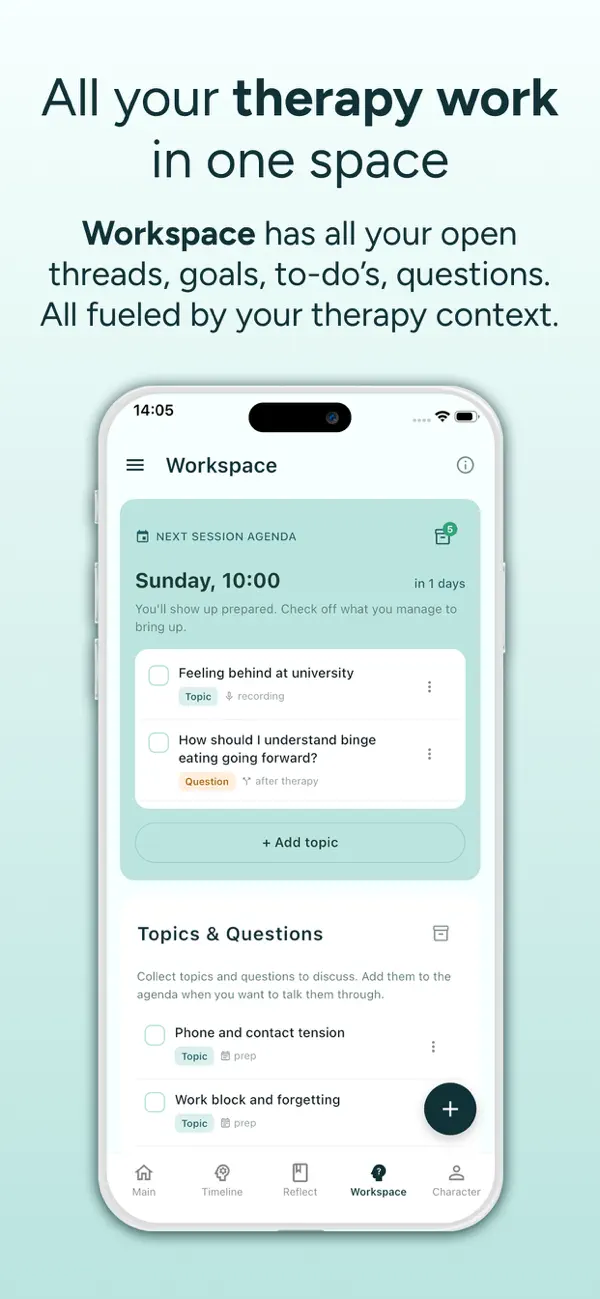
Workspace
Everything you flagged during the week is already sitting on your agenda for next time, so the night before is reading rather than remembering. Try it free in MindSync →
What to capture (and what to skip)
Moments, not essays
Two lines beats two pages, mostly because two pages will not happen twice. A usable capture has a situation and a reaction. "Manager rescheduled again. Went cold, said nothing, replayed it for an hour." That is enough for you and your therapist to work with in eight days.
The thing you almost said
Whatever you swallowed this week is worth more than most of what you actually said. The message you drafted and deleted. The boundary you rehearsed in the shower and then did not use. Those are specific, they repeat, and they are exactly the sort of thing you will not remember on Friday.
What the homework actually cost you
If your therapist suggested something, record what it cost, not just whether you did it. "Did the exposure, took me three tries to start, was easier than expected" is useful. So is "skipped it four days running and felt worse every time I saw it on the list." Both are data. Neither is a confession. If you want to know whether a particular technique is doing anything for you specifically, there is a way to test which coping skills actually work for you.
Skip the rest: transcribing your day, and writing for an audience you have invented. If the same situation keeps turning up in your captures, you are looking at a pattern rather than a bad week, and that is the point where it helps to spot your emotional triggers.
When the week goes sideways
Some weeks you will do none of this. You will be ill, or flattened, or busy in a way that makes 20 minutes look like a luxury. Missing the system is not evidence about your character, and treating it that way turns a practical problem into a moral one.
Ryum and Kazantzis say something useful about this in that 2024 review. When between-session work does not happen, they argue the therapist should look at how the task was set up before concluding anything about the client. Same logic when you are the one setting tasks for yourself. Four touchpoints failed twice in a row? The task is too big, and you are not the variable that needs fixing.
The fallback is one thing, not a shrunken version of everything. Keep the midweek check-in. One honest minute in a bad week beats a perfect system you abandoned in March, because a single line still shows up on the chart six weeks later and the abandoned system shows nothing at all.
If you only do one thing
Do the 20 minutes after the session.
Everything else in this rhythm is reconstruction. The midweek check-in compresses a whole day into a number. The agenda you build the night before is you interviewing your own memory. The 20 minutes after a session is the only window where the raw material is still lying there, free, costing you nothing to pick up. It makes the following week easier too, because you walk into Tuesday already knowing what you agreed to try.
If you want the whole thing in one place instead of spread across a notes app, a voice memo folder and a habit tracker you stopped opening, that is roughly what MindSync is. It was built by someone who spent 10 years and $130,000 on therapy, largely because the weeks in between kept leaking. You can see everything the app does, though the rhythm works on paper too. What does not work is having no rhythm and hoping the week reports itself accurately on Friday.
The week, in one place
- Wellbeing check-ins - One honest minute midweek, on the areas you are actually working on.
- Weekly & monthly summaries - The week read back to you before you walk in, instead of reconstructed in the waiting room.
- Prep Card - A prep card that turns seven days of scattered notes into one screen.
Frequently asked questions
What should I do between therapy sessions?
Four things, spaced across the week. Spend 20 minutes after the session writing down what happened. Capture whatever surfaces over the next two days, a line or two at a time. Do one honest check-in midweek on what you are working on. Spend 10 minutes the day before building your agenda for the next session.
How do I keep making progress between sessions?
Usually by doing whatever your therapist suggested and recording what it cost you, rather than by journaling more. Meta-analyses of homework in cognitive behavioral therapy, including Kazantzis and colleagues in 2010, find better outcomes when the same therapy includes between-session tasks. Record the attempt, including the ones that failed, and bring it back into the room.
Should I journal every day between therapy sessions?
No. Daily journaling is a popular recommendation and a popular quitting point. Two lines when something happens beats a page every night, because the page stops after two weeks. What matters is that something gets captured close to the moment, and that somebody reads it back before the next session, even if that somebody is you.
What if I forget everything by the next session?
Then the problem is capture, not memory. Forgetting the details of an emotionally loaded conversation is ordinary. The fix is recording something within a day of it happening, in whatever form you will actually use, including speaking it out loud rather than writing. Reading it back the evening before your session does the rest.
Is it okay to contact my therapist between sessions?
That depends on your therapist's policy, which is worth asking about directly instead of guessing. Some are fine with short messages between appointments, others hold everything for the session, and most set expectations about response times. Ask what their policy is, and ask what they would want to hear about before the next appointment.
Keep more from every session
MindSync keeps your sessions and the week between them in one place, so your progress stops slipping away. The trial is free, no credit card needed.


Get the app