
Therapy
How to Know If Therapy Is Working (Beyond a Gut Feeling)

Six months in. A charge on your card every week, an hour you rearrange your life around, and a question you have never said out loud: is any of this working? Most advice answers that with a list of feelings you are supposed to recognize in yourself. There is a better answer, and clinicians have been using it for years.
Why "do I feel better" is a bad measuring stick
Ask yourself how you were doing in March and you will not get March back. You get a summary your brain wrote afterwards, weighted toward whatever was loudest. Retrospective self-report is exactly the weak point researchers stopped trusting decades ago, which is why they moved to sampling people in real time instead of asking them to remember a whole month.
Then there is the baseline problem. The version of you who booked the first session is gone, and whatever you are now feels like it was always there. People describe six months of real change as "nothing really" all the time, because the change happened at the speed of a haircut growing out.
And then there are weeks. A good week is not evidence. A brutal week is not evidence either. At that resolution you are reading noise and calling it a verdict.
What therapists actually measure
Here is the short version of how to know if therapy is working. Track symptoms with the same instrument every time, watch whether ordinary life is getting easier, and pay attention to your working relationship with your therapist. Read all three across months rather than weeks. Clinicians call this measurement-based care: steering treatment by repeated answers to the same short questions instead of by impressions.
Symptom questionnaires
The two you are most likely to meet are the PHQ-9 for depression and the GAD-7 for anxiety. Kroenke, Spitzer and Williams introduced the PHQ-9 in 2001 in the Journal of General Internal Medicine, validated across 6,000 primary care patients. Spitzer, Kroenke, Williams and Löwe published the GAD-7 in 2006 in Archives of Internal Medicine. Nine questions and seven questions, both asking how often something has bothered you over the last two weeks.
The number matters less than the fact that the wording never changes. Same nine items, same scale, every time. So when the score shifts, something moved in you rather than in how you happened to phrase the question that morning.
Blunt version, because it matters: these tools screen for symptoms and grade severity. They do not diagnose anyone. A clinician reads a score with you, in context, across several rounds. Reading it alone at midnight gives you none of that. If your therapist or your doctor already uses them, ask what your numbers have been doing over time. Do not go hunting for cutoffs to grade yourself against.
Session by session feedback
Some therapists run something lighter and more frequent. The Outcome Rating Scale asks four questions at the start of a session about how the week went. The Session Rating Scale asks four at the end about how the session itself landed. Miller, Duncan, Brown, Sparks and Claud published the ORS in 2003 in the Journal of Brief Therapy, and Duncan and colleagues published the SRS in the same journal that year. Each takes under a minute.
The reason this practice exists is uncomfortable. Lambert and Shimokawa, writing in Psychotherapy in 2011, put the figure at 5 to 14% of clients getting worse during treatment, and noted that therapists fail to identify a substantial share of those cases. Hannan and colleagues had already shown how bad the blind spot is, in 2005 in the Journal of Clinical Psychology. Therapists who knew their own clinic's deterioration rate, and who rated every client after every session, flagged three clients out of 550 as likely to end up worse.
Three out of 550.
Does collecting the feedback help? Somewhat. De Jong and colleagues pooled 58 studies and 21,699 patients for a 2021 meta-analysis in Clinical Psychology Review and found a small effect on symptom reduction, d = 0.15, rising slightly to d = 0.17 among patients who were off track. Small is the honest word for it. Think of it as a steering correction from a system whose main job is catching the cases everyone else misses.
The working alliance, and why it predicts outcome
The third layer is the relationship itself. Flückiger, Del Re, Wampold and Horvath pooled 295 studies and more than 30,000 patients for their 2018 meta-analysis in Psychotherapy and found an alliance-outcome correlation of r = .278. It is one of the most replicated results in psychotherapy research.
The caveat is direction. People who are getting better may simply feel warmer toward the person they are getting better with, so the arrow does not only point one way. It still means something if you brace yourself before every session, or you catch yourself editing what you say in the room. Say that out loud instead of filing it away.
A home version you can run in 15 minutes a month
You do not need clinical instruments for the part that helps you. You need the same questions, asked on a steady schedule, written somewhere you can compare them later. That is the whole mechanism behind tracking talk therapy effectiveness over time, and it scales down to a phone and one reminder a month.
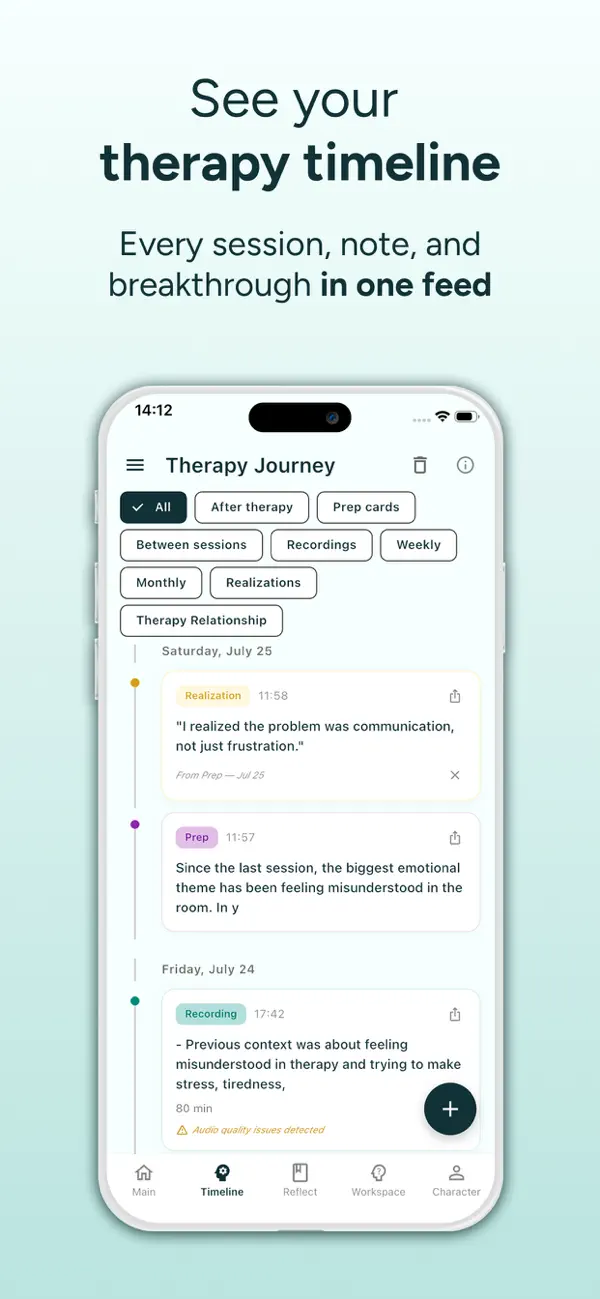
Pick three markers that matter to you
Skip "mood". Something specific enough that you would notice it moving: hours of sleep, how many days you dodged the thing you keep dodging, how often you snapped at someone you love, whether you answered your friend's message. Three at most. They should be the things you and your therapist are actually working on, which makes it worth asking them what they would pick.
Same question, same scale, same day of the month
Word each one once and then leave it alone. "Over the last two weeks, how often did this get in the way?" answered from 0 to 10 is plenty. Rewriting the question resets your history, because you stop comparing like with like. Pick a fixed day too, the first Sunday of the month or the morning after a session, whichever one you will keep.
Compare months, not days
Look back once a month and compare each month to the one before it. Daily numbers will happily convince you of things that are not true. Write one line of context next to each rating, because a 4 with nothing attached to it is unreadable by spring. And if you cannot remember what changed between sessions, the numbers on their own will not rescue you.
Mood & focus-area trends
Your ratings become a line you can actually read, week over week, instead of a feeling you argue with. Try it free in MindSync →
Progress is not a straight line
Most people improve in therapy. A minority get worse, and that is the 5 to 14% Lambert and Shimokawa reported. Both facts are real, and the second one is the whole reason routine measurement exists. You measure so that it gets caught early, while there is still time to change something.
Also common: feeling rougher for a stretch once you start approaching something you had been going around for months. That is not proof therapy is failing. It is not proof it is working either. It is a reason to say it in the room instead of carrying it quietly for another six weeks.
You keep the record for one reason. A slow direction is invisible from inside a bad week. A line you wrote three months ago survives the bad week intact.
When the data says something is off
Bring the pattern, not the verdict. "I have been rating my sleep for three months and it has not moved. Can we look at whether we are working on the right thing?" gives you both something to hold. So does "I notice I hold back in here, and I would rather say that than keep doing it."
Therapists who work with feedback will not take this badly. Pulling exactly this out of you is what the Session Rating Scale was designed for. If it does land badly, that is information too, though the next step is still a conversation rather than a quiet disappearance.
Deciding to continue, to change approach, or to work with someone else is a decision worth making with evidence and with your therapist in the loop. The raw 20 minutes after a hard session is the worst window for it.
Therapy relationship check
A short check on how therapy itself is going, so the conversation with your therapist starts from something concrete. Try it free in MindSync →
Whatever you use to keep the record, it only works if you trust where it lives. If you track in an app, read how your entries are stored before you commit to it. MindSync's answer is on the FAQ page, and you can see everything the app does in one place. If you already tried tracking and quietly abandoned it, there are three specific reasons mood tracking stops working after two weeks and none of them are that you lack discipline.
Making progress visible
- Goals - What you are working on, with evidence collecting underneath it.
- Weekly & monthly summaries - A monthly read on where the month actually went.
- Mood & focus-area trends - The long view, so one bad week stops looking like failure.
Frequently asked questions
How long does therapy take to work?
There is no clean number and the averages hide a lot. Hansen, Lambert and Forman reviewed this in 2002 in Clinical Psychology: Science and Practice and reported general consensus that 13 to 18 sessions are needed for half of patients to improve, while people in everyday practice often attend far fewer. Think in months, and watch the direction rather than the speed.
What are the signs that therapy is working?
Three layers, and they rarely move in step. Symptoms tracked the same way each time, trending down across months. Life getting concretely easier: sleep, work, arguments, the thing you avoid. And a relationship where you can say difficult things without editing them first. If two of the three are moving and one is stuck, the stuck one is your next conversation.
Is it normal to feel worse before you feel better?
It happens often enough that therapists expect it, especially once you start approaching material you had been going around. It is common without being universal, and plenty of people never go through it at all. Say it in session rather than waiting it out alone, because a rough fortnight and a rough two months are different problems.
How do I tell my therapist that therapy is not working?
Directly, early, and with something concrete attached. "I have been tracking this for three months and nothing has shifted, can we look at what we are doing?" gives you both a starting point. Most therapists would far rather hear it than lose you without knowing why. That conversation is part of the work itself, and most of them treat it that way.
How often should I check my progress?
Monthly for the big picture, plus a quick read on how each session landed if your therapist uses a session rating. Checking daily turns ordinary fluctuation into a story about failure. The value comes from the interval being long enough that the noise cancels itself out and the direction shows.
Keep more from every session
MindSync keeps your sessions and the week between them in one place, so your progress stops slipping away. The trial is free, no credit card needed.


Get the app