
MindSync Tips
How to Prepare for a Therapy Session When Your Mind Goes Blank

You sit down. Your therapist asks how the week went. And Tuesday, the day that actually mattered, is suddenly unreachable. So you say it was fine, mostly, and spend the first 15 minutes warming up to something you already knew on Tuesday. That is a memory problem, not a motivation problem.
Why your best material disappears in the waiting room
The thing you wanted to bring up did not happen in your therapist's office. It happened in your kitchen at 11pm, after a text you read three times. Your body was in a particular state and the room smelled like your own apartment. None of that is available on Thursday at 4pm in a different chair.
Psychology has a name for this. Godden and Baddeley showed in 1975, in the British Journal of Psychology, that divers who learned word lists underwater recalled them better underwater than on dry land. The honest caveat: a 2021 replication by Murre in Royal Society Open Science did not reproduce the effect, and an addendum the following year confirmed that reanalysis did not rescue it. So context-dependent memory belongs in this picture as a live hypothesis, and the evidence is thinner than the textbooks suggest.
The sturdier finding is about how you summarize. When your therapist asks about your week, you do not replay it. You build a fast verdict out of two or three moments, and those moments are not a fair sample.
Redelmeier and Kahneman published the cleanest demonstration in 1996 in Pain. They recorded discomfort minute by minute in 154 patients during colonoscopy and 133 during lithotripsy, then asked afterwards how bad the whole thing had been. The retrospective verdict tracked the worst moment and the last few minutes. How long the procedure lasted barely registered. That was pain research, not a study of ordinary weeks. But the mechanism it describes, a remembered stretch of time assembled from its peak and its ending, is why the loudest moment and the most recent one arrive first, while the quiet Tuesday that was the actual material stays where you left it.
The problem with preparing the night before
Almost every article about how to prepare for a therapy session ends with the same advice: make a list beforehand. The advice is not wrong. The timing is.
Sitting down on Wednesday night to reconstruct seven days is the same retrospective exercise, just performed at a desk. You reach for whatever was loudest and whatever happened last, which is roughly what you would have produced in the room anyway. The quiet moment on Tuesday, the one you would have called the real thing if you had caught it then, has no way of surfacing.
This is the whole argument behind ecological momentary assessment, the method clinical researchers use when retrospective self-report is not good enough for the question. In their 2008 review in the Annual Review of Clinical Psychology, Shiffman, Stone and Hufford put it plainly: global retrospective reports are limited by recall bias, so you sample experience in the moment, in the setting where it happens. Researchers stopped trusting week-long recall decades ago. You can borrow the fix.
Capture during the week, not the night before
The two-line rule
Two lines. What happened, and what it did to you. Thirty seconds standing in a corridor, and then the phone goes back in your pocket.
The limit exists so the habit survives. Ask yourself for a paragraph and you will quietly stop by Thursday. Ask for two lines and you are still doing it in month four, which is when the shape of things starts showing up.
What is worth capturing
Not everything. You are collecting material for one hour of conversation. Four kinds of moment earn the 30 seconds:
- A reaction that did not fit the situation, in either direction. Furious at a jar that would not open, or oddly numb about something that should have landed.
- A sentence you could not say out loud. To your partner, your manager, your mother.
- Something that went better than it used to. These vanish first, and they are your evidence that anything is moving.
- A thing you noticed yourself avoiding, including in the therapy room.
Five entries across a week is plenty. If you have 20, you have started journaling, which is a fine thing to do and a different thing to do.
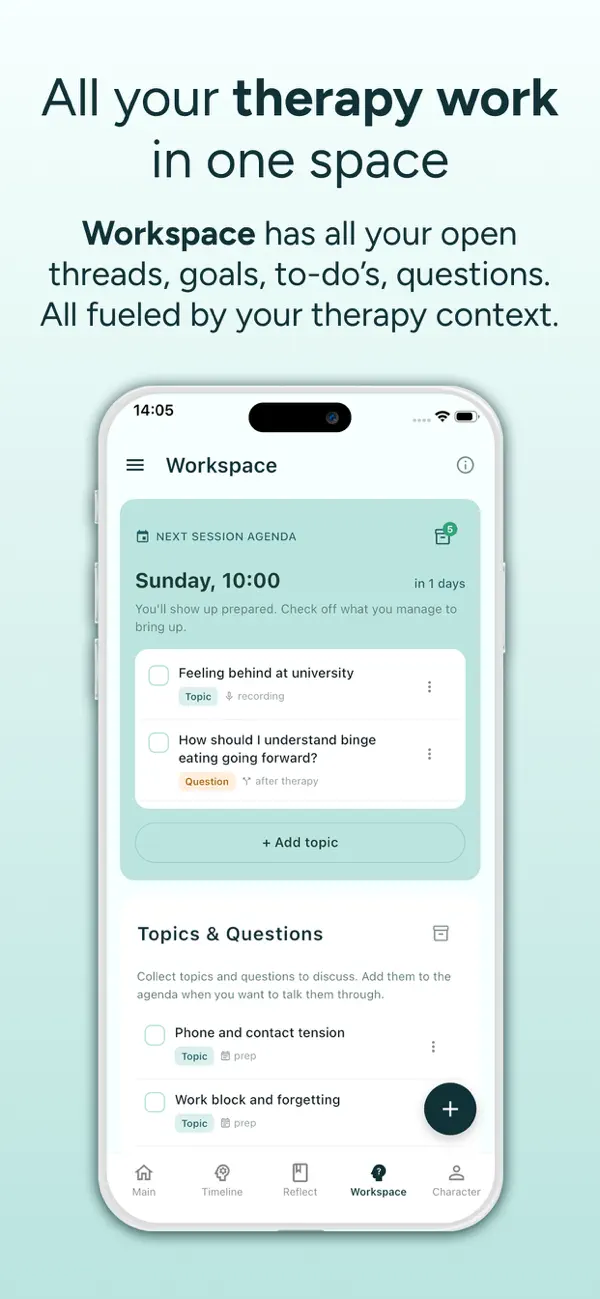
Workspace
Anything you flag during the week lands on your agenda for next time, so the list writes itself. Try it free in MindSync →
There is research behind the effort, though it is about therapy homework rather than notebooks. In a 2010 meta-analysis in Clinical Psychology: Science and Practice, Kazantzis, Whittington and Dattilio pooled 46 studies and found a small to medium effect, d = 0.48, favoring cognitive and behavioral therapies that included between-session work over the same therapies without it. Prep notes are not homework in the clinical sense, so do not read that number as a promise about your own notes. But the direction is consistent, and it is the same reason what to do between therapy sessions tends to matter as much as the hour inside one.
Build the session agenda in 10 minutes
Ten minutes, the morning of or the hour before. Three steps:
- Read the week's captures back without editing them.
- Pick one topic to lead with and two you would be glad to reach.
- Write the first sentence you will say, word for word.
People skip the third step. It is the one that buys back those 15 minutes.
One main topic, two backups
One is the target. The other two exist because the first sometimes collapses in three minutes, and when it does you are back to staring at the rug. Backups tend to be the same theme approached from a different side, which is why they work when the front door is locked.
Turn a vague feeling into an opening sentence
"I've been anxious this week" is not an opening. It is a weather report, and your therapist now has to spend 10 minutes drilling into it before anything happens.
An opening sentence has a scene in it. "On Tuesday I could not send one email for four hours and I want to know what that was." Or: "Something happened with my sister and I have been rehearsing the conversation since Sunday." Same feeling underneath, but now there is a place to stand.
Questions worth asking your therapist
You are allowed to ask questions, and most therapists find it a relief when you do. A few that reliably open something up:
- "What do you notice keeps coming back here?"
- "Are we still working on what I came in for?"
- "What would you want me to pay attention to this week?"
- "Is there something you think I am steering around?"
Writing the agenda by hand takes 10 minutes and works fine. You can also let the prep card assemble it from what you already captured.
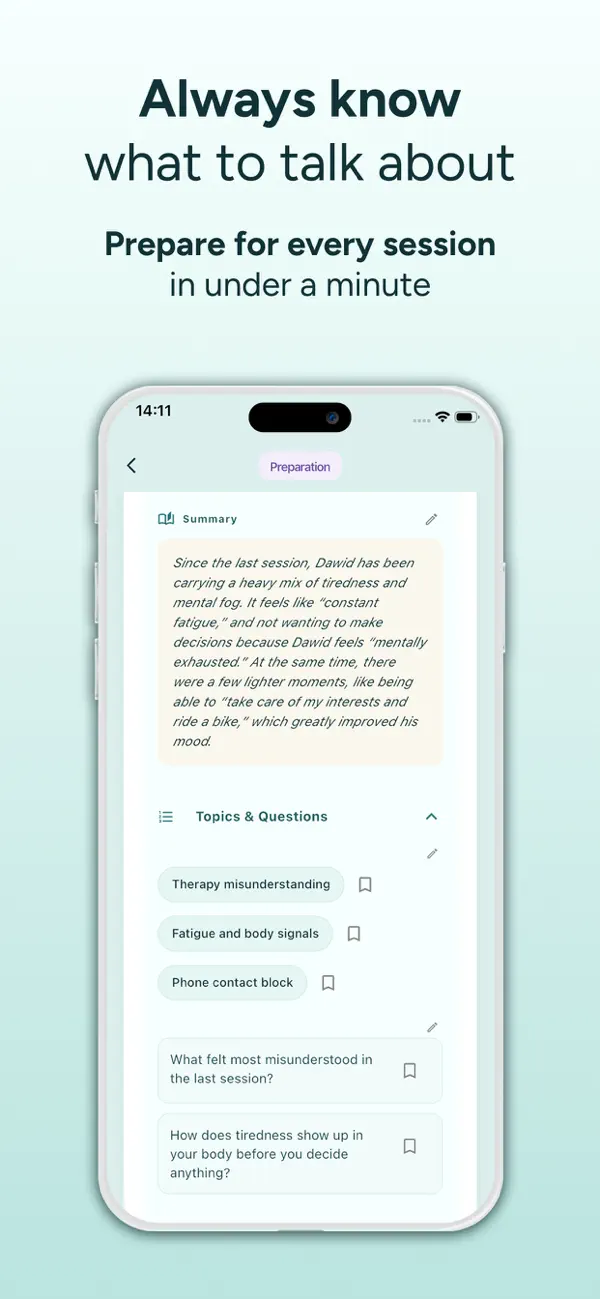
Prep Card
The prep card pulls your week into one screen: topics, questions worth asking, and how your mood actually ran. Try it free in MindSync →
What to do when you still go blank
Some weeks the captures do not exist, or you read them back and feel nothing. Three things to try, in order of how little they ask of you.
Start by saying it out loud. "I had things and they are gone" is a real opening, and most therapists will treat it as one. Blankness before a session is information, often the most interesting thing in the hour.
If that goes nowhere, go back to the last session. "You asked me something last time and I have been avoiding the answer" restarts the conversation where it stopped, which is usually where it was getting somewhere. That move is easier when you kept something from last time, which is its own problem: what to do after the session, when the same memory problem works against you.
And if you arrive wound up, the first minutes go to settling rather than talking. Ten minutes in the car or the waiting room is enough to calm your nervous system before you walk in, and it changes what you can reach once you sit down.
None of this is a script your therapist has to follow. A prep card is not an agenda you hand over and expect to see worked through, and a good session often abandons it in the first 10 minutes. The point is that the hour starts from something real instead of from a warm-up.
Frequently asked questions
What should I talk about in therapy?
Three places to look, in this order. What kept coming back during the week, especially reactions that did not fit the situation. What you and your therapist cut short at the last session and never finished. And what you have been avoiding, in your life or in the room. If all three come up empty, say that out loud.
Is it okay to bring notes to a therapy session?
Yes. Most therapists read your notes as a sign you are engaged and treat them as a starting point. Keep it short enough to glance at, a few lines rather than pages, and put it down once the session finds its direction. If the notes start running the hour instead of opening it, that is worth mentioning too.
What do I say when I have nothing to talk about?
Say exactly that. "I have nothing and I do not know why" is a legitimate opening and often a productive one. Blankness usually has a shape underneath it: exhaustion, avoidance, a week that genuinely was quiet, or a topic you are circling. Therapists are trained to work with an absence just as much as with content.
How early should I prepare for a therapy session?
Prepare during the week, in small pieces, while things are still happening. Capture two lines whenever something lands, then spend 10 minutes on the day of the session turning those captures into one topic, two backups and an opening sentence. Preparing only the night before means reconstructing from memory, which is the exact thing that fails you.
Should I tell my therapist I prepared?
You can, and it usually helps. Saying "I wrote a few things down this week and here is what stood out" tells your therapist what you have been carrying and how you selected it. It also lets them ask about what did not make the list, which is sometimes the better question.
Keep more from every session
MindSync keeps your sessions and the week between them in one place, so your progress stops slipping away. The trial is free, no credit card needed.


Get the app