
Therapy
Why You Feel Worse After a Therapy Session (the Therapy Hangover)

The drive home was fine. You put music on, you thought about what to make for dinner. Then it is seven in the evening, there is a message on your phone you cannot make yourself answer, and you are standing at the dishwasher crying about nothing you could name. The session finished three hours ago.
People call this a therapy hangover. The word covers at least three different situations, and they do not have the same answer.
"Therapy hangover" is a nickname, not a diagnosis
A therapy hangover is a nickname for feeling drained, foggy or tearful in the hours after a session. It is not a diagnosis, and no study has examined it under that name. What has been studied are the neighboring things: fatigue after concentrated effort, temporary symptom flare-ups during treatment, and strain in the relationship with a therapist.
Most writing about it treats those three as one thing, and then gives one piece of advice for all of them.
Three different things people call the same thing
Plain tiredness after an hour of concentrated work
An hour of therapy is an hour of sustained attention pointed at the things you normally arrange your week around not thinking about. You are talking, listening, remembering and being watched, all at once, with no break in it.
Tiredness afterwards belongs to the same family as tiredness after an exam or a hard conversation with someone you love. It is flat rather than sad. It usually wants food and quiet, and it lifts on its own.
What this one asks of you: an evening with nothing in it.
A temporary rise in what you came in with
Sometimes a session goes near something you have been circling for weeks, and for a day or two afterwards the thing you came in with gets louder. More anxious, more raw than your normal.
This is the version that frightens people, because it looks like going backwards. A rise like that does not prove anything on its own, in either direction. It is not evidence that therapy is failing, and it is not evidence that therapy is working. What makes it useful is whether it settles.
What this one asks of you: a note of when it started and whether it faded, so you have something better than a feeling to carry back into the room.
Something that happened between you and your therapist
The third one is not about the topic at all. Your therapist said something that landed wrong. You felt judged, or hurried. You agreed with an interpretation in the room and then spent the evening working out that you did not agree with it.
This one feels different from the inside. It usually has a shape, often a particular sentence you keep replaying, and it does not fade the way tiredness fades. It is also the one most people say nothing about, and the most fixable of the three. There is more on when it is the relationship and not the topic.
What this one asks of you: saying it out loud next session, which is a more ordinary thing to do than it sounds.
What the research actually shows
The closest thing to direct evidence comes from a study nobody ran for this reason. Foa, Zoellner, Feeny, Hembree and Alvarez-Conrad asked whether imaginal exposure makes PTSD symptoms worse, and published the answer in the Journal of Consulting and Clinical Psychology in 2002. They followed 76 women in treatment for chronic PTSD, with exacerbation defined by measurement rather than by feel. Only a minority showed a reliable increase in symptoms. The people who did benefited from the treatment comparably to everyone else, and the increase was unrelated to dropping out.
That was exposure therapy for PTSD, a specific and demanding protocol, not an ordinary hour of talking. It does not stretch over every session of every kind of therapy. What it does say is that in one carefully measured case, a temporary rise in symptoms during treatment was not a sign that the treatment was going wrong.
The other side of this gets quoted far less often. Crawford and colleagues surveyed people who had used psychological therapy services across England and Wales, and published the results in The British Journal of Psychiatry in 2016. Of 14,587 respondents, 763 reported lasting bad effects from their treatment. That is 5.2%, or about one person in twenty.
Lasting is the word doing the work there, and it is a different category from one wrung out evening. The same survey found that people who had not been told enough about their treatment beforehand were more likely to report negative effects. Not everything that feels bad after therapy is the work working.
The third situation, the one that sits between you and your therapist, is not a dead end. Eubanks, Muran and Safran gathered the research on repairing ruptures in the therapeutic alliance in Psychotherapy in 2018, and found that working a rupture through was related to how treatment turned out.
How long it usually lasts
Nobody has measured it. There is no data on how long a therapy hangover lasts, because there is no research on the therapy hangover, so any specific number of hours you see quoted is a guess.
What exists is accumulated observation. Therapists who write about this describe an evening more often than a week, and describe it shortening as people learn how their own sessions land. That is a pattern practitioners notice, not a finding.
The more useful question is not how long but whether it moves. A heaviness gone by the next afternoon is a different situation from one still sitting there on Sunday.
What tends to stretch it out
MindSync was started by someone who spent ten years and about $130,000 as a therapy client. The list below comes out of those years. Nobody measured any of it in a study.
- Driving straight from the session into something that needs you.
- An evening on your phone. Scrolling does not occupy the part of you that is still in the session, so it stays open in the background for hours.
- Using a drink to put a lid on the evening. It ends the evening. It does not usually end the feeling.
- Talking the session over with the person the session was about.
The hour after the session
The hour after a session is the part you have some say over, and most people spend it going straight back to work.
Give it ten minutes before you rejoin the day, in the car or on a bench outside the building. The point is a gap between the room and everything else, because the alternative is carrying the session into a meeting and then wondering at seven o'clock why you feel strange.
Write or record one sentence while you are sitting there. The one thing you would hate to have lost by Monday. This is the step that stops a session evaporating, and there is a whole method for it if you want to keep what the session gave you.
Then do something physical and slow. Walk the long way to the car, or put your hands in hot water. There are better and worse ways to settle your body before you go back to the day, and the good ones are dull.
And leave decisions alone today, including any decision about therapy itself. Whatever you concluded at seven in the evening will still be there on Saturday, when you can check it against a rested version of yourself.
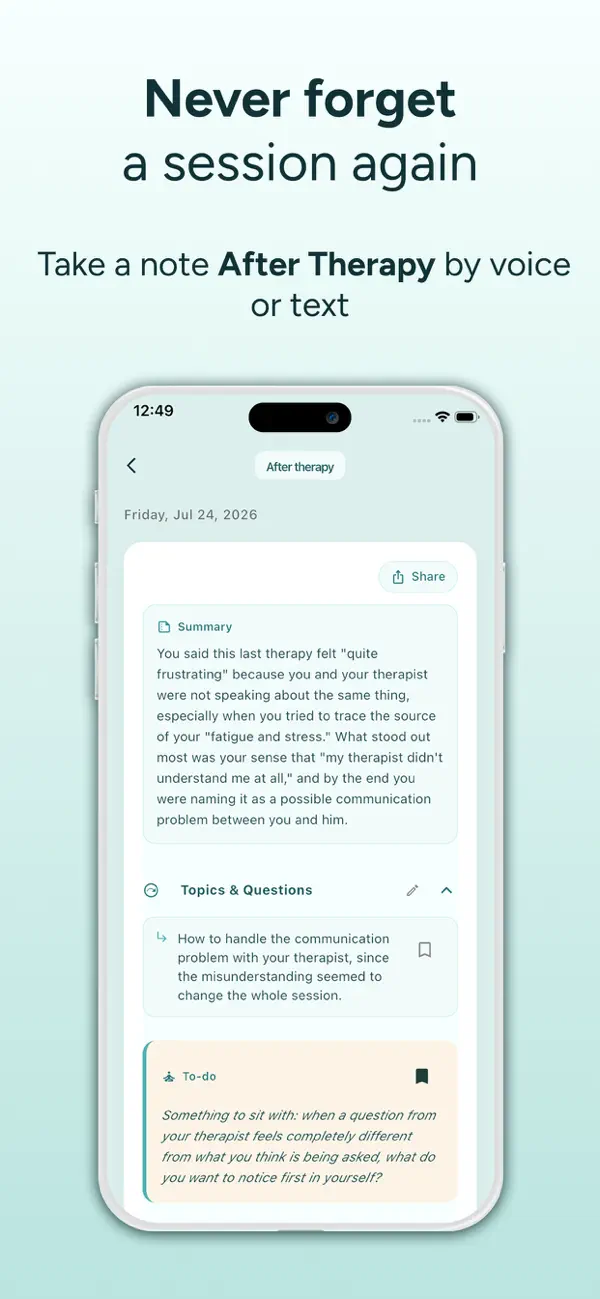
After-therapy debrief
Five minutes while it is still warm, so the hour you just paid for does not dissolve somewhere on the way home. Try it free in MindSync →
In MindSync that step is the after-session debrief, which exists because the stretch between leaving the room and getting home is where most of a session goes missing.
The next day is where the useful part is
Whatever is left the next morning is usually more useful than the session itself, because it has been through a night and it survived.
Write one question when you wake up: what is still bothering me from yesterday? Not the topic, the leftover. Half the time it is some detail nobody planned to discuss, and that detail is your opening line for next time.
Then rate the day the way you rate any other day. One rough evening inside a month of ordinary ones looks like very little on a chart. Three in a row looks like something. That difference is invisible from inside a Thursday night, which is why one bad evening is not a verdict on whether therapy is actually working.
Wellbeing check-ins
Rating the day after a session takes under a minute, and it is how you find out whether the dip lasts an evening or a week. Try it free in MindSync →
When the dip is worth raising with your therapist
None of this is a warning sign. It is a list of situations where the next session is the right place for the conversation.
- It does not fade. Several sessions in a row leave you flattened for days at a time.
- It is building. Each session costs you more than the one before.
- You have started rescheduling. Finding reasons to move a session is worth noticing early.
- It is about the two of you. Something in the room, not something in your life.
In all four cases the destination is the same: say it to your therapist, in session, out loud. Bringing it in is not a complaint, and it does not put your therapy at risk. A therapist who takes it seriously is doing the job, and one who brushes it aside has told you something too.
Making the day after a session usable
- Between-session voice notes - Say it out loud on the evenings when typing is too much, and read it back when it is not.
- Mood & focus-area trends - The days after your sessions, sitting next to the rest of your weeks instead of standing in for them.
- Therapy timeline - Sessions, notes and check-ins in one place, so a hard month is something you can look at rather than something you have to remember.
Frequently asked questions
Is it normal to feel worse after therapy?
Yes, it is common, and it arrives in more than one form. Sometimes it is plain tiredness after an hour of concentrated effort, which usually lifts by the next day. Sometimes it is a signal worth raising in the next session, especially if it keeps happening or keeps growing. What separates the two is not how bad the evening feels but whether it passes.
How long does a therapy hangover last?
There is no research on this, so any specific number you see is a guess. Practitioners generally describe an evening or a day rather than a week, and describe it shortening as people get used to how their own sessions land. What matters more than the length is the direction.
Why am I so tired after therapy?
Because an hour of therapy is an hour of sustained attention on material you normally avoid, while talking and being watched at the same time. Very little else in an ordinary week has that shape. The tiredness is usually flat, not sad, and it answers to food and quiet.
Does feeling worse after therapy mean it is working?
No, and treat anyone who tells you it does with some caution. Foa and colleagues found in 2002 that a temporary rise in symptoms during exposure therapy for PTSD was unrelated to how people eventually did, which makes it neither a bad sign nor a good one. Feeling worse is information about one session.
Should I tell my therapist that I feel worse after sessions?
Yes, and preferably in the first five minutes of a session rather than the last. It is standard material, not a complaint, and it changes how the hour gets paced. Crawford and colleagues found in 2016 that people given too little information about their treatment were more likely to report lasting bad effects.
Keep more from every session
MindSync keeps your sessions and the week between them in one place, so your progress stops slipping away. The trial is free, no credit card needed.


Get the app