
Therapy
What to Do When Your Therapist Is Not the Right Fit

You leave another session having narrated your week to someone who nodded in the right places, and nothing has moved. It has been four months. Starting over means the search again, the history again, and an awkward conversation before any of it, which somehow feels heavier than the thing you came in with.
Not clicking is common, and it is not a verdict on you
People leave therapy all the time. Swift and Greenberg pooled 669 studies covering almost 84,000 adult clients in a 2012 meta-analysis in the Journal of Consulting and Clinical Psychology and found a weighted dropout rate of 19.7%. Roughly one client in five stops before treatment is finished.
That number is not a measure of bad therapists or bad clients. Studies defined dropout differently, and the rate shifted with diagnosis, setting and how experienced the provider was. It did not shift much by type of therapy. What it does establish is that leaving is ordinary rather than exotic.
The harder finding is what happens before people leave. Blanchard and Farber surveyed 547 therapy clients for a 2016 paper in Counselling Psychology Quarterly and found 93% admitted lying to their therapist at least once, including how they felt about the therapy and about the therapist. The reasons were not sinister. They wanted to be polite. They did not want to upset the therapist.
So the usual sequence is not a fight. It is months of politeness, then a canceled appointment that never gets rebooked.
A rupture is not the same as a bad fit
These two things feel identical from the inside and call for opposite responses, which is most of why this decision is hard.
What a rupture looks like
A rupture is a break in the relationship, traceable to something specific. Your therapist said something that landed wrong. They pushed on a topic before you were ready, or did not push when you wanted them to. You noticed yourself editing what you brought the week after. It often has a date on it: things were fine, then there was that session in March, and since then you have been performing rather than working.
What a bad fit looks like
A bad fit has no incident in it. There is nothing to point at. Months pass with no direction, no plan you could describe to a friend, and each session covers whatever happened that week. You have raised the same concern more than once and nothing changed. Or the style is wrong for you: you need structure and get open silence, or you need room to think and get worksheets.
The two mistakes people make
The first is staying for years out of politeness, because the therapist is kind and canceling feels like an insult. The second is leaving in the exact week the work gets uncomfortable, which happens more often than anyone admits, because the discomfort is easier to blame on the therapist than on the material. Both look like a decision at the time. Neither one gets checked afterward.
Therapy relationship check
A short check on the working relationship, repeated over time, so you can see whether this is one bad month or a pattern. Try it free in MindSync →
What the research says about repairing it
The usual advice stops at the suggestion that you talk it through. The research goes further, and in a surprising direction: ruptures that get repaired are associated with better outcomes than therapy where nothing ever goes wrong.
Eubanks, Muran and Safran pooled 11 studies covering 1,314 patients in a 2018 meta-analysis in Psychotherapy and found rupture repair related to patient outcome at r = .29, equivalent to d = .62. Moderate, and pointing the same way across the studies they found.
Read it with the limits attached. Eleven studies is a small evidence base, the confidence interval was wide, running from .10 to .47, and researchers do not measure ruptures the same way. The same paper found that whether therapists had been trained in rupture resolution was not significantly related to outcome. Treat this as a good reason to say something rather than as a guarantee about what happens next.
A second line of evidence matters more when things are going badly. Lambert and Shimokawa reviewed feedback systems in Psychotherapy in 2011 and reported that for clients who were not on track, giving the therapist formal feedback related to outcome at r = .25, based on four studies and 454 clients. Small evidence base again. Consistent direction again. The information reaching your therapist is what changes the odds, and you are the only one holding it.
How to raise it, in actual sentences
Everyone says raise it with your therapist. Almost nobody supplies the sentences, and the sentence is the part people get stuck on at 8pm the night before.
Opening lines that are not accusations
Three that work, because they describe your experience instead of grading their performance:
- I want to talk about how therapy is going, not about my week.
- I notice I have been leaving sessions feeling like I reported rather than worked.
- Something shifted for me after the session where we talked about my mother, and I have not brought it up since.
Say it in the first five minutes. Held until minute 45, it becomes a farewell speech, and there is no time left to do anything with it.
What to ask for specifically
Vague dissatisfaction is hard to act on. Pick the thing you actually want. More structure, so sessions do not start from wherever your week left off. A plan you could repeat back. A slower pace on one topic, or a faster one. Permission to spend three sessions on a subject you keep circling instead of touching it for 10 minutes each time. Bring one request, not five.
What a good response from a therapist sounds like
They take it as work rather than as a complaint. They get curious about specifics and often connect it to something in the material, which is not a dodge when it is done well. Then something concrete follows: a change in how sessions are structured, a plan to review in a month, a straight answer about what they can and cannot offer. This is less dramatic on their side of the room than on yours.
What a defensive response tells you
If the answer explains why you are wrong to feel it, or turns into an interpretation of your resistance with nothing changing afterward, you have learned something useful, and you learned it in one session rather than another six months. Watch the next two sessions rather than the first 10 seconds. Momentary defensiveness is human. A pattern of it is data.
If you decide to leave
How much notice, and why one closing session helps
Say it in a session rather than by canceling and disappearing. One closing appointment is worth booking even when the fit was wrong, because ending things properly is rare and this is a comparatively safe place to practice. It also lets you ask what they observed, which is often the most useful hour of a bad match.
What to say in an email if talking feels impossible
Sometimes the conversation is not going to happen, and an email you send beats a conversation you keep postponing. Three lines are enough: that you have decided to stop, that you appreciate the work, and whether you want a final session. You do not owe an explanation, though naming one concrete thing that did not fit is useful to them.
What to take with you to the next therapist
The most valuable thing you leave with is a description of what happened: what you worked on, what helped, what made things worse, and what you would want done differently. That saves a month of rebuilding in the next first session, and it turns a failed match into information rather than a wasted year. If you are heading back into the search, how to choose a therapist in the first place covers what to ask before you book again.
One separate case. If what happened involves a boundary being crossed, that is not a question of fit and it does not belong in a pros and cons list. Therapists are regulated by a licensing body or professional association wherever you live, and that is where it goes.
Before you decide: three things worth checking
Do these before the conversation, not instead of it.
Name where the problem sits: method, pace, or relationship. A method problem can usually be fixed inside the same room by changing how you work. A pace problem is often a scheduling problem in disguise. A relationship problem, the sense of not being safe or not being liked, is the one that needs saying out loud, and the one people avoid.
Then count the sessions since the topic last changed. If you have been circling the same ground for two months with no new angle, that is a concrete thing to bring, and much easier to say than I do not think this is working.
Last, read back your own notes from the last six weeks. Memory grades therapy on how the most recent session went. Your notes will not. A month where you slept better and snapped at nobody reads differently in writing than it does on a Thursday when you feel like you have wasted a year. Before you decide anything, measure whether therapy is working instead of polling your mood.
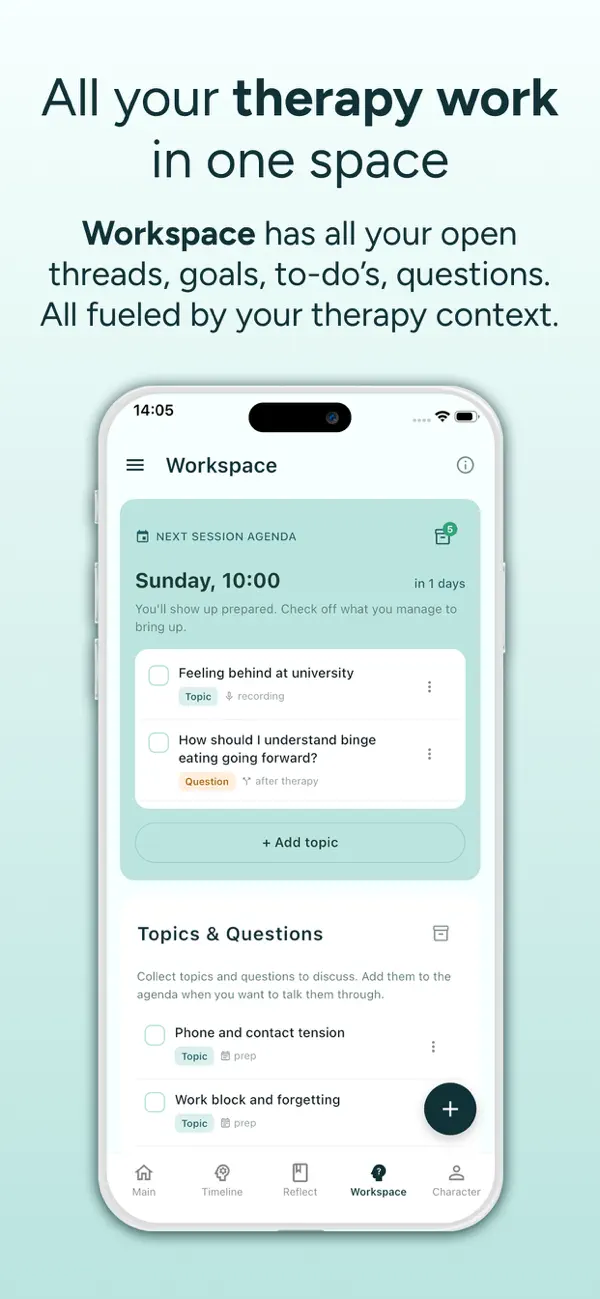
Workspace
The thing you almost said in session goes on your agenda for next time instead of dissolving on the way home. Try it free in MindSync →
If you decide to raise it, write the opening sentence down and put it on the agenda for next time, above whatever your week does. Money is part of this decision for most people, and what you are paying for, and how to judge it takes that side of it.
Deciding with evidence, not on a bad Thursday
- After-therapy debrief - Five minutes after the session, while you still remember how it felt.
- Mood & focus-area trends - Weeks side by side, so one hard session stops standing in for the whole year.
- Therapy relationship check - The same questions about the relationship, asked again a month later.
Frequently asked questions
How do I know if my therapist is not right for me?
Look for absence of direction over months rather than discomfort in one session. Signs worth taking seriously: you cannot describe what you are working on, you have raised the same concern more than once with nothing changing, or the way they work is plainly wrong for you. Discomfort by itself is not a signal, because useful therapy is often uncomfortable when it is working.
Is it normal to not click with your therapist?
Yes, and it is common enough to be unremarkable. Roughly one in five adult clients stops therapy early, according to Swift and Greenberg's 2012 meta-analysis of 669 studies. Fit depends on style, pace and personality as much as on competence, so a therapist who is excellent for someone else can be wrong for you.
How do I tell my therapist I want to switch?
Say it directly, early in a session, and keep it about your experience rather than their performance. Something like: I have been thinking about whether this is the right fit, and I want to talk about it today. Most therapists have had this conversation many times and some will suggest a colleague.
Should I give my therapist another chance?
Often yes, if you have not yet told them what is wrong, because they cannot work with information they do not have. Repaired ruptures are associated with better outcomes than therapy where nothing is ever raised, based on Eubanks, Muran and Safran's 2018 meta-analysis, though that finding rests on 11 studies. Give it two or three sessions after the conversation, then decide.
Do I have to tell my therapist why I am leaving?
No. You can end therapy without justifying it, and a therapist who makes that difficult is confirming your decision. One concrete reason is useful to them and often useful to you, since saying it out loud tends to clarify whether the problem was this person or something you would carry into the next room too.
Keep more from every session
MindSync keeps your sessions and the week between them in one place, so your progress stops slipping away. The trial is free, no credit card needed.


Get the app