
Therapy
How to Choose a Therapist: The Questions That Actually Sort Them

Fourteen tabs are open and every profile says the same three words: warm, collaborative, evidence based. Two of them use the same photo of a plant. You have a list of names from your insurer or a directory, no way to rank them, and a quiet suspicion that this comes down to a coin toss.
What actually predicts whether therapy helps
It is not a coin toss, though the directory works hard to make it look like one.
Start with the working alliance. Stripped of jargon, that means whether you and your therapist agree on what you are doing, agree on why, and can talk to each other while doing it. Flückiger, Del Re, Wampold and Horvath pooled 295 studies covering more than 30,000 patients in a 2018 meta-analysis in Psychotherapy and found the alliance related to outcome at r = .278.
The honest caveat: that is a correlation, not a lever you can pull. People who are already improving tend to rate the relationship more warmly, so the arrow runs both ways. Still, it tells you where to look: a therapist you can contradict out loud is not a soft preference.
The individual therapist matters too, though less than the internet suggests. Johns, Barkham, Kellett and Saxon reviewed the therapist-effects literature in Clinical Psychology Review in 2019 and put the therapist's share of outcome variance at a weighted 8.2% in randomized trials and 5% in routine practice, with individual studies ranging from 0.2% to 29%. Unstable estimates, in other words.
Your own preferences count as evidence, not fussiness. Swift, Callahan, Cooper and Parkin pooled 53 studies and more than 16,000 clients in the Journal of Clinical Psychology in 2018. People who got the format they said they wanted dropped out less often, at an odds ratio of 1.79, and did modestly better, at d = 0.28.
So the target is narrower than it looks: someone competent, whose way of working you had a say in, and who you can tell when something is off.
The three filters that come before personality
Access and logistics
The ideal therapist with one free slot at 11am on Thursdays is the therapist you will start canceling on in March. Before you compare personalities, decide which hours you can defend from work, whether video or a room suits you, and what you can pay for six months rather than three weeks. Ask about the cancellation policy in the first email. It is boring and it will matter.
Experience with your specific problem
Ask how often they see what you are bringing. Not whether they can work with it, since almost everyone says yes. How often, in a typical month. Someone who sees a lot of it will describe what that usually looks like without being prompted, and the description is the useful part.
License and scope
Titles travel badly. Psychologist, psychotherapist, counselor, clinical social worker and psychiatrist mean different things depending on where you live, and in some places one of those words is legally protected while another is not. Two administrative steps, five minutes each: find out which body registers therapists where you live, then check that this person is on the register.
The consultation call: six questions and what a good answer sounds like
Most therapists offer a short call before you book, often free, usually about 15 minutes. Consumer guides publish good question lists, including the one from the Association for Behavioral and Cognitive Therapies. The list is the easy half: almost anyone can produce a pleasant answer to a pleasant question, and pleasant is what you are trying to see past.
Six questions worth asking on that call:
- How do you usually work with someone dealing with this?
- What does the first month typically look like?
- How will we know if this is working?
- What do you expect from me between sessions?
- What happens if I tell you something is not working?
- What are your fees, your cancellation policy and your actual availability?
How do you usually work with someone dealing with this?
A good answer is specific and slightly boring. It has a sequence in it: two sessions of history, then two or three things to track, then a look around week four at whether any of it is doing anything. A vague answer stays at the level of adjectives. I am integrative, I meet each client where they are. Not wrong, not an answer, and you can ask again.
How will we know if this is working?
A good answer names something observable: a symptom measure repeated every few weeks, a behavior you want more of, a review at session eight. A vague answer is you will feel it.
The question earns its place because therapists are unreliable detectors of their own failures. Hannan and colleagues, in the Journal of Clinical Psychology in 2005, asked therapists to predict which of their 550 clients would end up worse off. Therapists flagged three. Forty actually deteriorated, and one of the three predictions was right. Clinical intuition is not built for this, which is why agreeing on a way to check matters.
What do you expect from me between sessions?
The answer tells you how structured the work will be. Some therapists set tasks, some ask you to notice things, some deliberately do neither because the work happens in the room. Any of those can be right. What you want is a therapist who knows which one they are and can say why. If between-session work is part of it, the week between sessions covers what that usually involves.
What happens if I tell you something is not working?
This is the question that sorts people, and hardly anybody asks it. A good answer treats the scenario as expected and describes what they would do: slow down, ask what specifically felt off, change the plan. A weak answer treats it as hypothetical hostility. Notice your own body while they answer. If a mildly awkward question over the phone already feels risky, that is information about the next 12 months.
Modality: how much should it decide?
Cognitive behavioral therapy works on the loop between what you think, what you do and how you feel, usually structured, usually with something to do between sessions. Psychodynamic work spends more time on patterns you learned early and on what shows up in the room between the two of you. EMDR is a structured protocol used mostly with traumatic memories. Those are caricatures, and any practitioner would add three qualifications to each.
How much should the label decide? Less than the marketing implies. Wampold and colleagues compared bona fide therapies head to head in a 1997 meta-analysis in Psychological Bulletin and found their effects roughly equivalent, a result that has been argued over ever since.
The counterweight matters, because the equivalence claim gets oversold. Tolin's 2010 meta-analysis in Clinical Psychology Review pooled 26 studies and found cognitive behavioral therapy outperformed psychodynamic therapy on primary symptom measures at d = 0.28, with no advantage over interpersonal or supportive approaches. For some problems, clinical guidelines do point toward specific protocols. So the modality is not nothing, just not the first thing, and it is a question for a therapist rather than a search engine.
The first three sessions are the real interview
What to notice in session one
Did they understand what you said, or did they translate it into their own material before you finished? Did you do most of the talking, and did it go anywhere? Was there any shape to the hour? Being nervous in session one is not information about fit. Being repeatedly not understood is.
What to notice by session three
By the third session there should be a shape. Not a cure. A shape. You should be able to say roughly what you are working on, how, and what would count as movement. Notice whether things come back: a therapist who returns to something you said two weeks ago is holding the thread while you cannot.
Relief is not the same as fit
The first session often feels like a weight lifting. That is real, and it is mostly about being listened to for 50 uninterrupted minutes, which is rare in adult life. Relief tells you that talking helps. It does not tell you that this person will be useful in month seven. A session that leaves you rattled is not automatically a bad one either.
Therapy relationship check
A short structured check on how the working relationship is going, so a vague sense that something is off turns into something you can name. Try it free in MindSync →
More on measurement in how to tell whether therapy is working once you have started. If the honest answer after a few months is no, what to do when the fit turns out to be wrong is next.
A simple way to keep score without turning it into a spreadsheet
Three lines after each of your first six sessions. That is the whole system.
- One sentence on what you actually talked about.
- A number from 0 to 10: how understood did you feel today.
- One thing you are taking away, or the word none.
Write them within an hour of leaving, while the session is still legible. On the way home, in a queue, out loud into your phone if writing kills it.
Six sessions later you are not deciding on a hunch. If the understood number sits at 4 and never moves, that is a pattern rather than a mood. If line three says none five times out of six, raise it in session seven, and how the therapist takes it will tell you more than anything they said on the phone. It also makes the sessions cheaper: more on that in walk into the first session with something to say.
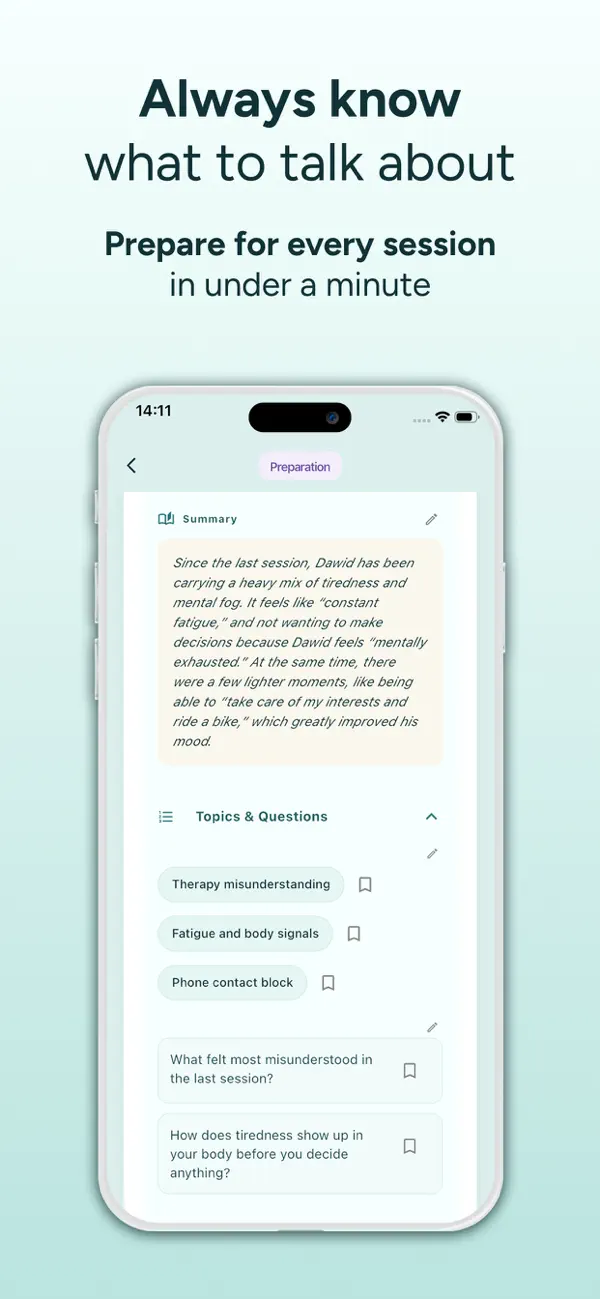
Prep Card
The prep card pulls your week into one screen, which matters most in the first months, when you are still learning what to bring. Try it free in MindSync →
None of this requires an app. MindSync exists because the founder spent 10 years and around $130,000 on therapy and kept losing the thread between appointments, so the app collects this for you and reads it back later. You can see what it actually does or check who it is built for. Cost belongs here too, and what therapy costs, and how to judge what you get for it takes that side.
Judging fit with something more than a hunch
- Goals - What you came for, written down, with evidence collecting underneath it.
- Mood & focus-area trends - The areas you are working on, charted over weeks instead of recalled after a hard day.
- Therapy relationship check - A regular read on the working relationship itself.
Frequently asked questions
How do I choose a therapist?
In four steps. Filter first on logistics you can sustain: hours you can protect, format, and what you can pay for six months. Then filter on how often they work with the problem you are bringing. Use a consultation call to ask how they work and how you will both know it is working. Then judge the answers over three sessions, not 15 minutes.
What questions should I ask a therapist before starting?
Six cover most of it: how do you usually work with someone dealing with this, what does the first month look like, how will we know if this is working, what do you expect from me between sessions, what happens if I say something is not working, and what are your fees and real availability.
How do I know if a therapist is right for me?
By the third session you should be able to name what you are working on and roughly how, and you should feel understood more often than not. Watch for continuity: a good sign is a therapist who brings back something you said two weeks ago. Relief in session one is not enough on its own.
How many therapists should I talk to before choosing one?
No study gives you a number, and anyone quoting one is guessing. Two or three consultation calls give you a comparison, which is the point, because most answers only sound vague once you have heard a specific one. If insurance or a waitlist leaves you one option, use the first three sessions as the interview.
Does the type of therapy matter more than the therapist?
Usually the therapist and the fit matter more, though the type is not irrelevant. Head to head comparisons of established therapies, going back to Wampold and colleagues in 1997, tend to find broadly similar effects, while later work such as Tolin's 2010 review finds differences in specific places. So ask a therapist what the evidence supports for your situation.
Keep more from every session
MindSync keeps your sessions and the week between them in one place, so your progress stops slipping away. The trial is free, no credit card needed.


Get the app