


Therapy
Why Do I Cry in Therapy? Your Tears Know Where the Work Is

You cry in therapy because it's often the first hour all week when you stop holding things together and someone is fully listening. Saying something out loud for the first time lands harder than just thinking it. Crying in therapy is common, it isn't a setback, and the tears usually point to what matters most right now.
Do any of these sound familiar?
- You've held it together all week. At work, on the bus, on the phone with your mom. Then your therapist asks "How have you been?" and it all comes out before your coat is off.
- You start on something small, the neighbor's dog or a two-line email from your boss, and suddenly you can't finish the sentence. Last week you described something genuinely big in a perfectly steady voice.
- You apologize. For the tears, for the tissue, for "taking up time". Five times in 50 minutes, once to the tissue box.
Can you cry in therapy? You can, plenty of people do, and you aren't ruining the session.
So why do I cry in therapy, of all places?
Most of the week, feelings get filed under "later". There's work, there are kids or roommates or a commute, and nobody has time to fall apart between the third meeting and the grocery run. The therapy room is often the first place where "later" finally shows up.
Then there's the listening. For 50 minutes nobody interrupts you, changes the subject or says "don't cry". That kind of attention is rare, and your body tends to notice it before you do. (It's also not a coincidence that the tissue box usually sits closer to your chair than your therapist does.)
And saying something out loud is different from thinking it. A sentence that lived in your head as a plain fact can sound, in your own voice, like the truth about you. Tears often arrive right at the sentence you've never said to anyone, or at the topic you were sure was small.
If "crying in front of my therapist" is the phrase that makes you wince, part of it is that they're someone you know well and not at all. It doesn't mean you're fragile. It means you finally stopped carrying it for a minute.
Think of the tears as a highlighter in a book. They don't tell you what the line means, only that it's worth coming back to.
What it looks like in the room:
- You're crying in therapy every session, sometimes from the first minute, and you've started to wonder if something is wrong with you.
- Once it starts, you can't stop, and half the hour goes to pulling yourself back together. You walk out feeling like you didn't say anything.
- The small thing gets you. The big thing, somehow, doesn't.
- You apologize and switch straight to something safer so the tears will stop. That's usually the moment the material slips away.
- Or the opposite: you describe the worst thing that ever happened to you with dry eyes, and then wonder whether you're broken.
If you've ever googled "is crying in therapy normal" in the waiting room, you're in good company. Most of the time the crying costs you very little. The apology and the quick change of subject right after cost a lot more.
What research turned up:
In 2008, Lauren Bylsma, Ad Vingerhoets and Jonathan Rottenberg asked about 5,000 students in 35 countries to describe the last time they cried, for a study in the Journal of Social and Clinical Psychology. Crying was more likely to bring relief when someone offered support and when it led to a new understanding of what was going on. When people held their tears back or felt ashamed of them, relief was less likely. These were memories from a survey, not crying measured as it happened, and none of it was in therapy. Still, it points somewhere useful: the shame and the holding back are the parts you can let go of.
In 2017, Sarah Knox, Clara Hill and colleagues interviewed 18 psychology doctoral students about crying in psychotherapy, including the times they had cried as clients, in a study published in Psychotherapy. As clients, they cried when talking about painful personal material, and they described what came after: a stronger bond with the therapist, deeper work, new insight. It's a small group of future therapists, so it says more about what's possible than about what's typical.
In 2024, Katz, Hilsenroth and colleagues surveyed 124 people currently in psychotherapy for Professional Psychology: Research and Practice. Those who had cried in sessions reported more improvement than those who hadn't. People with less secure attachment found crying more uncomfortable, but they were also more likely to feel better understood by their therapist afterward. The study looked at one point in time, relied on self-report and had a sample that wasn't very diverse, so it shows a link, not proof that crying causes progress.
The honest caveat: a 2021 review by Bylsma, Gračanin and Vingerhoets in Psychotherapy says plainly that research on crying in therapy is still very limited. That's oddly reassuring. There's no correct amount of tears and no rule for how many sessions it should take. There's your relationship with your therapist, and what the two of you do with the tears.
Crying doesn't prove therapy is working. It just tells you where to look.
What to do when the tears come:
- Skip the apology. Your therapist has seen more tears than a wedding photographer. Swap the sorry for something that buys you time. Instead of "I'm so sorry", try "Give me a second." "Sorry, this is stupid" can become "I don't know why this one got me." And "Sorry for wasting your time" doesn't need replacing at all: take the tissue and breathe.
- Notice the sentence the tears interrupted. What were you saying right before? That sentence is the material. Try: "Can we stay with what I just said?"
- Say what you need. A pause, some quiet, a glass of water, or permission to keep talking through it. If you cry every session and keep losing the hour, agree on a plan at the start: "If I start crying, can you help me keep going?" Most of the time you don't need to stop the tears at all. Slow your exhale, feel your feet on the floor, and calm your nervous system just enough to stay in the conversation.
- If nothing comes out, treat that as information too. If you're wondering "why can't I cry in therapy?", you're not the only one asking it, and dry eyes don't mean you're doing it wrong. Try: "I can feel it, but nothing comes out." And if what shows up is a blank, there's a guide for when your mind goes blank instead.
- Write down what came up, then bring it back. After the session, while you still remember: which topic, which sentence, what you felt in your body. If you can't put a name to what you felt, the sentence is enough. Notice when the topic comes back between therapy sessions and raise it at the start of the next one. That's a big part of what to do between therapy sessions. For the rest of your prep, here's how to prepare for a therapy session. And if the tears tend to wait until you get home, there's a reason for crying hours later, at home, too.
You don't have to stop crying. You just have to remember where it started.
Crying in a session is usually part of the work. If you're crying every day outside therapy and it's getting hard to function, tell your therapist. And if thoughts of hurting yourself show up, don't wait for the scheduled session: call or text 988 in the US, or 911 in an emergency.
Where MindSync fits:
This is what MindSync's After therapy card is for. Log the sentence that made you cry, the topic it came with and what you felt in your body, right after the session while it's still clear. When it comes back on the bus or at 2 a.m., say it in a voice note between therapy sessions, and it's transcribed for you to review. Give it time, and you'll see which topics keep bringing the tears back. Then add the one that matters most to your agenda for next time in Workspace, and your Before therapy card, with up to three questions to bring, is waiting before your next session. The app won't tell you what the tears mean. You work that out with your therapist.
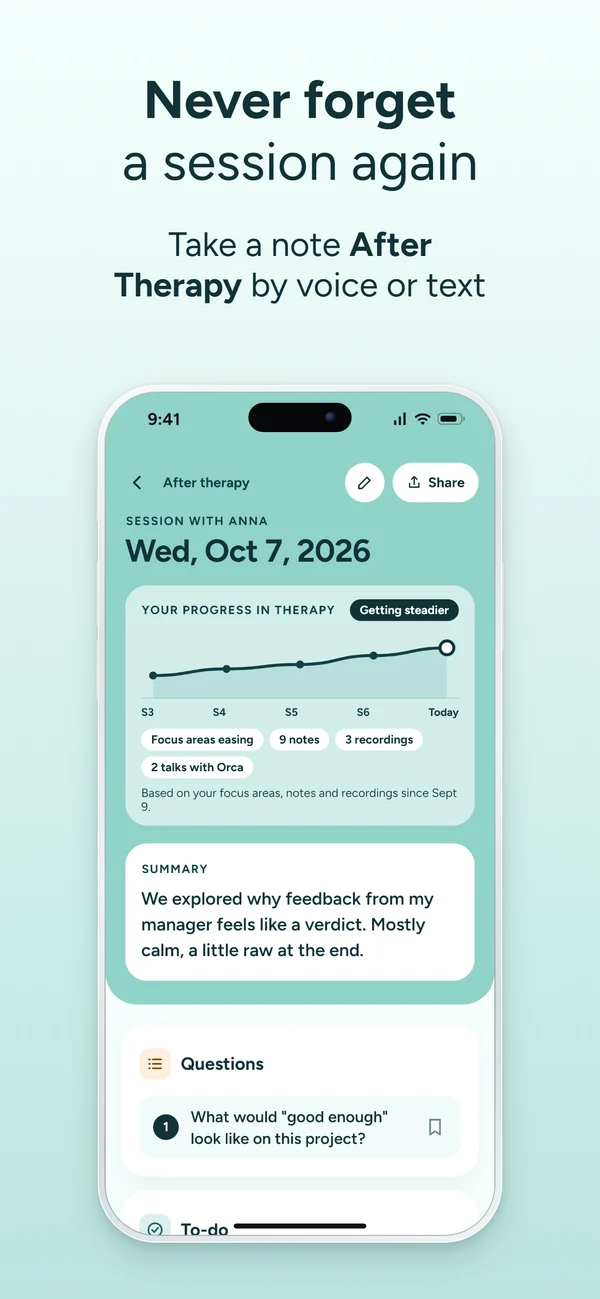
After therapy card
Right after the session, note what made you cry while you still remember the sentence. The card keeps it, with your questions and realizations. Try it free in MindSync →
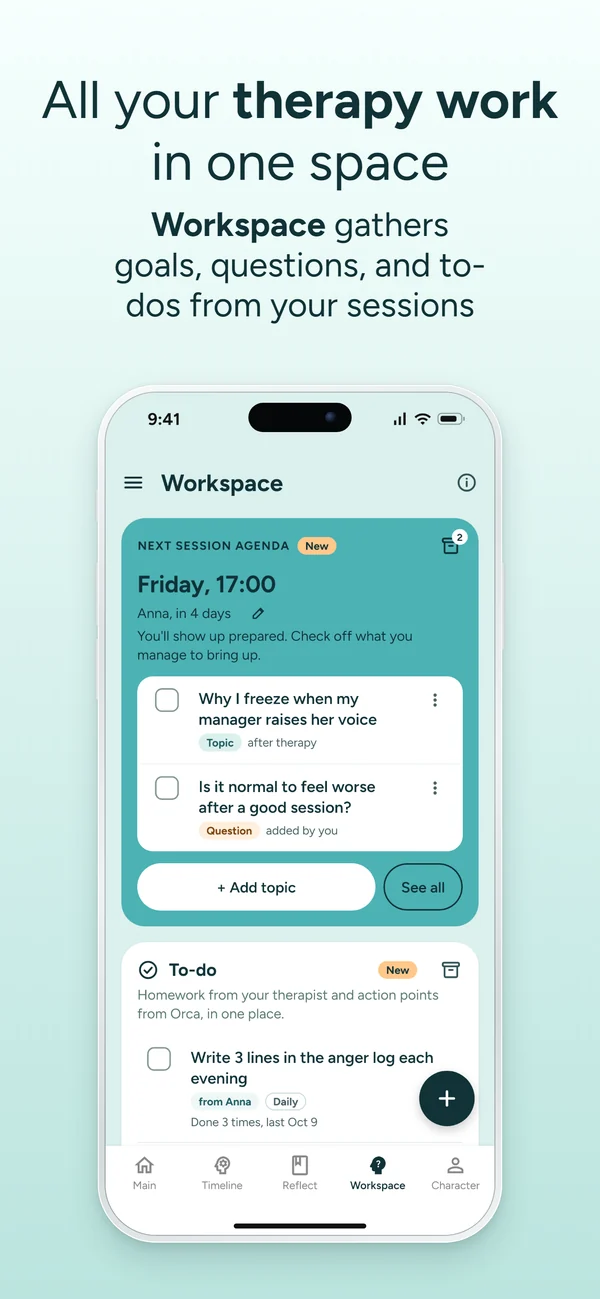
Workspace
Add the topic that brought the tears to your agenda for next time, so you get back to it instead of around it. Try it free in MindSync →
Note what the tears were about tonight, then bring it back to your next therapy session.


What was the last sentence you couldn't finish in therapy?
Frequently asked questions
Is crying in therapy normal?
Yes. Crying is one of the most ordinary things that happens in a therapy room, therapists expect it, and you don't need to apologize for it. It usually means you've reached something that matters to you. If you need a moment, "Give me a second" is enough.
Why can't I cry in therapy?
Plenty of people don't cry in sessions, even about hard things, and it doesn't mean therapy isn't working or that something is blocked. Feelings sometimes arrive later, or in another form, like tension, numbness or an awkward laugh. You can say what's happening instead: "I can feel it, but nothing comes out."
Is crying in therapy a breakthrough?
Not automatically. Tears often show you've touched something important, but a breakthrough is more likely to be the new understanding or change that comes afterward. A 2024 survey of people in psychotherapy linked crying in sessions with more self-reported improvement, but it couldn't show cause and effect. Write down what you were talking about when you cried, and bring it back next time.
How to stop crying in therapy?
You don't have to stop. If the tears are taking up too much of the session, slow your exhale, feel your feet on the floor, ask for a minute of quiet, and agree with your therapist on a plan for when it happens. Research on crying outside therapy suggests that holding tears back and feeling ashamed of them makes relief less likely, so there's little to gain from fighting them.
When will I stop crying in therapy?
There's no rule and no set number of sessions. For many people, crying eases as a topic gets worked through and comes back when a new one opens up. If you're crying in therapy every session and it worries you, tell your therapist, because that's a topic too. If you're crying every day outside therapy and it's hard to get through the day, say that plainly as well.
Keep more from every session
MindSync keeps your sessions and the week between them in one place, so your progress stops slipping away. The trial is free, no credit card needed.


Get the app