
Therapy
Mind Goes Blank in Therapy? The Week Didn't Vanish, the Cues Did

Do any of these sound familiar?
- All week you've been drafting what you'll say in your next session: in the shower, in the car, in the supermarket queue, where most of it got delivered silently to the back of a stranger's head.
- Your therapist settles in, asks "So, how was your week?", and you hear yourself say "Fine, I guess. Pretty normal."
- On the bus home, all of it comes back, in the right order, with the exact sentences you were looking for. Of course it does.
Why your mind goes blank in therapy, of all places:
We tend to picture memory as a drawer you open and empty onto the table. It works more like a search, and a search needs something to search with: a place, a mood, a smell, the exact words someone used. Psychologists call these retrieval cues, and the more of them you have, the more tends to come back.
Now think about where your week actually happened. The argument happened in the kitchen. The bad news came in while you were sitting in the car, and the thing you most wanted to say first showed up in a chat with your sister at 11 p.m. Then you carry all of it into a quiet room with a box of tissues and a plant, and that room has none of those cues. It's like keys that have "vanished" until you walk back to the front door, and there they are, exactly where your hand put them.
On top of that, being asked is a small stress of its own. Someone waiting for your answer, a clock on the wall, the sense that this hour costs money: pressure like that takes a bite out of working memory, the mental desk where you hold a thought long enough to say it. If your trouble runs the other way and the session itself is what slips, here's how to remember what you talked about in therapy.
The week didn't disappear. The cues did.
Three kinds of blank, and they don't want the same fix:
Not every blank is the same blank, and it helps to know which one you're sitting in.
- The empty blank. Nothing that happened feels big enough to count. Nobody shouted and the dishwasher still works, so it must have been a fine week, and "fine" is what comes out. Small moments often turn out to be the interesting ones, but they rarely feel important enough to say first.
- The crowded blank. So much happened that you can't pick a door. Work, the kids, the landlord, the dream from Tuesday, and every one of them wants to go first, so none of them does.
- The protective blank. Your mind goes quiet near one particular topic, every time. Some people describe it as freezing, or as feeling far away from the room. This isn't failing at therapy. It's information, and it's worth saying out loud to your therapist. If the blank comes with a sense that things aren't quite real, or you lose track of time, mention that too.
The first two blanks are mostly a cue problem. The third one is a conversation.
What research turned up:
Fun fact: the classic study on this happened in wetsuits. In 1975, Godden and Baddeley asked divers to learn lists of words either on the beach or underwater, then tested them either in the same place or in the other one. Words learned underwater came back better underwater, and words learned on land came back better on land. They published it in the British Journal of Psychology. If that holds, your therapist's office is different water.
In 2000, de Quervain and colleagues looked at what a stress hormone does to remembering. Volunteers were given cortisone, a close chemical relative of cortisol, before a memory test, and they had a harder time retrieving words they had already learned (Nature Neuroscience). Stress hormones get in the way of pulling memories out, not only of putting them in.
In 2016, Shields, Sazma and Yonelinas pooled dozens of experiments in a meta-analysis in Neuroscience and Biobehavioral Reviews and found that acute stress weakens working memory. The effect was small, but it kept showing up. Small and steady can be enough to swallow the first few minutes of a session, which is exactly when "So, how was your week?" arrives.
The same year, Blanchard and Farber asked 547 adults in therapy what they don't tell their therapists (Counselling Psychology Quarterly). 93% admitted they had lied to their therapist at least once, and many of the most common lies were small and polite: pretending to like a comment, or pretending therapy was working better than it was. So part of what feels like a blank may simply be manners. "Fine" can be a reflex, not a report.
The honest caveat: nobody has studied going blank in a therapy session directly. Everything above is borrowed from lab research on memory and stress, mostly with word lists. Even the wetsuit study has a twist: in 2021, Murre repeated it with 16 divers (Royal Society Open Science), and the same-place advantage didn't show up. So treat cues as a likely explanation rather than a certainty. And none of this is a diagnosis of what's happening to you.
What to try before, during and after the hour:
- Catch it while it's loud. When something happens during the week, say one sentence about it right away, in your own words. The exact words from that moment are the best cue you can leave for later, and they fade fast. Rehearsing a full speech in the shower for an audience of shampoo bottles is optional.
- Bring a scene, not a topic. "Family stuff" is a topic, and topics are slippery. "Tuesday, the text from my sister I didn't answer" is a scene: it has a day, a place and a phone in your hand. Scenes carry cues and topics don't, which makes a scene the first thing to write down when you prepare for a therapy session. One is plenty; you're not presenting a quarterly report.
- Name the blank out loud. Try: "My mind just went blank. Can you ask me about something from last time?" A blank that's been said out loud stops being a silence you have to fill and becomes something the two of you can work with.
- Let the protective blank be the topic. If it keeps happening near the same subject, say: "Every time we get near this, I go blank." You don't have to explain it or push through it. Your therapist can help you decide how close to go, and how fast.
- Give it two minutes after. Whatever comes back on the way home, write it down before you get off the bus. That's the first sentence of your next session. And if what follows is less a flood of words and more the tired, wrung-out feeling after a session, that's normal too.
Between-session voice notes
Say it the moment it happens, in your own words, and find it again before your session. Try it free in MindSync →
Where MindSync fits:
This is what MindSync's Between-session voice notes are for. Log the text you didn't answer, the speech you rehearsed in the shower, the sentence that came back on the bus home. Give it time, and your Before therapy card turns those notes into a one-page summary with up to three numbered questions to bring. Then, when your mind goes blank, read the first one out loud. MindSync is for the days between sessions, alongside therapy, and the hour itself stays yours.
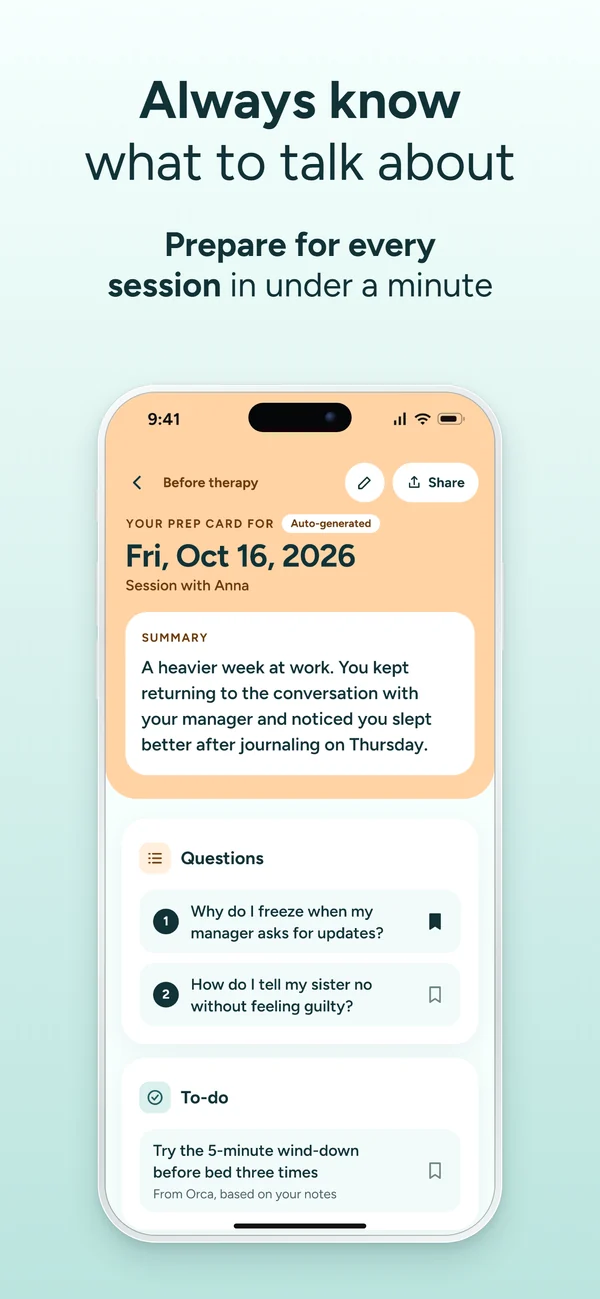
Before therapy card
One page with up to three questions you can read out loud when the words go missing. Try it free in MindSync →
What's the one thing you've meant to bring up for three sessions in a row?
Frequently asked questions
Is it normal for your mind to go blank in therapy?
Yes. Going blank in therapy is common, and it usually says more about how memory works than about you. Memory relies on cues like place, mood and exact words, a therapy room has few of the cues from your week, and the mild stress of being asked makes recall harder. Saying "my mind just went blank" out loud is a perfectly good way to start.
What to do when you don't know what to say in therapy?
Say exactly that, and ask for a starting point: "I don't know where to start. Can you ask me about something from last time?" Therapists hear this often and have plenty of ways in. Next time, bring one specific scene from your week (a day, a place, what was said) instead of a general topic, because a scene gives memory something to hold onto.
What if I have nothing to say in therapy?
Having nothing to say is still something to work with. Often it means nothing felt big enough to count, so start with a small moment from the last few days, or with how it feels to sit there right now. You can also tell your therapist the session feels empty, which is useful information in itself.
Why do I forget everything I want to say in therapy?
Mostly because memory leans on cues (a place, a mood, the exact words someone used), and the therapy room has almost none of the ones from your week. Add mild stress, which makes retrieval harder, and a full week can feel out of reach for a few minutes. Catching one sentence in your own words when something happens is one of the simplest answers to what to do between therapy sessions, and it gives you something to read from later.
Why do I freeze up in therapy?
Freezing can come from ordinary pressure, like feeling put on the spot, or it can show up around one topic that feels hard to approach. It isn't a sign you're doing therapy wrong. If it keeps happening near the same subject, or comes with feeling far away or unreal, tell your therapist. "Every time we get near this, I go blank" is enough to start. Approaches also differ in how they work with silence, something to ask about when you're figuring out which type of therapy is right for you.
Keep more from every session
MindSync keeps your sessions and the week between them in one place, so your progress stops slipping away. The trial is free, no credit card needed.


Get the app