
MindSync Tips
How to Name What You Are Feeling When All You Have Is Bad
Your therapist asks what you were feeling in that moment. You go looking for the word, and the only one that turns up is weird. You can hear how thin it sounds out loud, so you add something and it gets thinner. Here is what to do when the word is not there.
What emotional granularity means
Emotional granularity is how finely you tell your own feelings apart. Low granularity sounds like "I feel bad." High granularity sounds like "I am disappointed and a little embarrassed." Psychologists study it as a descriptive difference between people, measured from the way you report your states over time. It is a trait researchers observe, not a test you pass.
In research papers the same thing usually goes by emotion differentiation. If you met the term in an article somewhere and wondered what to do with it, the rest of this is the practical half.
Why a bigger vocabulary is not the point
The standard advice is a feelings wheel. A hundred words arranged in rings, and you are supposed to find yours.
Plenty of people look at it and pick nothing. The words are fine. A list of words is a menu, and a menu only helps once you have some idea what you want. People get stuck because they have nothing to hold the words against.
Precision comes from context: where the feeling sits in your body, what you wanted, who it is aimed at, what would end it. Get those and the word usually arrives on its own. Learning to name your emotions is mostly learning to ask those four questions, which is what the rest of this piece is.
What the research links it to
The measurement side goes back to Barrett, Gross, Christensen and Benvenuto in 2001, in Cognition and Emotion. They had people report their emotions repeatedly over time, then worked out from those reports how much each person separated one unpleasant state from another. The finding sounds obvious written down: people genuinely differ in this, and researchers can measure the difference.
The most quoted result came nine years later. Kashdan, Ferssizidis, Collins and Muraven followed 106 underage social drinkers for three weeks in Psychological Science, with handheld devices prompting reports through the day. In moments of intense negative emotion, the people who differentiated their emotions more finely drank less. What that shows is an association, in 106 young social drinkers, over three weeks. Nobody taught anyone to name emotions and then measured their drinking.
Kashdan, Barrett and McKnight pulled the literature together in Current Directions in Psychological Science in 2015, and the same caveat covers most of it. Higher granularity travels with better emotion regulation. The evidence is correlational, so it does not establish that getting more precise makes anyone regulate better.
One study did watch granularity move. Hoemann, Barrett and Quigley, in Frontiers in Psychology in 2021, took 50 healthy adults through roughly two weeks of intensive ambulatory assessment, meaning repeated prompts through the day plus physiological monitoring and a diary at the end of each day. Granularity increased over the study. How much it increased depended on methodological factors such as how many prompts a person answered per day, and on individual factors including resting respiratory sinus arrhythmia.
That one is the easiest to oversell. The increase was measured inside the study's own reporting system, and the size of it tracked the amount of measuring. The authors say the design sits at the upper bound of study complexity and cannot tell you which parts of the protocol were necessary. Nothing in it says that describing your feelings daily improves your mental health. It shows that reports get more specific when people make a lot of them, over weeks.
Lieberman and colleagues, in Psychological Science in 2007, found that labeling a negative image changed patterns of brain activity in a scanner, which is a finding about brains under laboratory conditions rather than a claim that naming a feeling makes it smaller.
The four questions that get you past "bad"
These work because none of them asks you to name the feeling. Each one comes at it sideways and hands you the material the word is made of.
- Where is it in your body?
- What did you want that you did not get?
- Who is it pointed at?
- What would have to change for it to stop?
Answer them in any order. Two of them usually do it. You are after a closer word than bad, which is a lower bar than the right one.
Where is it in your body?
Tight chest, shoulders up near your ears, everything slightly fast: that is a different neighborhood from heavy, slow and sunk. The first points toward the braced end of things, the second toward the flat end. This will not hand you a word by itself. It cuts the search roughly in half, which is enough to start.
What did you want that you did not get?
You left the dinner in a bad mood. Try the question: you wanted someone to ask how your week went, and nobody did. Not being asked, and minding that you were not asked, sits closer to hurt than to annoyed. Those are two different conversations to have later, and they both start from that one word.
Who is it pointed at?
The same tight evening reads differently depending on direction. Pointed at your brother, it is probably resentment. Turn it on yourself and it reads closer to shame. If it is aimed at nobody in particular, at a situation that simply happened, disappointment or grief is nearer. Ask where the feeling is aiming and half the candidate words fall away.
What would have to change for it to stop?
If the answer is an apology, you want repair, and the word is somewhere in the hurt family. If it is eight hours of sleep, part of what you are calling a feeling is tiredness. And when nothing anyone does would fix it, you are near grief, where no better word exists because none is needed.
This last question also runs backward into what set the reaction off in the first place, which is a separate job with its own piece.
Two words are usually more accurate than one
Single words fail most often when two things are true at once. That is ordinary, and it is not a sign that your vocabulary is the problem.
Relief and guilt, when a difficult plan gets canceled. Anger and shame, when you snapped at someone who had a point. Caring for somebody on a long day is mostly tenderness and irritation arriving together. If you keep rejecting words because none of them is quite it, the missing piece is often the second word rather than a better first one.
Practice where the stakes are low
The worst time to work on this is the middle of the worst evening. Precision needs a bit of slack and a bad night has none. The evening after a heavy session is for getting through, not for training.
So practice on the small stuff. The mild flatness at three in the afternoon. The thing a colleague said that you are still turning over. Give it thirty seconds, twice a day, on feelings that are not urgent. Say it or type it, whichever you will actually do, and there is more on writing it down or saying it out loud if you cannot decide.
Then give it weeks. In the Hoemann study the people who answered more prompts per day gained more, across about two weeks of it. Nobody has shown this turning around in seven days, and anyone promising you a number of days is making it up.
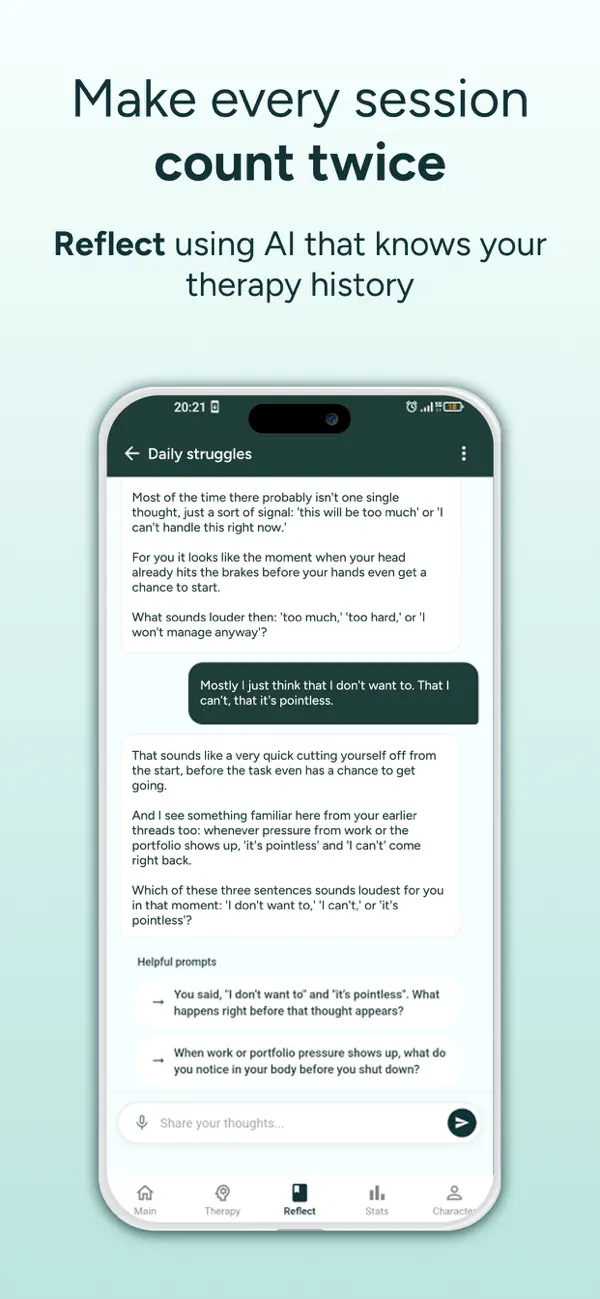
Reflect (AI journaling)
When the only word you have is bad, Reflect keeps asking, in writing or out loud, until the word gets closer. Try it free in MindSync →
What to do with the words once you have them
The point of all this shows up in the first fifteen minutes of your next session.
Opening with "I had a rough week" means your therapist spends a quarter of the hour finding out what rough meant. Opening with "on Wednesday I was humiliated in a meeting and I have been avoiding my inbox ever since" starts the work at the material. If you want the mechanics of that, here is how to turn it into an opening sentence for the next session.
Over months the words also start to repeat, and the repetitions are the interesting part. The same one showing up every Sunday evening is information you did not have back when each Sunday was just a bad mood. That is the case for a closer read on the emotions that keep repeating, once there is enough written down to read.
Getting more precise over weeks, not in one evening
- Wellbeing check-ins - The same few areas, scored each day, so the practice has a fixed slot instead of waiting for a bad evening to force it.
- Mood & focus-area trends - Weeks of your own ratings side by side, where the difference between a flat month and one hard week becomes visible.
- Personal bio & companion - A living picture of what you keep coming back to, built out of what you have actually written, not out of a questionnaire.
Frequently asked questions
What is emotional granularity?
Emotional granularity is how finely a person distinguishes between their own emotional states. "I feel bad" is low granularity; "I am disappointed and a little embarrassed" is high. Researchers also call it emotion differentiation and measure it from repeated reports of feeling across days rather than from a single questionnaire. It describes a difference between people, and it is not a diagnosis.
Why can't I identify my emotions?
Usually because the context is missing, not the words. Naming works from where the feeling sits in your body, what you wanted, who it is aimed at and what would end it. Without those, the best word available has nothing to attach to. Psychology studies a trait called alexithymia, a research construct rather than a conclusion to draw from one bad Tuesday.
How do I describe my feelings to my therapist?
Give the situation, the body and your best two words, in that order. "On Wednesday my manager cut me off, my chest went tight, and I think it was humiliated plus angry" gives your therapist more to work with than "a bad week." Being unsure out loud is fine, and so is saying you cannot find the word at all.
Does a feelings wheel actually help?
It helps as a menu, not as a method. A wheel is useful once you already have a rough sense of the feeling and need the more exact word, and it tends to stall people starting from nothing. There is no good evidence that wheels do not work, and none showing that a vocabulary list alone builds precision. Answer the context questions first, then reach for the list.
How long does it take to get better at naming emotions?
Weeks of repetition rather than one evening, and nobody can give you a real number. The one study that watched granularity rise ran about two weeks of intensive daily sampling, and the gains were largest for people who answered the most prompts per day, which the authors tie to the method as much as to anything the people learned. Treat any promise of a fixed timeline as marketing.
Keep more from every session
MindSync keeps your sessions and the week between them in one place, so your progress stops slipping away. The trial is free, no credit card needed.


Get the app