
MindSync Tips
Journaling vs Voice Notes: Which One Will You Actually Keep Doing?
You bought the good notebook. Four pages in January, then nothing, and now you open it only to feel bad about it. Before you file that under personal failure, there is a duller question worth asking. Was writing ever the right format for you, or did you just inherit it from everybody else?
What the writing research actually found
The whole field runs on one small study. Pennebaker and Beall, in Journal of Abnormal Psychology in 1986, had 46 undergraduates write for 15 minutes on four consecutive evenings, some about a trauma they had never discussed with anyone, some about trivial topics. The people who wrote about both the facts and the feelings felt worse straight afterwards, and over the following six months visited the student health center less often.
That result launched several hundred studies. Frattaroli pooled 146 randomized ones in Psychological Bulletin in 2006 and found the average effect was positive and statistically significant, at r = .075.
Sit with that number for a second, because most articles about journaling will not show it to you. An r of .075 is small. Real, replicated across a large body of work, and small. Results also vary a great deal between studies, which is why the meta-analysis spends most of its length on moderators: who is writing, about what, for how long, under what circumstances. Journaling is not a treatment. It is a cheap and generally mildly helpful thing, and the honest version of the pitch is exactly that.
What we know about saying it out loud
Less. That is worth saying plainly before anything else.
Some of the early studies did test the spoken version. Donnelly and Murray, in Journal of Social and Clinical Psychology in 1991, put 102 students through four days of either written essays or spoken therapy interviews about a difficult experience, against a trivial-topic control. Both disclosure conditions produced comparable emotional and cognitive changes, and both beat writing about nothing. Esterling and colleagues, in Journal of Consulting and Clinical Psychology in 1994, found that disclosure through writing and disclosure through speaking both moved a marker of immune function.
Frattaroli's meta-analysis tested the question head on, as a moderator. Whether people handwrote, typed or spoke their disclosure did not significantly change the size of the effect for any outcome type.
The honest caveat: far fewer studies used a spoken condition, and finding no moderator effect is not the same thing as proving two formats are equivalent. What the evidence supports is a modest claim. There is no good reason to believe speaking is a degraded version of writing, and no good reason to promise it is better.
One more piece of the mechanism, usually oversold. Lieberman and colleagues, in Psychological Science in 2007, showed that putting a feeling into words while looking at emotional images reduced amygdala activity and raised activity in the right ventrolateral prefrontal cortex. Naming a feeling appears to change how it gets processed. That is a laboratory finding about a mechanism, not evidence that a voice note on the walk home treats anything.
The differences that actually matter in practice
Speed
Speaking produces more material per minute, and the gap is large. Ruan and colleagues at Stanford, in a 2018 paper in the ACM's Proceedings on Interactive, Mobile, Wearable and Ubiquitous Technologies, found speech input on a smartphone ran about 2.9 times faster than the keyboard for short English messages: 153 words per minute against 52. That was a lab transcription task rather than journaling, so treat it as an order of magnitude and not a promise. On a bad evening, the distance between three sentences and 30 is the distance between a record and nothing.
Filter
Writing sorts. You choose words, you cross things out, you produce a version that is already partly organized. Speaking spills. You get the tangent, the tone, the sentence you would have deleted, which is often the useful one. Neither is better. They give you different raw material, and which one you want depends on whether you are trying to think clearly or trying to find out what you feel.
Friction
The notebook is in a drawer. The phone is in your hand. Journaling advice tends to assume a desk, an evening and a mood, while most of what is worth capturing happens in a parking lot. The best format is the one that survives the moment, not the one with the best reputation.
Privacy and place
You cannot say much out loud in a kitchen with a roommate in it. Writing is silent, which is not a minor advantage if you share a home, work in an open-plan office, or have kids who read. Voice also creates a recording of your voice, so it is worth being deliberate about where that ends up.
Choose by situation, not by identity
"I am not a journaling person" is a category error. Nobody is a journaling person at 11pm after an argument. Match the format to the moment instead:
- Right after a session, use voice. You are still in the room mentally, the material is warm, and you are not going to sit down and write in a parking lot.
- For a thought loop you cannot break, use writing. Speaking a loop tends to feed it. Writing forces sequence, and sequence is the thing a loop lacks.
- Two minutes before bed, use whichever needs no decision. The decision is what kills it.
- For a conversation you keep rehearsing in your head, use voice first and read it back the next day. Hearing the argument you are having with someone who is not in the room tells you something that writing it out does not.
Between-session voice notes
Say it out loud when it comes up, and the note is transcribed for you to review and accept later. Try it free in MindSync →
The post-session case is the strongest of the four, and there is a longer version of why in capture the session while it is still fresh.
The hybrid that survives a bad week
The format question is not either-or, and the arrangement that lasts longest looks roughly like this:
- Speak during the week, whenever something lands. Two sentences, no structure, no editing.
- Read it back once a week, on a fixed day. Reading is the part everybody skips and the part that does most of the work.
- Write only when reading it back raises a question worth answering slowly.
That gives you speed on the days you have none and structure on the days you have some. It also solves the failure mode of pure voice journaling, which is a folder of recordings nobody will ever open again.
If the blank page is the problem, the missing ingredient is usually a question. A prompt you wrote yourself is not really a prompt, because you already know what you were going to say. Something that asks a follow-up is a different exercise.
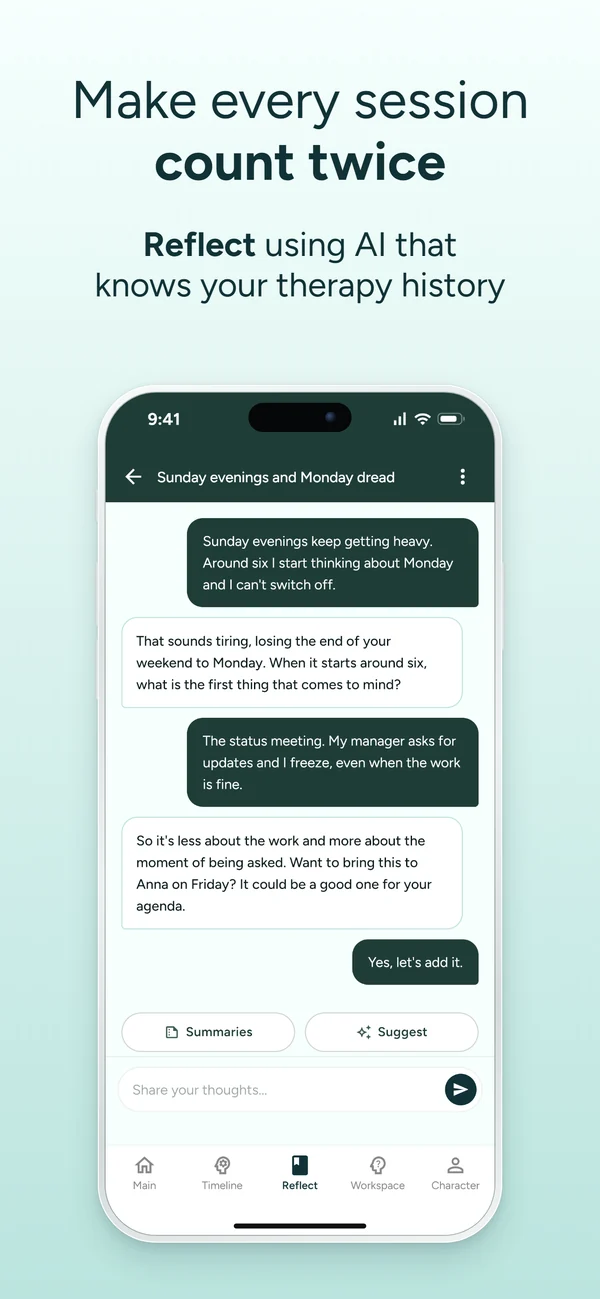
Reflect (AI journaling)
A guided reflection asks the follow up question a blank page never will, in text or out loud, whichever you have in you that day. Try it free in MindSync →
What to do with the pile afterwards
None of this is worth anything if nobody reads it back, and for most people nobody does. A month of captured material becomes useful at exactly two moments: when you notice the same situation for the third time, and when you sit down the evening before a session and need to know what your week contained.
The second one is where a voice folder starts paying for itself. 10 minutes, read back, pick one topic. There is a weekly shape for this in a weekly rhythm between sessions, and if what you keep finding is the same trigger rather than the same bad luck, catching a reaction in the moment goes further into it.
Some of the material will not sort itself out in a week, and the loops that show up in the dark are their own problem: when the loop shows up at one in the morning.
If you would rather have a deeper read on what you keep coming back to than another storage folder, that is what the analysis side of MindSync is for. The rest of the tools sit on the features page, and the method in this article works fine with a notebook and the voice recorder you already have.
Keeping the material usable
- After therapy card - The five minutes right after a session, while it is still warm.
- Therapy timeline - Notes, sessions and check-ins in one place you can filter later.
- Workspace - The parts worth raising next time, already on your agenda.
Frequently asked questions
Is journaling or talking better for mental health?
Both have research support, and the writing research is far larger. Frattaroli's 2006 meta-analysis of 146 randomized studies found a small positive effect overall, and found that whether people wrote or spoke did not significantly change it. Practically, the better format is the one you will still be doing in week four.
Does voice journaling work?
The early disclosure studies that included a spoken condition, such as Donnelly and Murray in 1991, found effects comparable to writing. The evidence base for speaking is much smaller than for writing, so the honest answer is that it looks similar rather than proven equal. It also produces more material per minute, which matters if your problem is starting at all.
How long should I journal for?
The classic protocol is 15 to 20 minutes across three or four sessions, which is what most of the research used. That is a short course, not a daily habit. For ongoing use, two minutes when something happens beats 20 minutes on a schedule you will abandon, because capturing something near the moment is what keeps the record accurate.
What do I do if I hate writing?
Speak instead. There is no evidence that written disclosure outperforms spoken disclosure, and a format you avoid has an effect size of zero. Record two sentences when something lands, then read the transcript back once a week. Keep writing for the moments when a thought is looping and needs to be put in order.
Can I use voice notes instead of a journal?
Yes, with one condition: something has to read them back. A voice folder nobody opens is worse than three written lines, because the material only becomes useful on review. Set one fixed slot a week to go through them and pull out what belongs in your next therapy session.
Keep more from every session
MindSync keeps your sessions and the week between them in one place, so your progress stops slipping away. The trial is free, no credit card needed.


Get the app