


Therapy
Feeling Stuck in Therapy? When Every Session Turns Into a Weekly Recap

Feeling stuck in therapy usually isn't a sign that therapy has failed. More often, your sessions have turned into a recap of the week. Tell your therapist you think you're stuck, ask to look at your goals together, and bring one thread to work on next time. If nothing shifts after a few sessions, talk about changing the approach.
Do any of these sound familiar?
- "So, this week..." has been your opening line for four months. Each session is another episode of a weekly podcast that nobody bothers to edit.
- You walk out thinking "that was nice," and by the time you're in the car you couldn't say what you worked on.
- Your therapist asks "How was your week?" and you already have slides.
None of it means something's wrong with you. If you've been asking yourself why you feel stuck in therapy, the answer is usually less dramatic than it feels.
Why therapy turns into a weekly recap:
Most people start therapy with an obvious reason to be there: a breakup, a crisis at work, a decision that won't make itself. Then the sharpest part settles down (often because therapy did its job), and the space it leaves gets filled by whatever is easiest to reach. Usually that's the week.
A recap is also comfortable for both of you. It's easy to tell and easy to listen to, and nobody has to go near anything that hurts. And when nothing gets noted between therapy sessions, you arrive with what's freshest instead of what's important. That's where the small habits of what to do between therapy sessions come in.
It's a bit like going to the gym for six months and doing the exact same workout every time, because you know it and it doesn't hurt. It isn't doing you any harm. It just stopped building anything.
Venting isn't wasted time. Sometimes being heard is the work. It's just not the only work, and you're allowed to want more.
A recap tells your therapist what happened. It doesn't tell them what you want to change.
What "stuck" looks like from your side of the room:
- You can't remember what the session two weeks ago was about, because they've all blurred into one long Tuesday.
- Your therapist asks how things are, you say "fine, actually," then go looking for something to report.
- The same three topics keep coming back and land on the same conclusion each time.
- The night before, you think about rescheduling because there's "nothing to talk about," and part of you wonders whether therapy feels like a waste of time.
- You like your therapist, and that's exactly why you haven't said any of this.
Being stuck in therapy usually looks like a pleasant hour you can't remember.
What research turned up:
In 1996, Clara Hill and her colleagues asked experienced therapists to look back on impasses in long-term therapy, the kind where the work stalled and therapy ended. In the Journal of Counseling Psychology, they reported that a lack of agreement between therapist and client about the goals and tasks of therapy was among the factors in most of the cases. What that means for you: therapists know this kind of stuck well enough to have a word for it, and one of the factors they named is something you can bring up yourself: what are we working on?
Two years later, David Petersen, a graduate researcher in Hill's group at the University of Maryland, asked the other side. He interviewed 11 former clients who had left therapy after an impasse that never got resolved. Saying they were unhappy had been hard for them, and few felt their therapists had even known there was an impasse. It was real to them and invisible in the room.
Then, in 1999, Tony Tang and Robert DeRubeis tracked how people improved in cognitive behavioral therapy for depression, in the Journal of Consulting and Clinical Psychology. Many patients had one large drop in symptoms between two sessions, and for them that single jump made up about half of their total improvement. A flat stretch isn't proof that nothing is happening.
The honest caveat: Hill heard from therapists, Petersen from a small group who had already left, and Tang and DeRubeis studied one therapy for one condition, so none of this promises a jump if you wait. We also couldn't find a study that counted how often clients feel stuck. The takeaway doesn't need that number: flat stretches are part of the process, and the conversation about direction is one you can start. For the measuring side, here's how to tell if therapy is working.
Progress in therapy is more staircase than ramp. Long landings included.
What to do when you feel stuck in therapy:
- Look back at the last few sessions. Ask two questions about your last three or four: what were they about, and did any of them end with something you did differently afterward? If the answers are "my week" and "not really," you've got something concrete to bring instead of a vague "it feels off."
- Bring one thread, not the whole week. Pick the thing that keeps coming back, the thing that bothers you, or the reason you started therapy in the first place. Try: "Can we spend today on one thing? I keep coming back to..." If you have too many candidates, here's how to prioritize what to talk about.
- Say "I think we're stuck," early in the session. At the start, not with your hand on the door. Try: "I think we might be stuck. I like coming here, but I'm not sure what we're working on anymore." Or: "Our sessions have turned into me catching you up on my week. I'd like to use them differently." Or, if you need to lighten it: "I've basically become your weekly newsletter." A good therapist hears that as useful information about direction, and this is exactly the kind of conversation therapy is for.
- Ask for a goals review. Try: "Can we look at what I came in for and whether it's still the goal?" Look at what's changed since the first session, what's already better (that's often why things went flat), and what comes next. You can also ask for a different structure, like a specific exercise in session or something to practice between therapy sessions. Here's more on what your therapy goals should be, and if the stuck feeling is really about the relationship, on what to do when your therapist isn't the right fit.
- Give the new direction a few sessions, then decide. One conversation rarely changes everything by next Tuesday. If things are still flat after a few sessions with a clear focus, taking a break from therapy or deciding when it's time to stop are fair options, and neither one is a failure.
You don't need a breakthrough. You need a direction you both agreed on.
One exception. If "stuck" feels less like boredom and more like things are getting worse, or hopeless, or you're having thoughts of hurting yourself, tell your therapist plainly at your next session. If it can't wait, call or text 988 in the US, or 911 in an emergency.
Where MindSync fits:
This is what MindSync's Before therapy card and Goals are for. Log the moments between therapy sessions that connect to what you're working on: the argument that sounded like the last three, the thing you avoided again on Wednesday, the "fine, actually" you didn't quite mean. Give it a week, and your Before therapy card turns those entries into a one-page summary with up to three numbered questions, so you walk in with a thread instead of a recap. Then Goals puts what you came in for next to the evidence from your sessions and check-ins, ready for a goals review. No app can tell you whether you're stuck. It can show you what the last month was about.
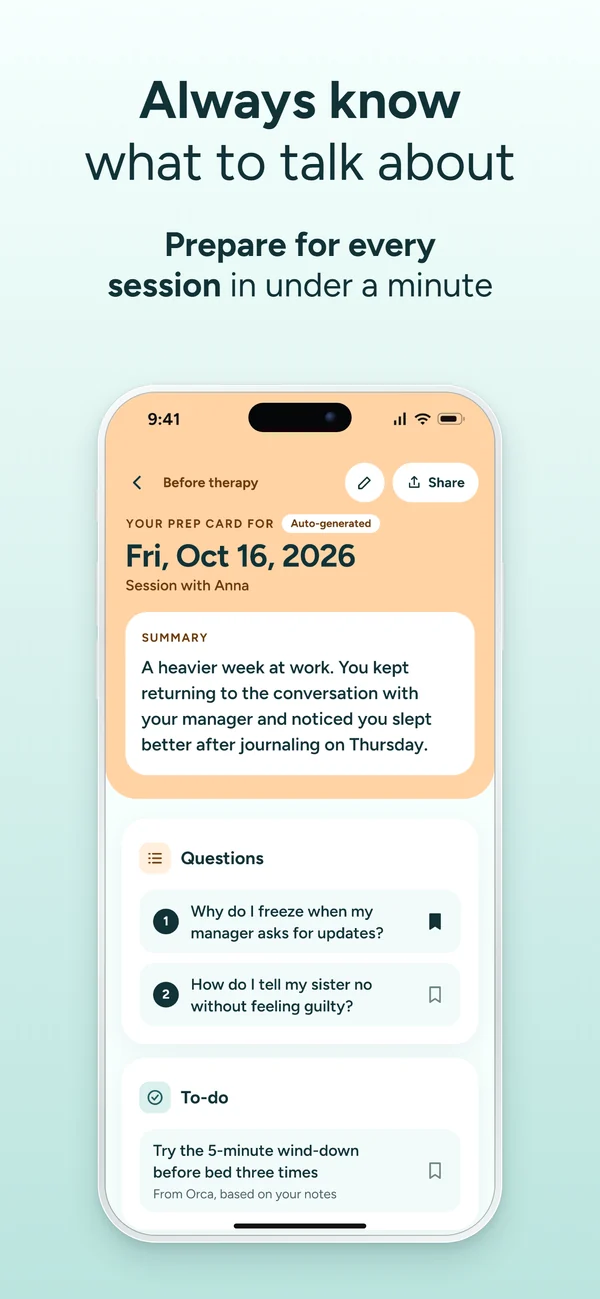
Before therapy card
A one-page card before each session with up to three numbered questions, so you bring a thread instead of a recap. Try it free in MindSync →
Goals
What you came to therapy for, kept in view with evidence from your sessions and check-ins. Try it free in MindSync →
Walk into your next session with one thread, not a recap of the week.


What's the one thread you'd pull on if your next session started with it?
Frequently asked questions
Why am I stuck in therapy?
Most often, your sessions have lost a shared direction and turned into a recap of the week. Other common reasons are goals that no longer fit because part of the problem has already improved, or something in the relationship with your therapist that's hard to say out loud. A flat stretch can also simply be part of the process. Tell your therapist "I think we're stuck" and ask to review your goals together.
Why does therapy feel like a waste of time?
Often because you can't see what you're working on right now, which is a different problem from therapy not being able to help. Change in therapy tends to be slow and uneven, so quiet weeks can feel like nothing is happening. Ask your therapist what they think the two of you are working on, then compare it with what you came in for. If the answers don't match, you know what your next session is about.
What to talk about in therapy when things are going well?
A good stretch is a good time for work that's hard to do in a crisis. You can look at what helped and how to keep it, patterns that tend to come back, goals for further ahead, and a plan for a harder week. It's also a fair moment to talk about whether to change how often you go. Try opening with: "Things are okay, so I'd like to use this time to look at..."
Keep more from every session
MindSync keeps your sessions and the week between them in one place, so your progress stops slipping away. The trial is free, no credit card needed.


Get the app