


Therapy
How to Prioritize What to Talk About in Therapy (Before the Doorknob Does It for You)

To prioritize what to talk about in therapy, write the whole week down first, then ask which one thing you'd regret not saying. Say that one in the first ten minutes, mention the rest in a sentence each, and park whatever doesn't fit for next time. Anything about your safety always goes first.
Do any of these sound familiar?
- There's a note on your phone with nine things on it, from the fight with your sister to "ask about sleep?", sitting right above "fix things with Mom". It reads like a grocery list where one of the items is your entire childhood. You're in the waiting room with no idea where to start.
- You open with the parking ticket because it's the most recent, and suddenly it's minute forty.
- "Oh, and one more thing." You already have your coat on.
Your mind isn't blank. It's full. That's a different problem, and it has a different fix.
Why everything feels urgent by session day:
A week is 168 hours. A session is less than one. Nothing waits its turn politely while you're living it: things pile up, and on session day they all arrive at once, each one sure it's the emergency.
Then the order picks itself, and not in your favor. The most recent thing sounds loudest, because it happened yesterday. The easiest thing goes first, because you need to warm up. The hardest thing waits until the exit is close enough that you can say it and leave.
It's a lot like packing a carry-on for a week away. You fold, you roll, you sit on the suitcase to get the zipper shut, and you land to find the one thing you were actually traveling for still lying on the bed. If nothing gets chosen, the important thing rarely makes it in.
If you've ever worried that you talk too much in therapy, this is usually what's happening. Having a lot to say doesn't mean you're doing therapy wrong. It usually means your week was full.
When everything is urgent, the important thing waits for the door.
What it looks like when the hour runs out:
- Fifteen minutes of context before you get to the point: "So, to explain, my sister's husband's boss..."
- You hop between three topics, and none of them gets more than two sentences.
- Your therapist asks "anything else?" at the end, you say "no, that's it", and in the car you know it wasn't.
- The thing that matters most comes out at the door. Therapists even have a name for it: the doorknob comment.
So can you talk too much in therapy? It's rarely about the amount. Usually you're talking around the thing instead of about it.
By the last minute, the door is doing the prioritizing for you.
What research turned up:
In 1982, psychiatrist Glen Gabbard wrote about what he called the "exit line" in the Journal of the American Psychoanalytic Association: a remark a patient makes on the way out, which often carries something they didn't say during the hour. He described these lines as kept just outside the session, and easy to never pick up again the following week. It's a clinical description drawn from his work with patients, not a study with numbers. Still, it tells you the thing said at the door is common enough to have a name. You're not strange for doing it.
In 1994, White, Levinson and Roter audiotaped visits between 88 patients and 20 primary care doctors and looked closely at the final minutes, in the Journal of General Internal Medicine. In about one in five visits (21%), the patient brought up a new problem while the visit was closing. The authors suggested it helps to lay out early how the visit will go, and to get to feelings and worries sooner.
In 2007, John Heritage and colleagues ran a trial with 20 family doctors in Los Angeles County and Pennsylvania, published in the same journal. After hearing the main complaint, the doctors were randomly assigned to ask whether there was "anything else" or "something else" the patient wanted to address. The "something else" version eliminated about 78% of unmet concerns compared with visits where neither was asked. The "anything else" version made no significant difference, and the visits didn't get any longer. What that means for you: the question has to come early, and it has to be easy to say yes to. You can ask it of yourself before you sit down.
The honest caveat: two of these three come from doctors' offices, not therapy rooms, and the third is one psychiatrist's clinical observation. We couldn't find a study that counted how often the most important thing in therapy comes out at the door. The good news is that the lesson all three share doesn't depend on the room: what you say early has time to be dealt with.
Said early, it's a topic. Said at the door, it's a cliffhanger.
How to prioritize what to talk about in therapy:
- Dump the week first, choose second. Put everything on one list, without judging any of it. Choosing gets much easier once the list is on paper and out of your head. If you want a system for collecting things through the week, here's how to prepare for a therapy session.
- Run each item through three questions. Is it still loud today? Would you regret not saying it? Does it touch what you came to therapy for? Anything with three yeses goes first. When you can't decide what to talk about in therapy, the regret question usually settles it on its own. The parking ticket almost never wins.
- Say the one thing in the first ten minutes. Try: "There's a lot this week, but the thing I most want to get to is..." Or, if you know yourself: "Can we start with the hard one? If we leave it, I'll chicken out." And when your mind goes blank instead, read it off your phone. Reading it out still counts as saying it.
- Hand your therapist the list, not just the topic. "There are three things on my list. Which one do you think we should start with?" Your therapist knows the context and might notice that two of them are the same thing in different hats. And if they ask whether there's anything else, take the opening: "Actually, yes, there's something else."
- If it comes out at the door, say it anyway, then book it. At the door beats never. Try: "I know we're out of time. Can we start with this next week?" Right after the session, write it down as the first item for next time. It's one of the smallest parts of what to do between therapy sessions, and it helps you remember what you talked about. If the thing at the door keeps coming back, here's how to bring up a pattern you keep noticing.
You don't have to fit the whole week in. Just the part you'd miss.
Priorities have one exception. If anything on your list is about your safety, like thoughts of hurting yourself or feeling you can't keep yourself safe, it goes first, never at the door. If it can't wait for the session, call or text 988 in the US, or 911 in an emergency.
Where MindSync fits:
This is what MindSync's voice notes and Before therapy card are for. Log the fight with your sister while it's still warm, the "ask about sleep?" you'd forget by Thursday, the thing you said at the door last week. Give it a week, and your Before therapy card turns those notes into a one-page summary with up to three numbered questions to bring, so half the choosing is done before you sit down. Then whatever doesn't fit goes on your agenda for next time in Workspace, and the After therapy card is where you note what you got to and what's still waiting. No app decides what matters most to you, ours included. It just keeps the list.
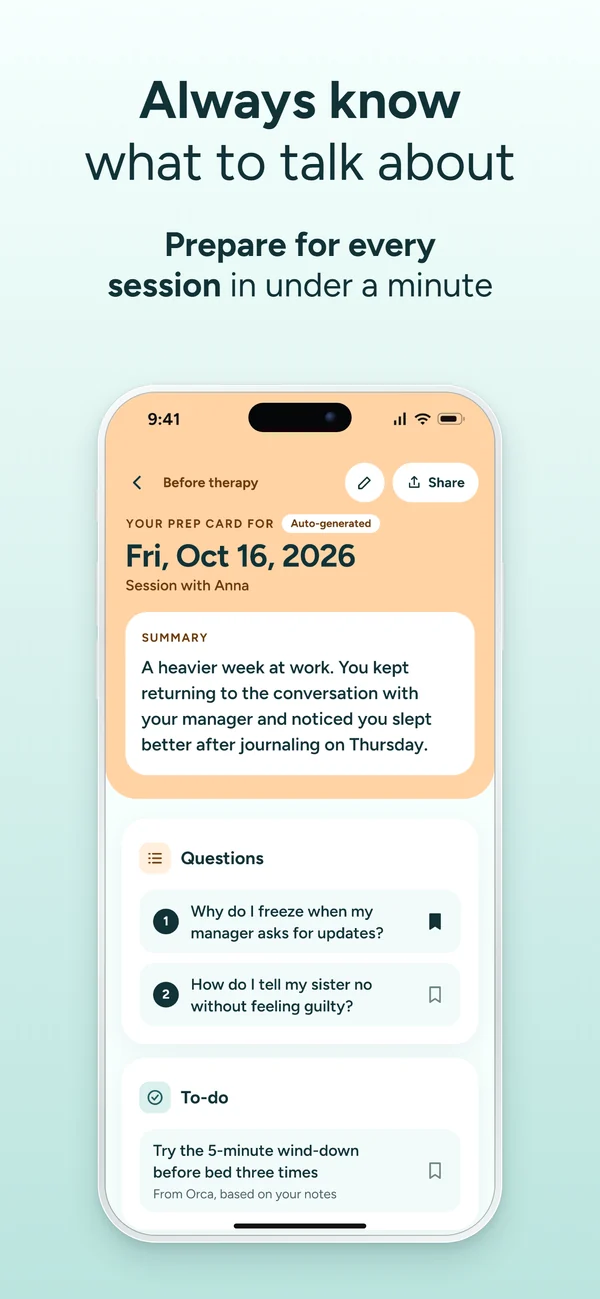
Before therapy card
Before each session, a one-page card with what came up since last time and up to three numbered questions to bring, so the hardest one can go first. Try it free in MindSync →
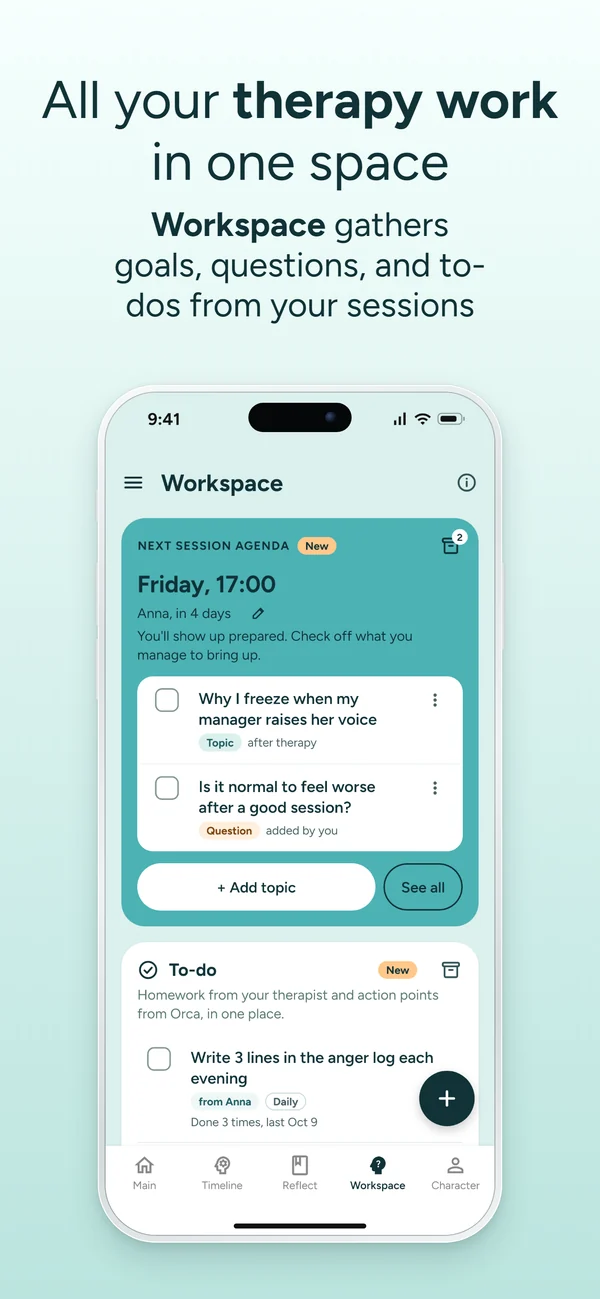
Workspace
Your agenda for next time, so whatever didn't fit this week is waiting at the top instead of by the door. Try it free in MindSync →
Keep the week's list in one place, and walk in knowing which one goes first.


What's the thing you keep saving for the last five minutes?
Frequently asked questions
How do you decide what to talk about in therapy?
Start with the thing you'd most regret not saying, then the thing that's still loud today, then whatever touches the goals you came to therapy for. Anything about your safety always goes first. If you still can't choose, tell your therapist what's on your list and ask where they'd start. Choosing together is part of the work.
Do I talk too much in therapy?
Probably not. In most talk therapy, talking is your part of the job, and your therapist will steer if the session needs it. Feeling like you talk too much usually means you're talking around the main thing instead of about it. If it worries you, ask directly: "Do you want me to slow down, or get to the point faster?"
What is a doorknob comment?
A doorknob comment is something important said in the very last moment of a session, often with a hand already on the door. Psychiatrist Glen Gabbard described it in 1982 as the "exit line", and in a 1994 study of recorded primary care visits, patients raised a new problem during the closing in about one in five visits. If it happens to you, say it anyway, then ask to start with it next week.
How much should I tell my therapist?
You don't have to tell your therapist everything in one session. The more you share, the more there is to work with, but the pace is yours. If something feels too big for today, you can flag it without opening it: "There's something I'm not ready to go into yet, but I want you to know it's there." If you're unsure what stays confidential, ask your therapist, because the limits depend on where you live and how they practice.
Keep more from every session
MindSync keeps your sessions and the week between them in one place, so your progress stops slipping away. The trial is free, no credit card needed.


Get the app