


Therapy
How to Bring Up a Pattern in Therapy: You Don't Need a Diagnosis, Just Dates

To bring up a pattern in therapy, describe what you noticed, not what you think it means: "I've noticed I get tense before the Wednesday family call, and I'm not sure why." Bring two or three dated examples, raise it at the start of the session, and let your therapist help you read it.
Do any of these sound familiar?
- Third Sunday in a row, the same argument about the same thing at the same time, like a show with its own time slot. (More on the same argument over and over.)
- Your mom's name lights up the screen and your stomach tightens before you've even picked up. She calls every Wednesday. Your stomach knows.
- The third canceled plan this month. You were "tired". You're always "tired" on Thursdays.
You noticed, and that's the hard part. The trouble starts in the room, where what felt obvious at home comes out as "so I think it's definitely a trigger", which sounds a lot like a diagnosis you wrote yourself.
Why it's so hard to say out loud:
Part of it is vocabulary. "Trigger", "trauma response" and "attachment style" are everywhere now, so almost any sentence about yourself comes out sounding like a label. You worry your therapist will hear the label and miss the thing you actually saw, and you can't work out how to say it without saying it's a trigger.
Part of it is the fear of being wrong. What if it's nothing? What if you're making a big deal out of three Sundays? Staying quiet can feel safer than being wrong out loud, which might be why "how to bring up things in therapy" is something people type into a search bar at night instead of asking it in the waiting room.
Then there's the vanishing act: patterns fade the moment you walk in. All week it's loud and clear, and in the room it's gone, like the noise your car makes every morning on the way to work and never once in front of the mechanic. Without a few written examples, the repeat turns back into a vague feeling, and vague feelings are easy to talk yourself out of.
None of this means you're overthinking it. You don't have to know what it means. You only have to have seen it.
What it looks like when a pattern stays in your head:
- You talk about the incident, not the repeat. Twenty minutes on one Sunday, zero on the fact that it was the fourth.
- You open with a label ("I think it's my anxious attachment"), and the conversation turns to the label instead of to you.
- You wait for your therapist to spot it. They see you for an hour a week. You see yourself for the other 167.
- You mention it in the last five minutes, coat on, hand on the door. Therapists even have a name for it, the doorknob comment.
A pattern you keep to yourself is still just a hunch.
What research turned up:
In 1999, psychologists Arthur Bohart and Karen Tallman published How Clients Make Therapy Work with the American Psychological Association. Their argument was that clients aren't passive recipients of treatment. They're the active ones, bringing their own observations and effort, while the therapist works more like a collaborator and coach than a healer handing out a cure. Nobody ran an experiment to prove it, but it changes how your Sunday notes look: they belong in the session.
In 2018, Georgiana Tryon, Sarah Birch and Jay Verkuilen pooled the research on collaboration in a meta-analysis in Psychotherapy. Across 53 studies, stronger collaboration between client and therapist went with better outcomes, and across 54 studies, so did agreeing on goals. Both links were medium-sized. The authors were upfront that the studies were correlational and measured collaboration at a single point in treatment, so they can't say what caused what.
The same year, Jennissen and colleagues looked at insight in the American Journal of Psychiatry. They defined it as understanding things like recurring relationship patterns, and across 22 studies and different kinds of therapy, more insight went with better outcomes, a moderate link. The studies measured insight in many different ways, and it's unclear whether insight drives improvement or follows it. Either way, understanding a pattern tends to grow in therapy, so you don't have to walk in with it finished.
The honest caveat: nobody has tested which opening sentence works best for raising a pattern, and these studies describe links, not guarantees. Which is good news, in a way. You don't have to get the interpretation right. The observation just has to make it into the room.
You bring the data. The meaning is a joint project.
How to bring up a pattern in therapy, step by step:
- Collect two or three examples, with dates. What happened, what came right before, what you did after. Dates turn "I always do this" into something you can look at: the 3rd, the 10th, the 17th, all Sundays. If you want a way to catch a reaction while it's still fresh, there's a whole guide for that.
- Describe it, don't diagnose it. Instead of "It's definitely a trigger", try "I've noticed I react strongly when...". Instead of "It's my attachment style", try "Something happens to me when people go quiet." Instead of "I think I'm self-sabotaging", try "I've canceled three plans this month, and I'm not sure why."
- Open with a tentative sentence. "I've noticed something, and I'm not sure what it means." "This has happened three times now. Can I walk you through it?" "I've got a guess, but I'd rather hear what you see first." The same sentences work for anything you want to bring up, not only patterns.
- Put it first, not by the door. Say it in the first ten minutes, not the last five, when a big topic gets exactly one reply: "let's pick that up next week". It's part of the rest of your prep for the session. And if your mind goes blank once you're in the room, read the examples off your phone. That counts.
- Let your therapist read it with you, even if they read it differently. Hand over the interpretation: "What do you make of that?" "Does this connect to anything we've talked about?" If they see something other than what you expected, it doesn't mean you noticed wrong. It means the conversation has started. Afterwards, jot down what came out of it; that's half of what to do between therapy sessions.
"I'm not sure what it means" is a complete opening.
This piece is about everyday patterns. If the one you're seeing involves your safety, like thoughts of hurting yourself or drinking that's getting away from you, don't wait for the scheduled session: contact your therapist, or call or text 988 in the US, or 911 in an emergency.
Where MindSync fits:
This is what MindSync's voice notes and Workspace are for. Log the Sunday argument while it's still warm, the knot before the Wednesday call, the plan you canceled and the excuse you gave. Give it a few weeks, and Mood & focus-area trends show how the area you're working on has moved across your last 14 ratings. Then pin the pattern to your agenda in Workspace, dates attached, so it comes up first. The app won't tell you what the pattern means. That part belongs in the room.
Voice notes between therapy sessions
Say it out loud the moment it happens again, between therapy sessions. It's transcribed for you, and the date comes with it. Try it free in MindSync →
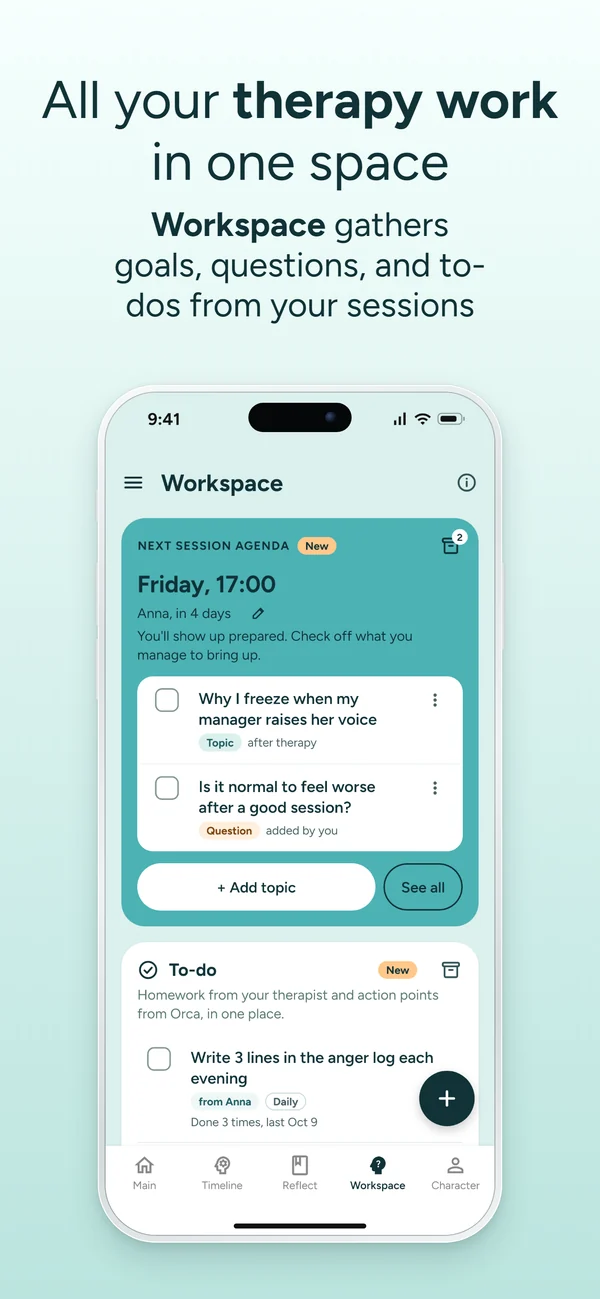
Workspace
Pin the pattern to your agenda for next time, with the dates attached, so it comes up first instead of by the door. Try it free in MindSync →
Catch the repeat when it happens, then bring it to your next session with the dates.


What's the thing you've noticed three times now and still haven't said out loud?
Frequently asked questions
How do I bring up a pattern I noticed without saying it's definitely a trigger?
Describe what you saw and leave the meaning open: "I've noticed this happens when that happens, and I'm not sure what it means." Two or three examples with dates do more than a label. You can leave the word "trigger" to your therapist, and if they use it, it's a conclusion you reached together.
How to bring something up in therapy?
Say at the start of the session that there's something you want to talk about, then say in one sentence what it is. You can read it from your phone or a note. It also helps to say what you need, for example: "I don't need an answer yet, I just want it said."
What to bring up in therapy?
Bring up the things that repeat, the reactions that surprised you with how strong they were, and the topics you keep steering around. One repeat with dates often makes a better topic than the worst day of the week. For the full picture, here's how to prepare for a therapy session.
How to bring up topics in therapy?
Bring topics up at the start of the session rather than the end, and pick one to focus on, with the rest written down for later. If a topic feels big, you can name it and come back to it: "I want to start on this next time." Your therapist can help you decide what to take first.
Keep more from every session
MindSync keeps your sessions and the week between them in one place, so your progress stops slipping away. The trial is free, no credit card needed.


Get the app