
Therapy
Taking a Break From Therapy Without Losing the Thread

Do any of these sound familiar?
- You've moved two sessions in a row "because of work," and you both know it isn't only work.
- Every month the same line on your bank statement looks back at you, and lately it looks a little smug about it.
- You're typing "I think I need a little break" to your therapist. You've spent twenty minutes choosing between "little" and "short."
If one of these was you this month, you're in very good company. The useful move now is to plan the pause, so you don't just drift into one.
Why you want a break (and why it feels like skipping school):
Some reasons are plain logistics. Money gets tight, you move cities, a new job eats your weekday evenings, exams show up, a baby shows up and nobody sleeps again. None of these need a defense speech.
Other reasons come from the therapy itself. The work is tiring, and if you regularly feel drained after therapy, a breather starts to sound like oxygen. Sometimes there's a plateau: weeks where you show up, talk, nod, and nothing seems to move. And sometimes things are going well and you want to see whether the tools hold without the safety net underneath.
The guilt has its own source. Somewhere along the way therapy got filed under "things a responsible adult should be doing," right next to flossing and backing up your phone. So a pause feels like skipping school, even though you're the one paying the tuition. In strength training, rest days are written into the plan, because that's when the muscle adapts.
Wanting a break doesn't make you a bad client, and it doesn't mean therapy stopped working. Check one thing, though: if "I need a break" really means "this person isn't right for me," that's a different conversation, and it's covered in when your therapist isn't the right fit.
Rest is part of the training too.
Taking a break from therapy: what a planned pause looks like:
Taking a break from therapy tends to happen in one of two ways: the drift or the planned pause.
The drift goes like this. You cancel one session, then another, and suddenly it's been three months and writing an email feels as awkward as texting an ex to ask for your hoodie back. It's very common and nothing to be ashamed of, but it leaves the work wherever it happened to fall.
The planned pause is one you agree on with your therapist ahead of time: you close the topic you're working on, decide what you'll keep practicing, set a date to check in, and name the signs that would bring you back sooner. It usually starts with one sentence said in session and ends with something as plain as "I'll email you in eight weeks."
A full stop isn't the only option, either. Some people switch to every other week or once a month for a while, and if cost is the reason, there are ways to make therapy more affordable worth checking first. If you're really deciding whether you're done for good, that's a separate question, and when to stop therapy walks through it.
On medication: a break from therapy is not a break from medication. If you take medication, any change goes through the person who prescribes it.
The difference between a pause and a disappearance is one conversation and a date in your calendar.
What research turned up:
In 2015, Erekson, Lambert and Eggett looked at records of more than 21,000 students at a university counseling center (Journal of Consulting and Clinical Psychology). Students seen weekly recovered faster than students seen about every two weeks, but by the end of therapy both groups had changed about the same amount. The honest caveat: this was observational data from one university, not a randomized trial. Still, rhythm seems to matter while the work is moving, so a pause in the middle of something hard probably costs momentum. That argues for choosing your moment well. It says nothing against pausing.
In 2007, Vittengl and colleagues pooled 28 studies with 1,880 adults treated with cognitive behavioral therapy for depression (Journal of Consulting and Clinical Psychology). Among those who had responded well, about 29% relapsed within a year and 54% within two years. Extra sessions after the main phase of treatment lowered the risk of relapse compared with simply monitoring people. This is about depression and CBT, not every therapy or every reason for a break. What it does show is that gains from therapy aren't frozen in place, which is a good reason to give a pause a return date, especially if depression is what brought you to therapy.
Then, in 2016, Kazantzis and colleagues pooled 17 CBT studies with 2,312 clients (Behavior Therapy). How much homework people did, and how well they did it, was linked to results at the end of therapy and at follow-up (the "how well" part rests on only three studies). The work you do between sessions, your therapy homework, is the part of therapy you can take with you on a break.
This is where the research runs out. We couldn't find a good study comparing planned breaks in talk therapy with continuous therapy. The studies cover session frequency, relapse and dropout, so the rest comes down to common sense and a conversation with your therapist.
Progress doesn't evaporate the week you stop. It just needs somewhere to live.
How to pause without losing the thread:
- Say it in session, not in a cancellation email. Try: "I'd like to take a break for a couple of months. Can we use the next session or two to plan it?" Your therapist has heard this many times, and it beats rewriting a cancellation email five times until it sounds casual.
- Close the chapter you're in. Ask what's worth wrapping up before the break and what's better left unopened in the last session. A pause after something has settled costs less than one in the middle of something raw.
- Pick a date and a few warning signs. Agree on a real check-in date, one with an actual day on it, because "at some point" has never once arrived. Then name two or three signs that mean coming back sooner, like sleep going off the rails for more than a week or old avoidance creeping back, and write them in your own words. If things get much worse during a break, or you're thinking about harming yourself, don't wait for your check-in date: call or text 988 in the US, or your local emergency number.
- Keep one thread running. Choose one thing to keep practicing (an exercise, a technique, a weekly note on how things are going) instead of trying to keep up everything. A few lines once a week, written or said out loud, is plenty. Think of the break as one very long stretch between sessions.
- Come back with a recap, not a blank. In your first session back, cover what happened, what worked, what came back and what you want now. Try: "Here's what happened during the break, and here's what I want to work on now." It helps to prepare for your first session back the way you would for any session.
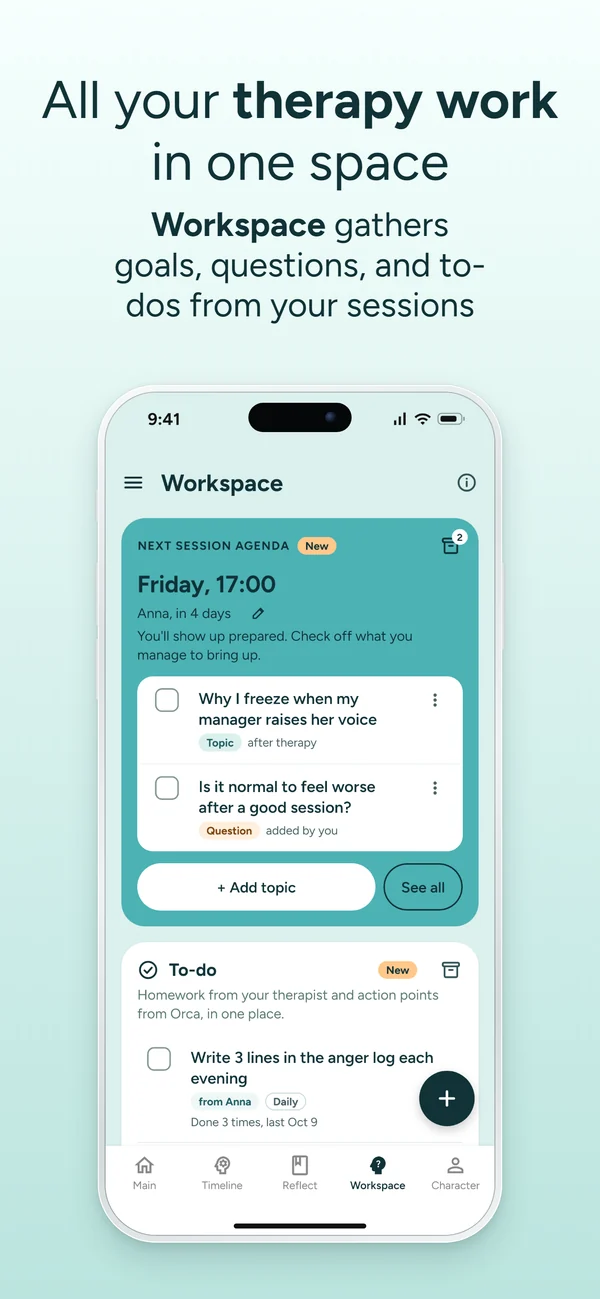
Workspace
Keep the one thread you're working on, the realizations worth keeping and your agenda for the day you go back, all in one place. Try it free in MindSync →
Where MindSync fits:
This is what MindSync's Workspace is for. Log the one exercise you kept doing, the week your sleep slipped, the thing you'll want to tell your therapist the day you're back. When typing feels like too much, say it out loud as a voice note. Give it time, and your Before therapy card turns what came up since your last session into a short summary and up to three questions to bring. Then open your first session back with the first one. MindSync won't do your therapist's job while you're away, and nothing in it goes to your therapist. It keeps the notes, so the work can pick up where it stopped.
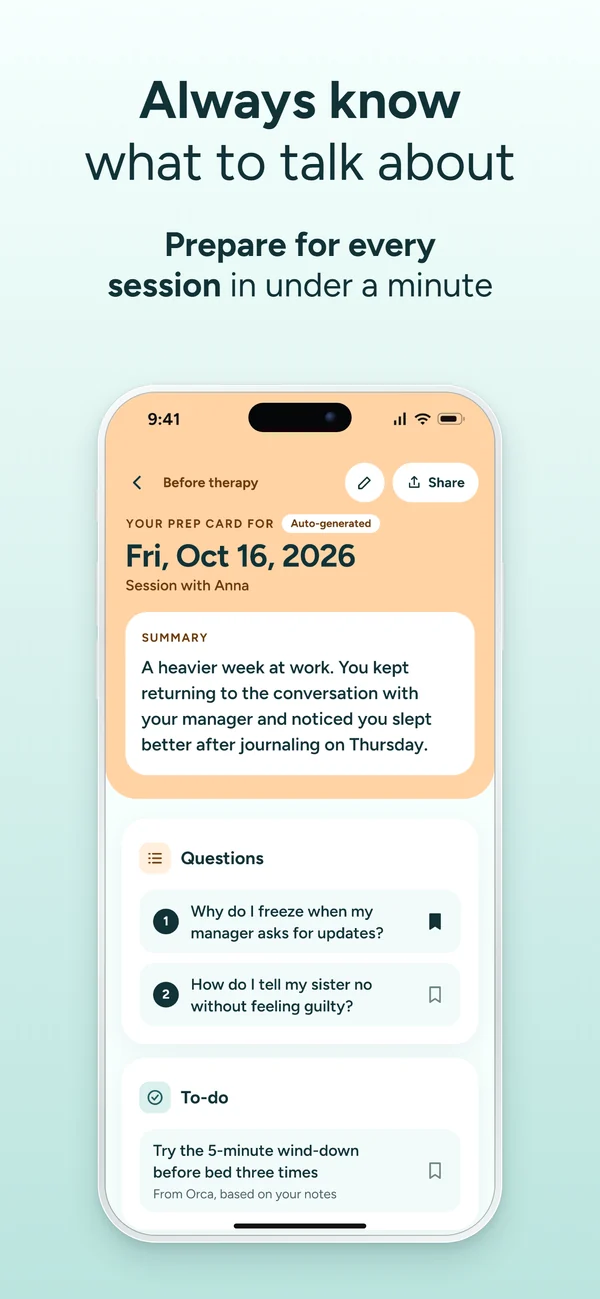
Before therapy card
Coming back after a break? The card turns what came up while you were away into a short recap and up to three questions for your first session back. Try it free in MindSync →
MindSync is free to download on iPhone and Android.


If you took eight weeks off starting tomorrow, what's the one thing you'd want to still be doing in week six?
Frequently asked questions
Is it okay to pause therapy?
Yes, it's okay to pause therapy. Breaks for money, a move, a busy season or plain fatigue are common, and they work best when you plan them with your therapist instead of just cancelling. Agree on a date to check in and on the signs that would mean coming back sooner.
How do you tell your therapist you want to pause?
Bring it up in a session rather than in a cancellation message. Say what you need and ask to plan it together, for example: "I'd like to take a break for a couple of months. Can we use the next session or two to plan it?" Therapists hear this often, and planning it together makes coming back easier.
How long should a therapy break be?
There's no standard length. It depends on why you're pausing and how things are going, so pick a check-in date with your therapist instead of leaving the gap open-ended. Come back sooner if your warning signs show up, and if things get much worse or you're thinking about harming yourself, call or text 988 in the US or your local emergency number.
How do I go back to therapy after a break?
Contact your therapist or the practice and say you'd like to restart. In the first session, tell them what happened while you were away, what worked, what came back and what you want to work on now. Therapists are used to this, and a short recap saves you from starting at zero.
Will I lose progress if I take a break from therapy?
Not necessarily. Skills you practiced don't disappear, but research on depression shows that gains can fade over time. That's why it helps to plan the break with your therapist: keep one thing you practice while you're away and agree on a date to come back.
Keep more from every session
MindSync keeps your sessions and the week between them in one place, so your progress stops slipping away. The trial is free, no credit card needed.


Get the app