
Therapy
The Price Tag Isn't the Only Door: How to Afford Therapy

It takes most people a long time to decide they want therapy. Months of "maybe I should talk to someone," a few late-night searches, one brave conversation with a friend. Then you open a therapist's website, find the fees page, and close the tab "for a minute." The minute lasts three months. Meanwhile the calculator on your phone gets opened more often than your calendar, and at some point you've worked out how many coffees one session costs (and concluded, grimly, that the coffees have to go too). Does any of that sound familiar?
Why does therapy cost what it does?
When you pay for a session, you're paying for an hour of a trained, licensed person's attention, plus a lot of time you never see: the notes written after you leave, supervision and training, licensing, insurance, and rent on a quiet room with a box of tissues in it. The hour is only the visible part of the job.
Insurance adds another layer. Billing a plan means paperwork and rates set by the insurer, and plenty of therapists opt out of it. In 2024, Jane Zhu and colleagues looked at 175,083 psychotherapists listed in the Psychology Today directory and published the results in Health Affairs Scholar: about a third of them didn't accept any insurance at all. If you want the numbers on what a course of therapy usually costs, they live in a separate piece. This one is about paying less.
Fun fact: in the US, if you don't have insurance or choose not to use it, you have a legal right to a written cost estimate before your care starts. It's called a Good Faith Estimate, it comes from the No Surprises Act, which took effect on January 1, 2022, and the American Psychological Association confirms it applies to psychologists. According to CMS, you may be able to dispute your bill if it comes in at least $400 above the estimate.
What "I can't afford therapy" usually looks like:
- You put off searching because you assume every therapist charges the highest rate you've ever seen.
- You go, but part of your brain runs a taxi meter during the session, pricing every silence by the minute.
- You cross someone off after reading their fees page, without ever asking whether they have a lower rate.
- You take a break "for a month," and the month turns into a year.
- You pick the cheapest option you can find and then feel you don't have the right to ask for anything better.
Call it what it is: arithmetic, done alone at 11 p.m. with the banking app open in the next tab. It has very little to do with how much you want to feel better.
What research turned up:
When SAMHSA looked at its National Survey on Drug Use and Health for 2009 to 2011, affordability was the most frequent reason adults with an unmet need for mental health care didn't get it, so you're far from the only one doing this math.
In 2016, Gary Burlingame and colleagues pulled together 25 years of studies that compared the same therapy delivered one-on-one and in a group, and published the analysis in Psychotherapy. When the method, the kind of patients and the number of sessions matched, the outcomes were equivalent. There was no difference in how many people accepted treatment, improved, recovered or dropped out. Group isn't therapy's budget version. For a lot of problems, it's the same therapy with more chairs.
That holds when the same treatment is compared, though, and a group isn't the right fit for every person or every problem. Whether it fits yours is a question for your therapist.
In 2020, Sanne Bruijniks and colleagues ran a trial in the Netherlands with 200 adults with depression and published it in the British Journal of Psychiatry. People were randomly assigned to one or two sessions a week of either CBT or interpersonal therapy. With two sessions a week, symptoms dropped faster and fewer people dropped out. So spacing sessions further apart to save money is a clinical decision as well as a financial one. It's one trial, in one country, about depression, and it's still a good reason to have that conversation with your therapist instead of deciding it alone.
How to afford therapy without giving up on it:
- Ask about a sliding scale out loud. Plenty of private practices keep a few reduced-fee spots and never advertise them. Try: "Do you offer a sliding scale, or do you keep any reduced-fee spots?" The question takes about four seconds, and nobody has ever been escorted out of a practice for asking it.
- Look where fees are lower by design. University training clinics, where trainees see clients under a licensed supervisor. Community mental health centers, which often set fees by income. Nonprofit networks like Open Path Collective: according to its own site in October 2026, members pay a one-time $65 fee and then $40-$70 per individual session, or $30 with a student intern. Check the current numbers yourself, because they change.
- Check what your job already pays for. Many employers offer an Employee Assistance Program with a small number of free, confidential counseling sessions. The phone number is usually somewhere in your benefits materials, so you don't even need a speech for HR.
- Talk about format and frequency with your therapist, not behind their back. Ask whether a group would work for what you're dealing with, or whether spacing sessions out makes sense at this stage. If you're trying to budget for the whole course, there's research on how many sessions change usually takes.
- Make each paid hour carry more. Walk in with one topic instead of a recap, so the 15 minutes you'd spend summarizing Monday through Sunday go to the work you're actually paying for.
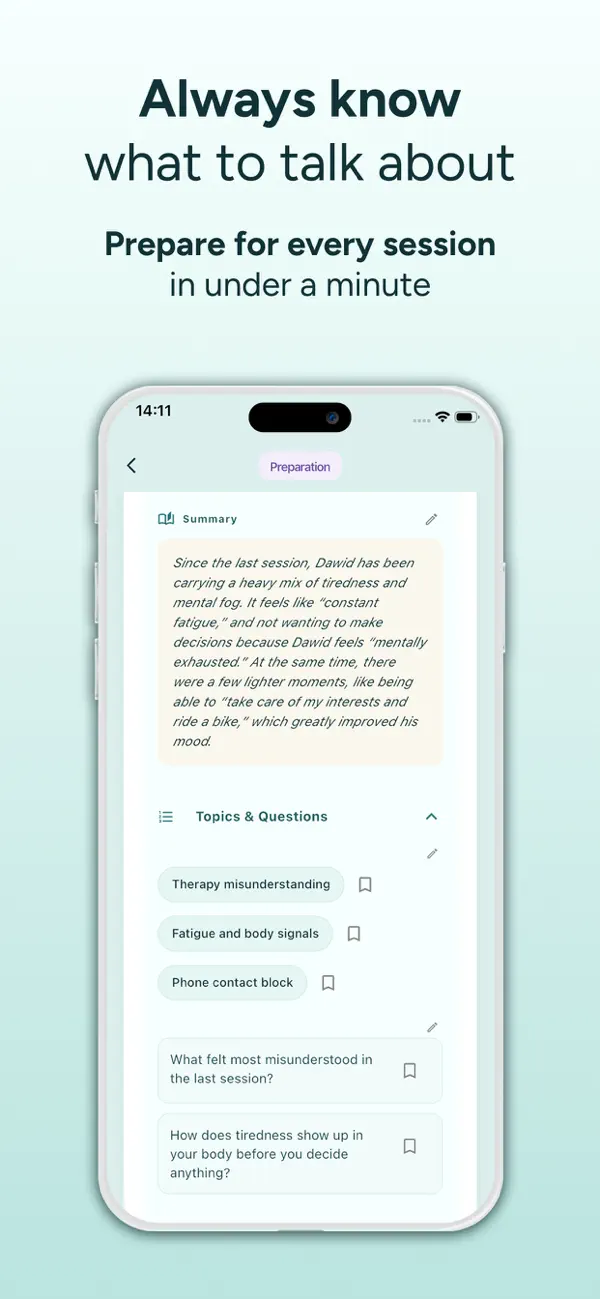
Prep Card
The topic you picked on Wednesday, waiting on one card when the paid hour starts, so the hour doesn't go on reconstructing your week. Try it free in MindSync →
If you have insurance, the first question is whether your plan covers outpatient mental health, and that deserves its own guide. Everything here is information, not financial or legal advice, and your plan or state may differ.
The cheapest session is the one you actually use.
MindSync was started by someone who spent about $130,000 on therapy over ten years, so the question of what each hour carries isn't abstract here. This is what MindSync's Prep Card is for. Log the one topic you can't stop circling, the question you want answered this week, and the moment this week it came up again. Give it time, and your Weekly & monthly summaries turn those entries into something you can read: what came up, month by month. Then walk into the next paid hour already at the point where the work starts.
Which of these have you never actually asked out loud?
Getting more from every paid hour
- Homework & to-dos - The thing you agreed to try lands on today's list, which is where cheap progress usually happens.
- Weekly & monthly summaries - A month of entries read back to you, useful when you are deciding with your therapist whether to change how often you meet.
- Workspace - Questions and threads you collect during the week, parked until the session instead of paid for twice.
Frequently asked questions
How can I afford therapy with no money?
With little or no money, start with places that set fees by income or offer free sessions: community mental health centers, university training clinics, and your employer's Employee Assistance Program if you have one. Availability depends on where you live, so call and ask what they offer right now. In the US, sliding scale practices and Open Path Collective are other lower-cost options.
What is sliding scale therapy?
Sliding scale therapy means the fee per session is adjusted to your income by the practice or clinic. Many therapists keep a limited number of reduced-fee spots and don't always advertise them, so you usually have to ask. Expect a question or two about your income, and know that those spots can fill up.
Can you ask a therapist for a lower rate?
Yes, you can ask a therapist for a lower rate, and it's an ordinary question for them. A simple version: "Do you offer a sliding scale, or do you keep any reduced-fee spots?" If they can't lower the fee, many therapists can point you to a colleague, a training clinic or a community center that can.
Is group therapy as effective as individual therapy?
For many problems, yes. A 2016 meta-analysis by Burlingame and colleagues in Psychotherapy, covering 25 years of studies, found equivalent outcomes when the same treatment, patients and number of sessions were compared in group and individual formats. Groups don't suit every person or every problem, so ask your therapist whether one fits your situation.
What is a good faith estimate for therapy?
A good faith estimate is a written estimate of what your therapy is expected to cost, which US providers must give you if you're uninsured or paying out of pocket. The rule comes from the No Surprises Act, in effect since January 1, 2022. According to CMS, you may be able to dispute a bill that comes in at least $400 above the estimate.
Keep more from every session
MindSync keeps your sessions and the week between them in one place, so your progress stops slipping away. The trial is free, no credit card needed.


Get the app