
Therapy
Is Therapy Worth the Money? How to Judge What You Are Getting

Seven months of weekly transfers, and you still cannot say what you bought. Something has shifted. Probably. That vagueness is the problem, because the price of therapy is a precise number and the value of it usually is not. One side of the equation is measured to the cent. The other side is a feeling on a Sunday.
What therapy actually costs (and why the number moves so much)
Start with somebody else's data. SimplePractice, a practice management company, published an analysis in March 2025 built on nearly 105 million therapy sessions billed during 2023 and 2024 by roughly 204,000 US behavioral health therapists. The average session came out around $139. The spread between states was wider than the average is useful: $122 in Missouri, $227 in North Dakota.
Grow Therapy, a US therapy platform, gives the version aimed at patients in its cost guide, updated June 2026: $100 to over $200 per session when you pay yourself, $0 to $50 when insurance is doing most of the work. Two views of the same market. What therapists charge, and what patients actually hand over.
Both are American numbers attached to an American insurance system. If you live somewhere else, the arithmetic below still works and the inputs do not transfer. Sliding scale fees, university training clinics, community mental health centers and group therapy all sit under those ranges, and the only way to find out what you qualify for is to ask, which is uncomfortable and takes about four minutes.
The number that matters is the course, not the session
Nobody buys one session. You buy a stretch of months, and the sticker price you keep quoting to yourself is the smallest unit of it.
An example, labeled clearly as an example. Take the US average of about $139 and 20 weekly sessions: roughly $2,800 across five months. The same 20 sessions at a $50 copay: about $1,000. At North Dakota's $227: over $4,500. Put your own numbers in. What matters is the order of magnitude. You are making a four-figure decision in weekly installments, which is the format in which people notice large sums least.
What the research says about how long that takes
The classic reference point is Howard, Kopta, Krause and Orlinsky, writing in American Psychologist in 1986. Pooling outpatient data, they described a curve with diminishing returns: about 30% of clients showed measurable improvement after two sessions, 41% after four, 53% after eight, and 75% by session 26.
Hansen, Lambert and Forman revisited the question in Clinical Psychology: Science and Practice in 2002 and landed on a rough consensus of 13 to 18 sessions for half of patients to improve. In carefully run clinical trials, between 57.6% and 67.2% of patients improved, across an average of 12.7 sessions.
Then they looked at routine care, and the picture changes. In a national database of more than 6,000 patients treated outside trials, the average number of sessions attended was under five, and roughly 20% improved. Be careful with that one before you draw a conclusion about therapy. Most of those people left long before the dose the trials delivered. It says at least as much about attendance as it does about treatment.
One thing belongs in anything that talks about paying for this: not everybody gets better, and a minority get worse. Cuijpers and colleagues pooled deterioration rates for depression treatments in the Journal of Affective Disorders in 2018 and found a median of 4% deteriorating in the therapy groups, above 10% in some studies. They also found deterioration was less likely in therapy than in the control conditions, and that only 6% of trials reported the number at all. Which is a decent argument for measuring your own.
There is a fuller method for that in how to know if therapy is working. This piece is about the money side of the same question.
The part nobody prices: the other 167 hours
A weekly 50-minute session is under 1% of your week. Nobody needs a study for that, and it is still the most useful number on this page, because the other 167 hours cost nothing and carry most of the load.
Kazantzis, Whittington and Dattilio pooled 46 studies covering 1,072 people in a 2010 meta-analysis in Clinical Psychology: Science and Practice. Comparing controlled studies that ran the same therapy with and without between-session tasks, the versions including homework came out ahead at d = 0.48. A moderate effect, generated entirely outside the room you are paying for.
That is the lever. You cannot change the hourly rate, and haggling over it is awkward and usually pointless. You can change how much of the week feeds into the hour. There is a whole rhythm for that in the week between sessions, which costs nothing.
How to raise the value of a session you already paid for
Come with one topic, not a week to summarize
The first 10 or 15 minutes of a session often go on a verbal news bulletin: what happened, who said what, how the week went. Some of that is necessary. Most of it is you warming up on billed time.
Pick one thing before you walk in. Write the opening sentence too, because that is the part that evaporates the moment you sit down. The mechanics are in come in with one topic instead of a summary of the week.
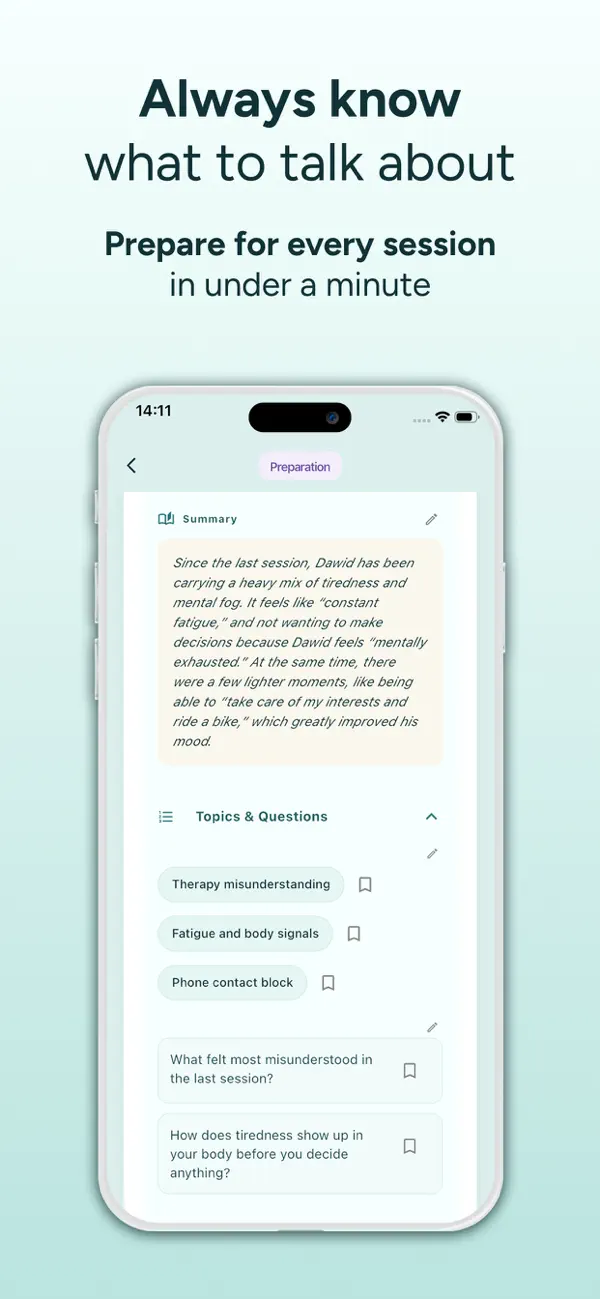
Prep Card
The prep card turns seven days into one screen, so the first 15 minutes stop going on a warm up you are paying for. Try it free in MindSync →
Leave with one thing to try
Before the session ends, ask what you should do with this during the week. Not as a formality. One specific action, small enough to survive your worst evening. If your therapist does not work that way, ask what you should pay attention to instead. Either answer turns an hour of talking into something the next seven days can act on.
Close the loop at the start of the next session
Report what happened with it, including the weeks when nothing did. "I did not do it, and here is what got in the way" is more useful than a clean report, because the obstacle is usually the material. It is also the cheapest quality control you have. It stops a course of therapy turning into 20 unconnected conversations.
How to judge value over a quarter, not over one bad session
A single session is a terrible unit of evaluation. You can leave a good one feeling wrung out and a mediocre one feeling relieved, and neither feeling knows anything about the trajectory.
Three months is a fairer window. Here is a version that costs about a minute a week:
- Pick three markers specific to what you came for. Not "mood". Hours slept, times you canceled on people, how often the argument in your head about your job ran.
- Rate them on the same scale at the same point in the week, whether or not the week went well.
- On the same date each month, write down how the month went before you look at the chart, then look at the chart.
- At the end of a quarter, compare it with the quarter before, and take the comparison into a session.
What that minute buys you is protection from your own recall. Ask yourself in December how March felt and you will answer from the last two weeks. Three tracked markers will contradict you where you are wrong, which is the entire point of them.
Weekly & monthly summaries
A monthly summary reads the month back to you, which is the only fair way to compare it with the one before. Try it free in MindSync →
If you want the longer version of this method, including which markers survive contact with a real life, it is in tracking that survives past week two.
When it is honest to say it is not worth it
Sometimes the answer really is no, and pretending otherwise is not respect for therapy. It is expensive politeness.
Signals worth taking seriously: a quarter with no movement on markers you chose yourself, no working plan you could describe out loud, the same conversation looping with no change of angle, a slow drift into a weekly debrief you enjoy and nothing more. None of these mean quit. They mean this belongs in the room.
Say it plainly. "I have been tracking three things since March and none of them have moved. What do you think is going on?" A therapist who can work with that question is worth staying with. What comes next might be a change of approach, a different frequency, a referral, or a rethink of what you are working on. If the conversation goes nowhere twice, choosing a therapist covers what to look for in the next one.
What should not decide it for you is a single hard week, a session that made you cry, or a bank balance you looked at on a Sunday night. Cost is a real constraint and a bad narrator.
Getting your money's worth
- Goals - What you came for, written down, with evidence collecting underneath it.
- Mood & focus-area trends - Months next to each other, not a feeling on a Sunday night.
- Workspace - The topics you flagged during the week, waiting for the next session.
MindSync was built by someone who spent roughly $130,000 on therapy across 10 years, largely because so much of what happened in those rooms leaked away before the next appointment. It does not make therapy cheaper and it does not replace it. It makes the hour you already paid for easier to use, and gives you something to look at other than a feeling. You can see what the free trial includes.
Frequently asked questions
How much does therapy cost?
In the US, roughly $100 to $200 per session out of pocket and $0 to $50 with insurance, according to Grow Therapy's cost guide updated in June 2026. A March 2025 SimplePractice analysis of nearly 105 million sessions put the 2024 average around $139, ranging from $122 to $227 depending on the state. Sliding scale, training clinics and group therapy run lower.
Is therapy worth the money?
It is worth it when you can show yourself it is, which takes three things: tracking a few specific markers over months, arriving with one topic instead of a week of news, and leaving each session with something to try. Not everyone improves and a small minority get worse, which is exactly why measuring beats guessing.
How many therapy sessions do I need?
Research on dose suggests roughly 13 to 18 sessions for half of patients to improve, according to Hansen, Lambert and Forman in 2002, with diminishing returns after that. Your number depends on what you came for and how the work goes. Ask your therapist for an estimate early, then revisit it out loud at three months.
Is online therapy cheaper than in person?
Often, though not always, and the gap is smaller than people expect. Rates depend more on the clinician's license, experience and state than on the medium. Online widens your options past your own neighborhood, which can find you a cheaper clinician, and platform pricing varies a lot. Compare the total course, not the headline session price.
How do I get more out of each therapy session?
Arrive with one topic and the first sentence already written, ask for one thing to try before you leave, and open the next session by reporting what happened with it. Meta-analyses of between-session tasks in cognitive behavioral therapy, including Kazantzis and colleagues in 2010, find better outcomes when therapy includes work done outside the room.
Keep more from every session
MindSync keeps your sessions and the week between them in one place, so your progress stops slipping away. The trial is free, no credit card needed.


Get the app