


Therapy
When Your Therapist Hurts Your Feelings: Bring It Back Into the Room

When your therapist hurts your feelings, the most useful move is usually to tell them, early in your next session, what they said and how it landed. Hurt inside therapy is common and often repairable, and a good therapist will want to know. Write it down first, so a week between therapy sessions doesn't shrink it to "it was nothing".
Do any of these sound familiar?
- You were talking about your dad, properly, for the first time in months, and your therapist glanced at the clock. The most-watched clock in America, and it picked that moment.
- They laughed at something that wasn't a joke. Or, three months in, called your sister "your brother". (Here's what's going on when your therapist forgets something you told them.)
- You rehearsed "I need to tell you something" nine ways in the shower. In the room you said, "Good, thanks, you?"
"My therapist hurt my feelings" is a sentence people type at midnight. It makes sense that it stings here of all places, and it doesn't make you too sensitive for therapy.
Why one comment can land so hard:
In therapy you're less guarded than almost anywhere else, and the person across from you knows exactly where the sore spots are, because you showed them. So how much it hurts depends less on how heavy the words were and more on where they landed.
Then there's the expectation. This is the one relationship where someone is literally paid to pay attention to you. So when they slip, the slip reads as proof: even here, I'm too much. A canceled session can land the same way (more on that when your therapist goes on vacation).
And old patterns walk into the room with you. If the comment sounded like someone from your past (clinicians call this transference), you're reacting to that person and to this moment at the same time. It's like a bruise you'd forgotten about: fine until someone presses on it, and then it hurts for every time it was pressed before.
It hurts because it matters. That's also why it's worth saying.
What it looks like from your side:
Researchers Jeremy Safran and Christopher Muran call a strain or break in the working relationship between you and your therapist a rupture, and they described two broad shapes it takes (a rating system their team published in 2019 in Psychotherapy Research still codes it this way). The labels are theirs, the examples are everyday ones:
- Withdrawal. You agree too fast, change the subject, get unusually pleasant. You "forget" to book the next session. You've drafted the breakup email three times and the subject line twice.
- Confrontation. A sharp tone, a bit of sarcasm, a long message at 11:40 p.m., criticism of their method instead of saying what hurt.
If you've been asking yourself "why am I angry at my therapist?", anger like this is common, and on its own it isn't a problem. It's information about what landed.
Going quiet is still saying something. Just not out loud.
What research turned up:
In 1992, Regan and Hill asked clients and counselors in short-term therapy to note, after each session, what they had thought or felt but not said (Journal of Counseling Psychology). Clients often kept negative reactions to themselves, and counselors noticed little of it. Which means your therapist probably doesn't know.
In 1994, Rhodes, Hill, Thompson and Elliott asked clients to look back on feeling misunderstood in therapy (Journal of Counseling Psychology). Across 19 cases, the misunderstandings that got resolved went with clients willing to voice their negative feelings and therapists who stayed flexible and accepting. The unresolved ones went with therapists who didn't take up the client's reaction or didn't notice it, and those clients often ended therapy. Saying it out loud came with no guarantee of a fix, but it gave both of you something to work with.
In 2016, Blanchard and Farber surveyed 547 adults in therapy about what they don't tell their therapist (Counselling Psychology Quarterly). Pretending to like the therapist's comments was one of the common lies about therapy itself, and wanting to be polite or not to upset the therapist was a typical reason. Being nice is one way hurt stays unsaid.
A 2018 meta-analysis on rupture and repair (repair meaning the two of you notice the strain and work through it together) points the same way, and its numbers are in the piece on whether it's one moment or the wrong fit.
The honest caveat: these studies are small, some are over 30 years old, the 2016 survey was online with volunteers, and "rupture" gets measured in different ways. They show links, not causes, and nobody knows which way of bringing it up works best. Which is good news, in a way: you don't need a lab-tested sentence, just the subject back in the room.
A rupture you talk about is a different thing from one you carry.
What to do when your therapist hurts your feelings:
Think of it as a plan for the week between therapy sessions, in this order:
- Write down the moment within a day. The exact words, what you felt, what you did after. A week later, memory tends to either shrink it ("it was nothing") or add to it ("they clearly don't like me"), and neither version is the one you want to bring in.
- Let the first wave pass before you send anything. The 11:40 p.m. message rarely says what you mean (mostly it says it's 11:40 p.m.). If you do write before then, keep it short and save the content for the room: "Something from last session stayed with me. I'd like to start with it on Thursday." Whether and when your therapist reads messages depends on their practice.
- Pick your opening sentence. "Something you said last time stayed with me, and I want to talk about it." "When you said [their words], I felt dismissed. I don't think you meant it that way, but I'd rather tell you than carry it around." "I'm a bit angry with you, and I'd rather say it than go quiet." The same works for anything hard you need to tell your therapist: say that it's hard, then say it.
- Put it first, not in the last five minutes. The last five minutes of a session are the traditional home of "oh, and one more thing", which then gets exactly zero minutes. Open with it instead; it's part of how you prepare for your next therapy session. And if your mind goes blank in the room, read it off your phone. That counts.
- Watch what happens over the next two sessions. A good response looks like curiosity, owning their part, and coming back to it later. A defensive response, or a pattern instead of a one-off, is a bigger question than one comment, and there's a guide for if you decide to switch therapists. The repair session itself can be tiring, too (here's why you can feel worse after a hard session).
You don't need the perfect sentence. You need the first one.
When it isn't a rupture:
An awkward comment, a forgotten detail or a wrong interpretation is a rupture you can talk through. Sexual or romantic contact, pressure to be friends outside therapy, sharing your information without consent (outside the legal exceptions), humiliation, discrimination, harassment or showing up intoxicated are something else: an ethics issue, not something to work through together. In the US, therapists are licensed by a state licensing board for their profession, and you can usually check a license and file a complaint on that board's website. On an online platform, report it there too. This isn't legal advice. If you ever feel unsafe, call or text 988 in the US, or 911 in an emergency.
Where MindSync fits:
This is what MindSync's Therapy relationship check is for. Answer it over a few sessions, ideally not on the night after the one that stung. Between therapy sessions, log the sentence that hurt, what you did after (went quiet, almost canceled, deleted the 11:40 p.m. message) and how the next session felt. Give it time, and the check shows how therapy itself is going over those weeks, so the verdict isn't left to one bad Thursday. Then pin "the thing from last week" to your agenda in Workspace, so it comes up first next time.
Therapy relationship check
A short check-in on how therapy itself is going, answered over a few sessions, so one bad Thursday doesn't decide for you. Try it free in MindSync →
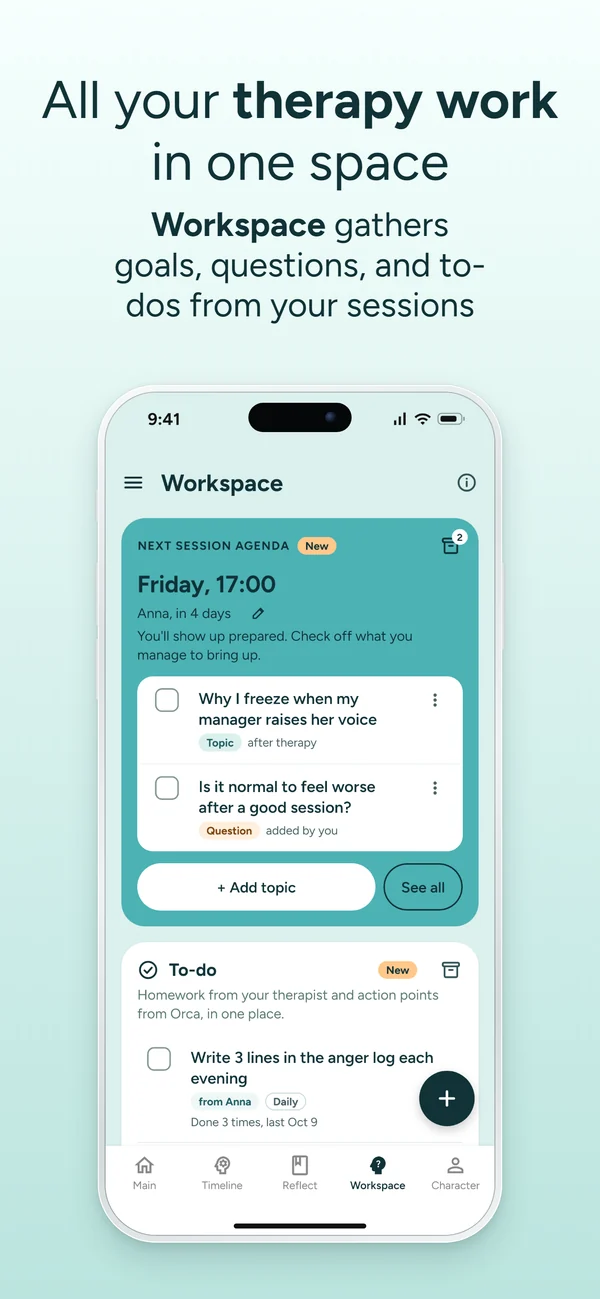
Workspace
Pin "the thing from last week" to your agenda for next time, so it comes up first instead of in the last five minutes. Try it free in MindSync →
Keep the moments worth bringing up in one place, between therapy sessions.


What's the sentence you've been saving for the right moment?
Frequently asked questions
Why am I angry at my therapist?
Anger at a therapist is common, and it usually means something specific stung or the relationship touched an old sore spot. It doesn't prove therapy isn't working, and it doesn't mean something is wrong with you. Bring it to the session in one sentence: "I'm a bit angry with you, and I'd rather say it than go quiet."
How to tell your therapist something hard?
Say that it's hard before you say it, and bring it up at the start of the session, not at the end. You can read it from a note or your phone. It also helps to say what you need from them, for example: "Please just listen first."
Do I tell my therapist everything?
You don't have to tell your therapist everything at once. The pace is yours, and "I'm not ready to talk about this yet" is a complete answer. Things you keep quiet about the therapy itself, like a comment that hurt, are hard for a therapist to guess, though. Confidentiality has legal limits your therapist should explain at the start, so if you're not sure where they are, ask.
How to tell your therapist it isn't working?
That's a different conversation from one moment that hurt. Start with something specific you're missing, not with a verdict, for example: "I'm not sure we're working on what matters most to me." There's more on telling a bad week from a bad match in the piece on when your therapist isn't the right fit.
Keep more from every session
MindSync keeps your sessions and the week between them in one place, so your progress stops slipping away. The trial is free, no credit card needed.


Get the app