
Therapy
What to Do When Your Therapist Is on Vacation (and Why Two Weeks Feels So Long)

When your therapist is on vacation, give the gap a shape before it starts. In the last session before they leave, say out loud that the break means something to you and agree on one small thing to keep doing. Give your usual hour a job, write down what you'd have said, and bring that list to your first session back.
Do any of these sound familiar?
- At the end of a session, your therapist says "I'll be away the last two weeks of December" in the voice people use for the weather. You say "Oh, nice, enjoy!" and somewhere between the door and the car, something drops into your stomach.
- Thursday, 5 p.m. The hour that usually has somewhere to go. You sit there with your phone in your hand, not sure what to do with it.
- You catch yourself running a whole session in your head. With her. She even answers.
If two weeks without therapy feels bigger than two weeks, that doesn't mean something is wrong with you or with your therapy.
Why a two-week gap can feel like a month:
Feeling unsettled when your therapist is on vacation is common, and it tends to come from two places. The first is the anchor. The weekly session is a fixed point where things get put down: the argument from Sunday, the thought you couldn't finish, the small win nobody else would understand. When the hour disappears, none of that has anywhere to land, so it keeps circling. It's like someone taped over your mailbox for two weeks. The letters keep coming. They just pile up on the doormat.
The second is the relationship, and it's a real one. Someone listens to you regularly without judging, and a pause in that can brush against older experiences with people who weren't there when you needed them. If your patterns lean toward anxious attachment, the gap may simply feel louder.
And some people feel relief. Therapy is hard work, it costs money, and a few weeks off can feel like breathing out. Missing your therapist and feeling relieved are both normal, and neither one tells you whether therapy is working.
Fun fact: attachment to a therapist is common enough that in 1995 researchers built a questionnaire just to measure it, the Client Attachment to Therapist Scale.
You're not overreacting to a vacation. You're reacting to a missing anchor.
What it can look like while they're away:
- You keep saving things "for Thursday," and Thursday isn't coming.
- You hold conversations with your therapist in your head, or wonder what they'd say about the thing that just happened.
- You feel a flash of resentment ("she's at the beach and I'm here"), followed right away by shame about the resentment.
- You drop what you agreed on, the exercises and the check-ins, because nobody is going to ask anyway.
- You check whether your therapist has a public Instagram, find one, and close the app as if it had caught fire.
- Or the opposite: a strange calm, and a question you didn't expect, about whether to go back at all. That one is worth bringing to the first session rather than settling alone (and if you're wondering about a break of your own, that's a separate decision).
The work keeps running through all of this, just without a room.
What research turned up:
The scale from that fun fact came from Mallinckrodt, Gantt and Coble in 1995, in the Journal of Counseling Psychology. It describes different ways clients attach to their therapists, including secure and more preoccupied patterns. So the pull you feel toward your therapist has had its own questionnaire for more than 30 years.
In 1999, Knox, Goldberg, Woodhouse and Hill, in the same Journal of Counseling Psychology, interviewed 13 adults in long-term individual therapy about how they carry their therapist around inside them. People described a mix of the therapist's voice, an image and a sense of their presence. These inner representations showed up when clients thought about sessions or were going through something hard, and clients used them to keep working on therapy outside the room. Over the course of therapy they came more often and felt more comfortable. Few clients had ever mentioned them to their therapists. The honest caveat: this is 13 people in one qualitative study. Still, the session you ran in your head on the bus is, in research terms, a fairly ordinary part of the process.
In 2011, Hartmann, Orlinsky and Zeeck, writing in the Journal of Clinical Psychology, asked clients about their experiences between psychotherapy sessions and found that some kinds were linked to the strength of the therapeutic alliance. So what goes on in your head on a Tuesday night and what happens in the room seem to be connected.
Here's where the research runs out: there is almost no work on how therapist vacations themselves affect clients, and most of what's written about breaks comes from clinicians' own experience. That's good news, in a way. There's no correct reaction you're supposed to be having, so whatever comes up is information to bring to your next session, not a test to pass.
The sessions pause. The relationship doesn't.
Your therapist on vacation, and a plan for before, during and after:
A therapist on vacation is easier to get through when the gap has a shape.
- Bring the break up before it starts. When your therapist is going on vacation, say in the last session before they leave that it means something to you, even if it sounds silly out loud. Try: "I know it's just two weeks, but it's bringing up more than I expected. Can we talk about that today?" Ask the practical questions too: whether someone covers for them, and whether to message your therapist between therapy sessions while they're away.
- Agree on one small thing to keep going. One, not a rescue plan for your whole life: a short daily check-in, one exercise, one note a week. Ask: "If there's one thing you'd want me to keep doing while you're away, what would it be?" The plan where you meditate twice a day, journal every evening and finally read that attachment book usually dies on day two, somewhere around lunch (important: that's not a character flaw, that's just two plans too many).
- Give the empty hour a job. At your usual session time, take a walk and record a voice note about what you'd have said today, or write for 20 minutes. If your body is wound up, here are some ways to calm your nervous system between therapy sessions. If it's a therapy break over the holidays, when everything gets louder (family, loneliness, the end of the year), the first two steps matter even more.
- Write down what you'd have said, not just how you felt. The situation, the thought, the question. A list like that turns the gap into material, and it's half of what you need to walk into the next session prepared. For the ordinary weeks, here's more on what to do between therapy sessions.
- Make the first session back about the gap, too. Tell them how it went, anger and relief included. Try: "Before we pick up where we left off, can I tell you how the break went for me?" The first session after a pause can stir things up, so feeling worse after a session that day doesn't automatically mean you've gone backward.
If things get really heavy while your therapist is away, you don't have to wait for them: call or text 988 in the US, and if you're in danger, call 911.
A gap with a plan is a pause. A gap without one is just waiting.
Where MindSync fits:
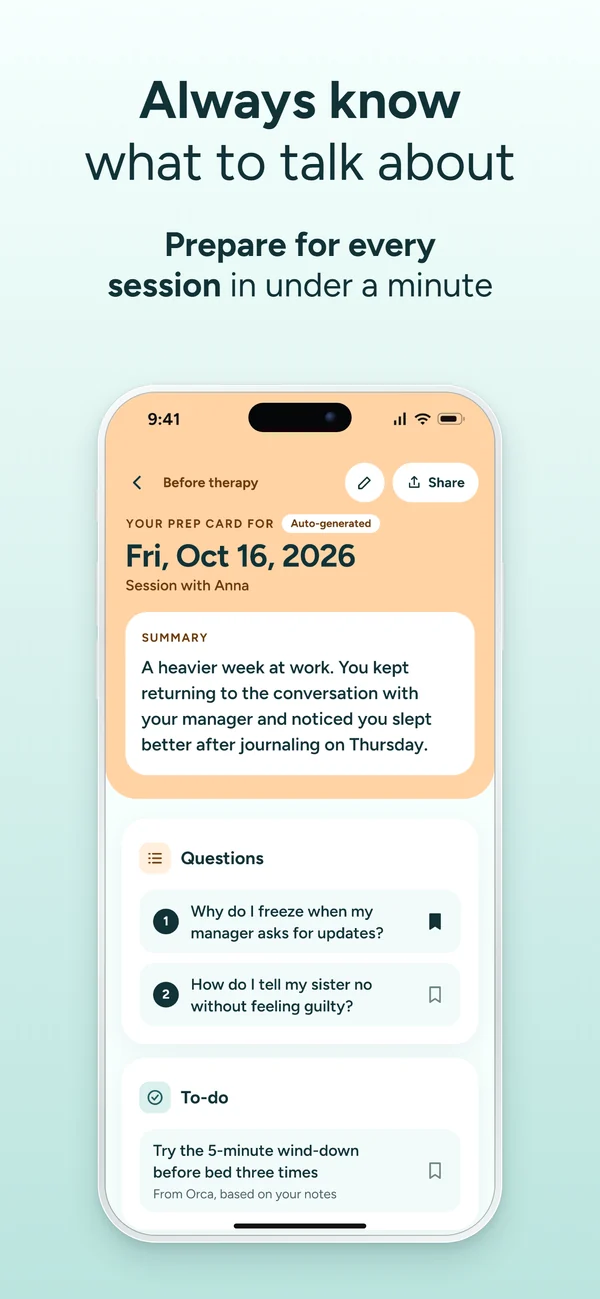
This is what MindSync's voice notes are for. Log it out loud: the thing you'd have saved for Thursday, the moment you got angry that she's at the beach, the conversation you finished with her in your head on the bus. Give it time, and the Before therapy card turns everything since your last session into a short summary and up to three questions to bring, so your first session back starts with the two weeks you actually had, not a blank "so, how were the holidays?" Then walk in with it. MindSync doesn't replace your therapist while they're away; it keeps what came up so none of it gets lost.
Voice notes between therapy sessions
When something comes up and Thursday is two weeks away, say it out loud. It's transcribed, you check the text, and it's there when your therapist is back. Try it free in MindSync →
Before therapy card
Before your first session back, the card gathers what came up during the break into a short summary and up to three questions to bring. Try it free in MindSync →
Keep what comes up while your therapist is away.


If your therapist asked how the break went, what's the part you'd be tempted to leave out?
Frequently asked questions
Is it normal to miss your therapist?
Yes. Therapy is a real relationship with someone who listens to you regularly, and a 1999 interview study in the Journal of Counseling Psychology found clients carrying an inner image or voice of their therapist between therapy sessions, especially when things were hard. Missing them says the relationship matters, not that something is wrong. You can say it out loud in your next session.
Why do I feel anxious when my therapist is on vacation?
The weekly session is a fixed point where things get put down, and without it they pile up with nowhere to go. A break can also touch older experiences of people who weren't around when you needed them. Anxiety, anger and relief are all common reactions while your therapist is on vacation, and none of them tells you whether therapy is working.
What should I do when my therapist is on vacation?
Plan the gap before it starts: talk about it in the last session, agree on one small thing to keep doing, give your usual session hour a job, and write down what you'd have brought. Start the first session back with how the break went. If you feel unsafe at any point, call or text 988 in the US instead of waiting for them to come back.
Should I see another therapist while mine is on vacation?
For a short break, usually not, but ask before they go whether someone covers for them. A covering therapist is typically there for urgent needs rather than to continue your work, and starting from scratch with someone new for two weeks is rarely worth it. If you're unsure, decide it together with your therapist in the session before the break.
How do I tell my therapist their vacation upset me?
Say it simply and early in the session, as information rather than a complaint, for example: "I know it's silly, but your break was harder for me than I expected." It gives your therapist something useful to work with, and it isn't an accusation. If saying it feels too hard, write it down beforehand and read it out.
Keep more from every session
MindSync keeps your sessions and the week between them in one place, so your progress stops slipping away. The trial is free, no credit card needed.


Get the app