
Therapy
Do Therapists Remember What You Tell Them? The Shape, Yes. The Sister's Name, Maybe.

Do any of these sound familiar?
- You say "my sister", and your therapist asks, "Remind me, is that the older one?" She's your only sister. You've been talking about her since March.
- Something that took you weeks to say out loud comes back three sessions later as a question, as if you'd never said it.
- Your therapist remembers your cat's name. Your boss's name, not so much. Priorities, apparently.
If one of these stung a little, you're in good company. And the answer is a lot kinder than "they weren't listening."
How do therapists remember everything? Mostly, they don't have to:
A therapist's memory works like anyone's. It holds on to meaning, patterns and emotional weight far better than dates, names and the order things happened in. Think of a taxi driver who has worked the same city for 20 years. They know how the streets connect, which bridge jams at five and which shortcut is worth it. Ask them for the house number of every building on a street, and they'll look at you like you asked for their PIN.
That's why notes exist. In the US, there are two kinds. Progress notes go into your official record: session dates, symptoms, the treatment plan, how things are moving. Psychotherapy notes are something else. Under the HIPAA Privacy Rule (the definition sits in 45 CFR 164.501, on Cornell Law School's site), they're a mental health professional's notes on what was said in a session, kept separately from the rest of the record. It's common for therapists to skim their notes before you walk in. If yours ever seemed to remember everything, those quiet few minutes before the session probably had something to do with it.
Fun fact: remembering what clients say looks like a skill that grows with practice. In 2013, Nagaoka and colleagues in Japan had experienced counselors, novice counselors and people outside the profession watch videotaped interviews, then write down everything they could remember the client saying (Psychologia). The experienced group recalled the most, and they recalled different things. The groups were tiny (only four experienced counselors), so treat it as a hint.
Do therapists remember what you tell them? What sticks and what slips:
Mostly, yes, just not the way a recording does. What usually stays: your patterns, what moves you, the goals you came in with, the people who matter most, how you've changed since the first session. What usually slips: the names of supporting characters (the coworker who came up once), dates, who said what in the argument, anything you mentioned only in passing. So if you're wondering whether it's normal for a therapist to forget things from that second list, it often is.
The line sits somewhere else. A forgotten detail here and there is common, and it doesn't mean they weren't listening. A forgotten important thing, something hard you finally said, can hurt, and you're allowed to say so. If important things keep going missing week after week, even after you've raised it, that's worth a conversation, and it may tell you something about when your therapist is not the right fit.
What research turned up:
In 2009, Schröder, Wiseman and Orlinsky surveyed 1,040 therapists in the US, Canada and New Zealand about how often their patients were on their minds between sessions, in thoughts and in feelings (Psychotherapy Research). The paper is titled "You were always on my mind," which tells you a fair amount already. How often those between-session experiences came up was most strongly tied to how much difficulty therapists were having in their practice overall. So yes, therapists do take clients home with them, in their heads. Not as an archive to search, more like the cases that are still occupying them.
In 2015, Miriam Creaser compared therapists' process notes, written from memory shortly after sessions, with audio recordings of the same sessions, in a doctoral study at the Tavistock and Portman. She looked at nine sets of notes and recordings from three child and adolescent psychotherapists. The notes didn't match the recordings, and the differences weren't random: they fell into patterns linked to what was going on between therapist and patient. Even a careful therapist writes down their version of a conversation, not a transcript.
The honest caveat: nobody has measured, on a large sample, how much of a session therapists actually forget. What we have are small studies of memory and notes, so this is a picture, not a number.
What to do when your therapist forgets, or before they can:
- Open with a 30-second recap. "Last time we talked about my sister and the wedding. This week, she called." It hands your therapist the thread before they have to go looking for it, like the "previously on..." bit before a TV episode, minus the dramatic music. It's also the simplest way to prepare for a therapy session, and it helps on the days when your mind goes blank.
- Say it when something important got lost. Try: "I told you about this a few weeks ago, and it mattered to me. Can we go back to it?" You don't need to apologize for it.
- Ask how they keep track. "Do you take notes during or after our sessions? Is it okay if I bring my own?" It's a perfectly ordinary question. Some therapists write during the session and others wait until you've left, and neither tells you how closely they're listening. And if you've caught yourself wondering what your therapist is writing down while they scribble nonstop, no, it's probably not a novel about you.
- Carry the details yourself. Names, dates, the homework from last week. Your therapist can hold the shape of your story, and the small pieces travel better with you. Here's how to remember what you talked about in therapy.
- Watch the pattern, not the slip. One forgotten detail is a human being. The same important topic going missing every week, after you've said it matters, is a conversation about fit, and sometimes the first step toward starting over with a new therapist.
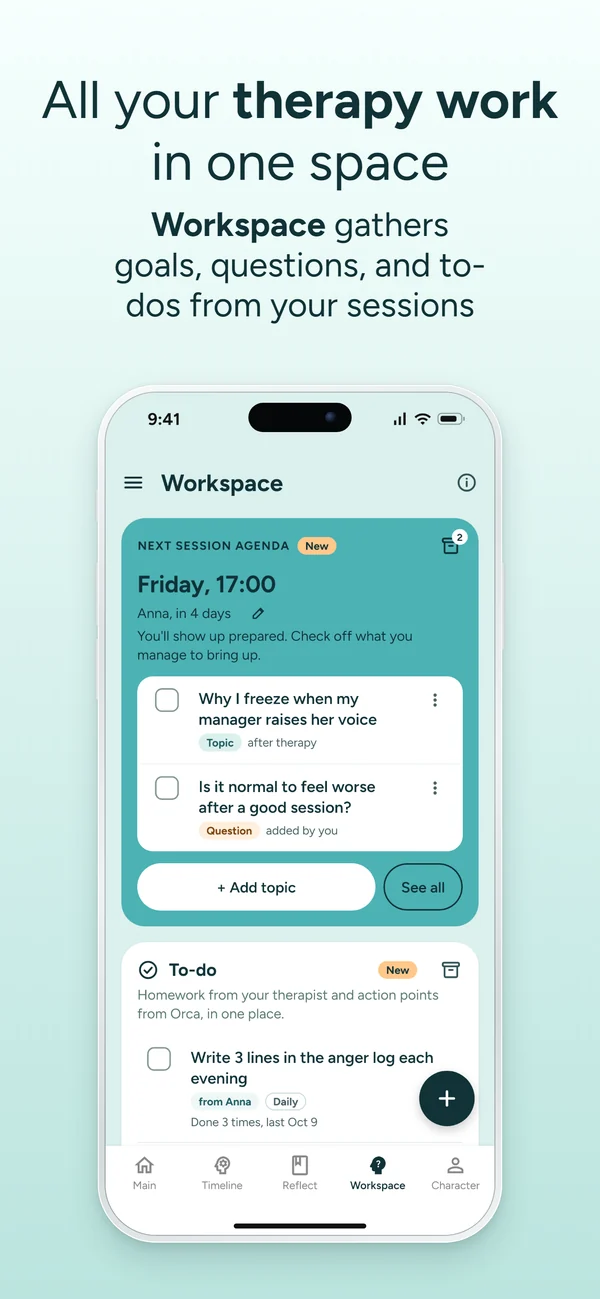
Workspace
Keep the threads, names and to-dos from therapy in one place, so the details don't depend on anyone's memory. Try it free in MindSync →
Where MindSync fits:
This is what MindSync's Workspace is for. Log the thread you keep pulling on, the name of the coworker who keeps coming up, the thing you finally said three weeks ago. Give it time, and your Before therapy card turns what came up since last time into a short summary and up to three questions to bring. Then, at the start of your session, take out your phone and read the first one out loud. Your therapist never sees the app. You're the one who brings it into the room, in your own words, and the hour itself stays yours.
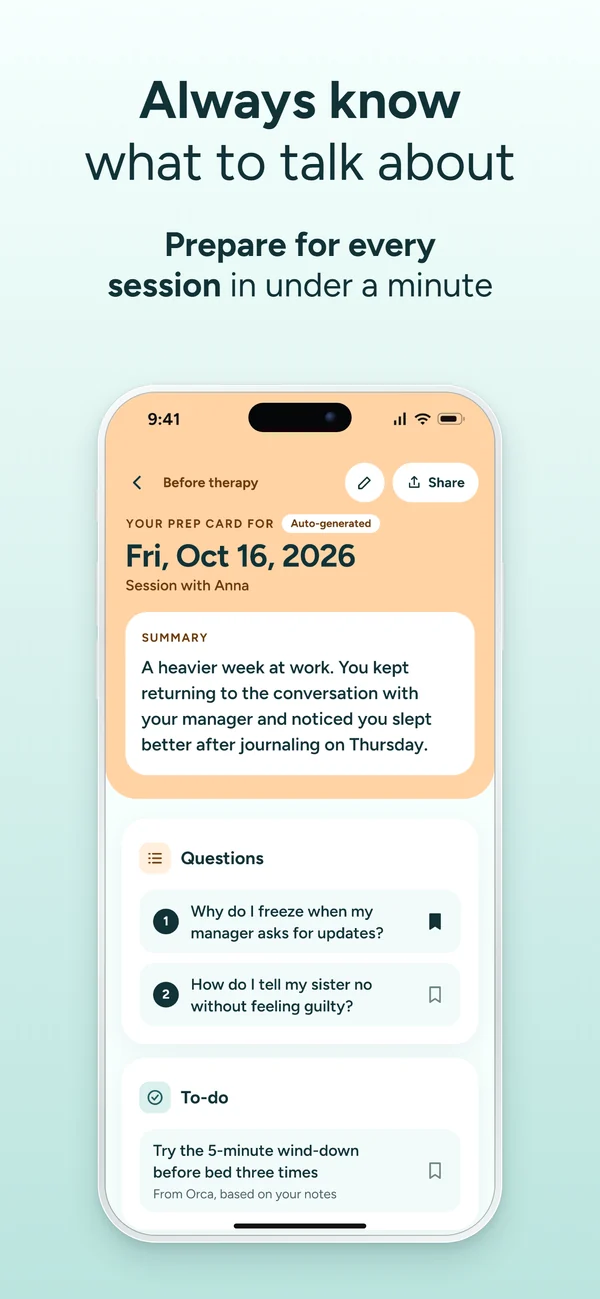
Before therapy card
A short recap of what came up since last time, ready to read out at the start of the hour. Try it free in MindSync →
Leave the shape of the story to your therapist and keep the sister's name on your phone.


If your therapist could remember only one thing about you, what would you want it to be?
Frequently asked questions
Do therapists remember what you tell them?
Mostly, yes. Therapists tend to remember the big picture of what you tell them: your patterns, your goals and the people who matter to you, and many look over their notes before a session. Small details like names, dates or something you mentioned once can slip, the same way they would for anyone. If something important gets lost, it's fine to say so.
How do therapists remember everything?
They don't, and they don't need to. Therapists keep notes and often skim them before you arrive. In the US there are two kinds: progress notes in your official record (dates, symptoms, treatment plan, progress) and psychotherapy notes, the therapist's own notes on what was said in a session, kept separately from that record.
Is it normal for a therapist to forget things?
Forgetting the occasional detail is normal. Therapists are people with a full caseload and an ordinary human memory. Forgetting something important you shared is worth raising calmly: "I told you about this a few weeks ago, and it mattered to me. Can we go back to it?" If important things keep slipping after that, it's a fair question about fit.
Do therapists take notes during sessions?
Some do, many write right after the session, and some do a bit of both. It comes down to the therapist's style and training rather than one rule, and it says little about how closely they're listening. You can simply ask: "Do you take notes during or after our sessions?"
Do therapists think about their clients between sessions?
Many do. In 2009, Schröder, Wiseman and Orlinsky surveyed 1,040 therapists in the US, Canada and New Zealand about their thoughts and feelings about patients between sessions, and how often those came up was most strongly tied to how much difficulty the therapists were having in their practice. The study can't tell you whether your therapist thinks about you on a Tuesday evening, but it does show the work doesn't always stay in the office.
Keep more from every session
MindSync keeps your sessions and the week between them in one place, so your progress stops slipping away. The trial is free, no credit card needed.


Get the app