
Therapy
You Don't Have to Start From Zero: Starting Over With a New Therapist

Do any of these sound familiar?
- You're telling the story of your childhood for the third time in your life, starting from the day you were born, with the same footnotes in the same places.
- You catch yourself saying "my old therapist used to say..." and realize it sounds a lot like bringing up your ex on a first date.
- The new person asks, "So, what brings you here?" and part of you wants to hand over a binder and go get a coffee.
Starting with a new therapist can feel like rewatching a series you already know by heart. You don't have to start from zero, though. Most of the trick is knowing what to carry over.
Why the first sessions feel like a rerun
A new therapist has to build their own picture of you. They'll ask what brought you in, about your history and your goals, and whether you're safe, because they can't work from somebody else's impression. That's good practice. It's also tiring when you've already walked that road once, and impatience in the first few sessions is an understandable reaction.
Comparison adds to it. Whether you mean to or not, you'll measure the new person against the old one, and the scoring isn't always fair. Sometimes the old therapist gets remembered as wiser than they were, and sometimes the new one gets credit just for not being the person you left.
Fun fact: in clinical writing you'd be called a "transfer client," and the awkwardness runs both ways: researchers have also studied what it's like for therapists to take over someone else's client.
None of this makes the early sessions wasted time. The bond with a new therapist starts forming early, which is why the first few sessions matter so much. The rerun is for their benefit, and it gets shorter when you bring notes.
Starting over with a new therapist, in real life:
- You summarize your last therapy for 20 minutes, or you don't mention it at all.
- You leave out what didn't work, because it feels like gossiping about someone who isn't there to defend themselves.
- You assume the new person already knows everything from your records.
- You bring the exact topic that got stuck last time, half hoping and half testing whether this one will do better.
- You feel relief and guilt at the same time, sometimes in the same sentence.
What's worth telling, and what can wait
Four things earn a place in the first sessions: what worked last time, what didn't, what you already know about your patterns, and what you need now. "I already know I go quiet when I'm angry" can save a lot of circling. So can "I need you to push me more." Your full life story can wait. It'll come out in pieces, when it's relevant, and that's usually when it's most useful anyway.
What research turned up:
In 2014, Pam Clark, Charles Cole and J. Michelle Robertson published a study in Contemporary Family Therapy about clients at a family therapy training clinic who had been transferred to a new therapist. The clients described anxiety, sadness and even anger about the change. Those whose transfers went well said their therapists had helped them deal with their reactions to the transfer itself.
So the awkward part is worth saying out loud. Talking about the switch is part of the work, not a detour from it. The limit: this was one training clinic, where transfers usually happen because therapists finish their training, not because clients ask for them.
In 2017, Marmarosh and colleagues looked at the same moment from the other chair. Their study in Psychotherapy interviewed 12 therapists in training about taking over clients from someone else. Among the things they found helpful: a previous therapist who had prepared the client for the move, and a new therapist who was open to talking about grief and loss. Your new therapist has probably thought about this moment too. You're allowed to bring it up first.
Then there's the paperwork. According to the US Department of Health and Human Services, HIPAA gives you a right to access your health records, which can include things like your diagnosis, treatment plan and summaries of your progress. Psychotherapy notes are the exception: a therapist's personal notes on the content of sessions, kept separate from the rest of the record, aren't covered by that right. State law can give you more. In practice, ask for a treatment summary instead of "all the notes." This is not legal advice, and the rules are different outside the US.
How to hand over your story in four steps:
- Write a one-page version of your therapy so far. What you came in with, what changed, what worked, what didn't and what you want now. One page, not a trilogy with a prequel. Your new therapist will still ask their own questions, and a page gives those questions a better starting point.
- Ask for a treatment summary, or sign a release. Your previous therapist can send a short summary, or your new therapist can request records with your written permission. Try: "Could you send a short treatment summary to my new therapist? I'll sign whatever release you need."
- Say what didn't work, without turning it into a review of the person. Describe your experience, not the therapist: "Last time, I'd leave sessions feeling heard but not moved. I'd like to try something more structured." That gives your new therapist something to work with and stays fair to the old one.
- Bring your page to the first session and read from it. Reading from paper is allowed, and it keeps you from spending 40 minutes on background. It helps to know what to bring into the first hour, and after it, keeping what each new session gives you makes any future handover far easier.
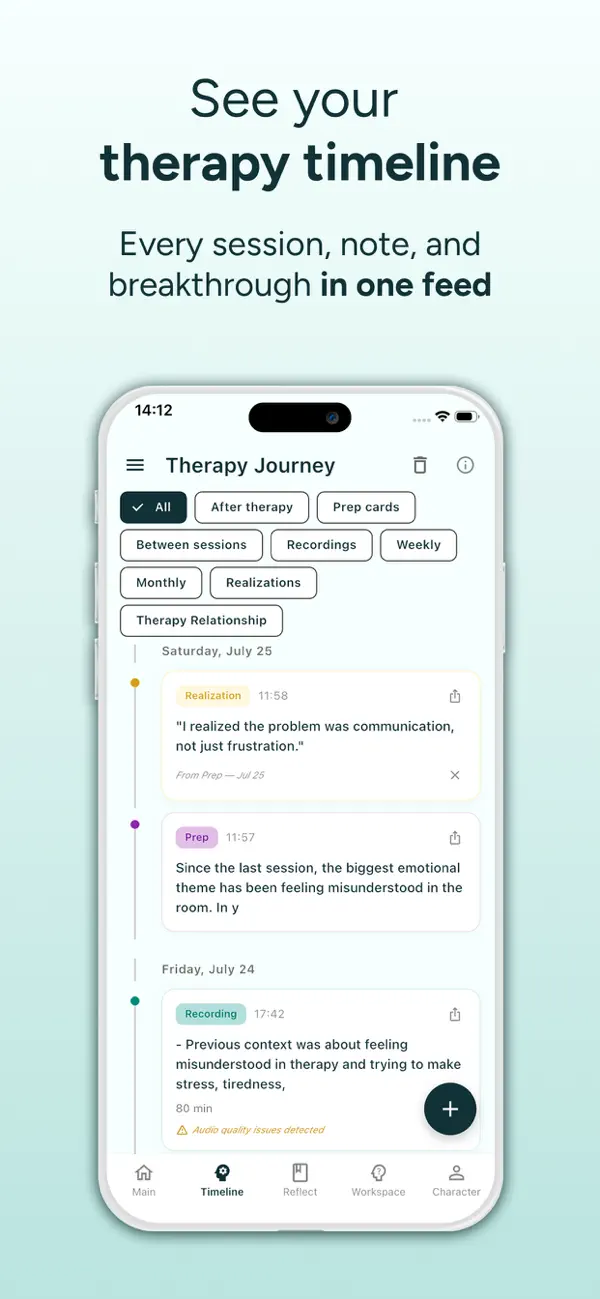
Therapy timeline
Everything you worked through, in order, which turns writing the one-page version into reading and choosing instead of remembering. Try it free in MindSync →
If you're still in the middle of the switch, there's a separate guide to the practical side of switching. And pay attention to the weeks between your first sessions, because that's where you notice how the new work sits with you.
Your new therapist doesn't need your whole life. They need your best summary of it.
This is what MindSync's Workspace is for. Keep the realizations you don't want to lose, start a thread for the tools that worked, and add the one thing you never quite said in your last therapy as a topic for next time. Give it time, and your Therapy timeline and Weekly & monthly summaries turn all of it into something you can read: a short version of months of work, ready before your first session with someone new. Then open your Prep Card the night before and pick what you want to say first.
If your new therapist could only read one sentence about your last therapy, what would you want it to say?
Bringing your history with you
- Weekly & monthly summaries - Weeks and months already condensed into something you can read in a waiting room.
- Prep Card - The night before session one, a card with your topics and the questions you want to ask this new person.
- Workspace - The realizations from last time, kept where you can find them, so the new work starts from them.
Frequently asked questions
What should I tell a new therapist about my old therapist?
Tell a new therapist what worked with your old therapist, what didn't, and what you need now, describing your experience rather than judging the person. It also helps to say how you feel about the switch itself. A 2014 study found that clients whose transfers went well had therapists who helped them talk through their reactions to the change.
Can I get my records from my old therapist?
In the US, generally yes: HIPAA gives you a right to access your health records, such as your diagnosis, treatment plan and progress summaries. A therapist's separate psychotherapy notes are an exception and can be withheld, though state law may give you more access. Outside the US the rules differ; in the EU, GDPR gives you a right to access your personal data. This is not legal advice.
Do I have to start therapy over with a new therapist?
You don't have to start from zero with a new therapist, even though the first sessions will cover familiar ground. The new therapist needs their own assessment, but you can make it faster with a one-page summary of what worked, what didn't and what you want now, plus a treatment summary from your previous therapist if you have one.
How long does it take to feel comfortable with a new therapist?
It takes a different amount of time for everyone, and no number of sessions counts as normal. Some people feel at ease in the first hour, others only after several weeks. If it still feels like talking to a stranger after a few sessions, say so directly. That conversation gives both of you useful information.
What should I bring to my first session with a new therapist?
Bring a short summary of your previous therapy, a list of what you want to work on now, and any questions about how this therapist works. If your old therapist sent a treatment summary, mention it. Practical things matter too, like your insurance details if you use them and any forms the practice sent ahead of time.
Keep more from every session
MindSync keeps your sessions and the week between them in one place, so your progress stops slipping away. The trial is free, no credit card needed.


Get the app