


Therapy
What to Write in a Therapy Journal? A Few Lines at Three Moments

What to write in a therapy journal is whatever your next session will need. Usually that's a few lines at three moments: what stayed with you right after the session, the moment the topic showed up again midweek, and the one thing you want to say next time.
Do any of these sound familiar?
- Your therapist said "you could journal about that," so you bought a nice notebook. It now holds three pages of Monday and nothing since.
- You write a lot, but it's the same argument with your sister, page after page, and on Thursday you still don't know where to start.
- You open the page, write "Today was... fine," and close it again.
Most of the time the trouble is the page itself: it has no job. Lists of therapy journal prompts usually hand you fifty questions and no order, so the page stays blank, just with more pressure on it.
Why "just write about your week" rarely works:
A journal for mental health in general can hold anything: gratitude lists, song lyrics, a rant about the parking lot. If you've ever wondered what to write in a journal for mental health, whatever helps is a perfectly good answer. A therapy journal has one job: carrying something from one session to the next.
Without that job, a blank page asks for a summary of your day, which is rarely what you need on Thursday. It's a shopping list versus a note that says "write down everything in the fridge." The list gets you through the store. The fridge inventory mostly tells you that you own four kinds of mustard.
So what to journal about for therapy, if not your week? The things your next session will need.
Fun fact: expressive writing, where most journal prompts come from, started in 1986 as a short lab experiment by James Pennebaker, a few days of short writing rather than a notebook kept for years (he looked back on it decades later in Perspectives on Psychological Science).
If the notebook went quiet after Monday, that's not a discipline problem. It just never had a job.
What a useful entry looks like:
Short and specific beats long and complete, and it keeps the journal from turning into homework. A useful entry usually has:
- A date and one real scene. "Tuesday, 8:40 pm: said yes to covering Dana's shift, felt sick about it for an hour."
- A sentence in quotes, something someone said to you or something you said to yourself. "'You're overreacting,' again."
- An ending that's a question or something to check, rather than a verdict about who you are.
The less useful kind is three pages of the same fight in the same sentences, and you feel worse after writing than before. That's usually writing that goes in circles, and it's fine to stop mid-page. Also, nobody needs the full transcript of what you ate on Wednesday. Your therapist definitely doesn't.
Pen, notes app or voice, the prompts work the same (if you're still deciding whether to write it or say it out loud, start there).
One real scene beats three pages of weather report.
What research turned up:
In 2008, Graf, Gaudiano and Geller turned Pennebaker's method into homework for people in outpatient psychotherapy. In a small study in Psychotherapy Research, clients were randomly assigned to write either about their emotions or on a control writing task alongside their sessions. The emotional writing group had bigger drops in anxiety and depression and made more progress in therapy overall. Writing next to therapy can help the therapy itself.
Then, in 2018, Reinhold, Bürkner and Holling pooled 39 randomized trials in Clinical Psychology: Science and Practice. For physically healthy adults, brief, self-directed expressive writing had no significant long-term effect on symptoms of depression. Effects were larger, though, when people wrote more times and when the topic was more specific. That doesn't prove any particular set of prompts works, but it points away from "write whatever."
A 2022 review of 20 randomized trials by Sohal and colleagues, in Family Medicine and Community Health, found journaling gave a small edge over control groups: about a 5% bigger drop in symptom scores, larger for anxiety and PTSD than for depression. It also worked better when nobody collected or analyzed the journals. The authors flag big differences between studies and uneven study quality, and suggest journaling as an add-on to treatment. Your journal is for you.
The honest caveat: the effects are small, the reviews don't fully agree, and most studies tested a few days of writing about stress, not a journal kept alongside therapy for months. As far as we know, nobody has tested prompts tied to moments of the week. That's good news in a way. You don't have to write a lot, or write well, for it to count.
Writing helps a little on its own. It helps more when it has somewhere to go.
What to write in a therapy journal, moment by moment:
Three moments, a few prompts each. Pick one or two, not all of them. The plan for the whole week is in what to do between therapy sessions; this part is about the page.
Right after the session (10 minutes, still in the car)
To journal after therapy without retelling the whole hour, write down what stayed with you and what you want to watch for. If your problem is remembering what was said at all, start with how to remember what you talk about in therapy. Then finish one of these:
- "The part I keep replaying is ___."
- "I felt ___ when we talked about ___, and I didn't say it."
- "This week I want to notice ___."
- "Something to try this week: ___. When I'll do it: ___."
If your therapist gave you a specific worksheet, it comes first, before any prompt here (some examples of therapy homework). And yes, you'll be absolutely sure you'll remember. You won't, and that's not a character flaw.
Midweek (when it shows up again)
Catch the scene where the thing from the session turns up in real life. Keep it short and do it the same day, by voice if typing feels like too much:
- "It showed up today when ___. What I did: ___."
- "What I wanted to do instead: ___."
- "Something went differently than usual: ___." Good moments count too.
- "A question to bring next time: ___."
The day before (pick the one page to bring)
Read back through the week and choose one entry. Should you bring your journal to therapy? Bring one page, not the notebook. That page is for when your mind goes blank in therapy.
- "The entry I'd most want to talk about is ___, because ___."
- "The thing I'm most likely to skip if I don't write it down: ___."
- "One sentence to open the session with: ___."
Then say it out loud: "I wrote something down this week. Can I read it to you?" The rest of your prep is in how to prepare for a therapy session.
Which one? The entry that came back more than once, has a real scene in it, and feels a little uncomfortable to say. Too many contenders? Here's how to decide what to talk about first.
You're not writing for an audience. You're packing for one hour.
A journal doesn't replace therapy. If writing about something hard leaves you shaken past that evening, stop, write one line ("I want to talk about this") and leave the rest for your session. If writing ever brings up thoughts of harming yourself, don't wait for your next session: call or text 988 in the US, or 911 in an emergency.
Where MindSync fits:
This is what MindSync is built around. Log the part you keep replaying on the After therapy card right after the session. Midweek, record a voice note (it's transcribed for you), or open Reflect and let Jake, MindSync's therapy assistant, ask the follow-up questions a blank page never will. Give it a week, and Workspace holds the entries worth bringing, right next to your agenda for next time. Then, the day before, pin the one you pick. Your therapist only hears what you choose to read out loud.
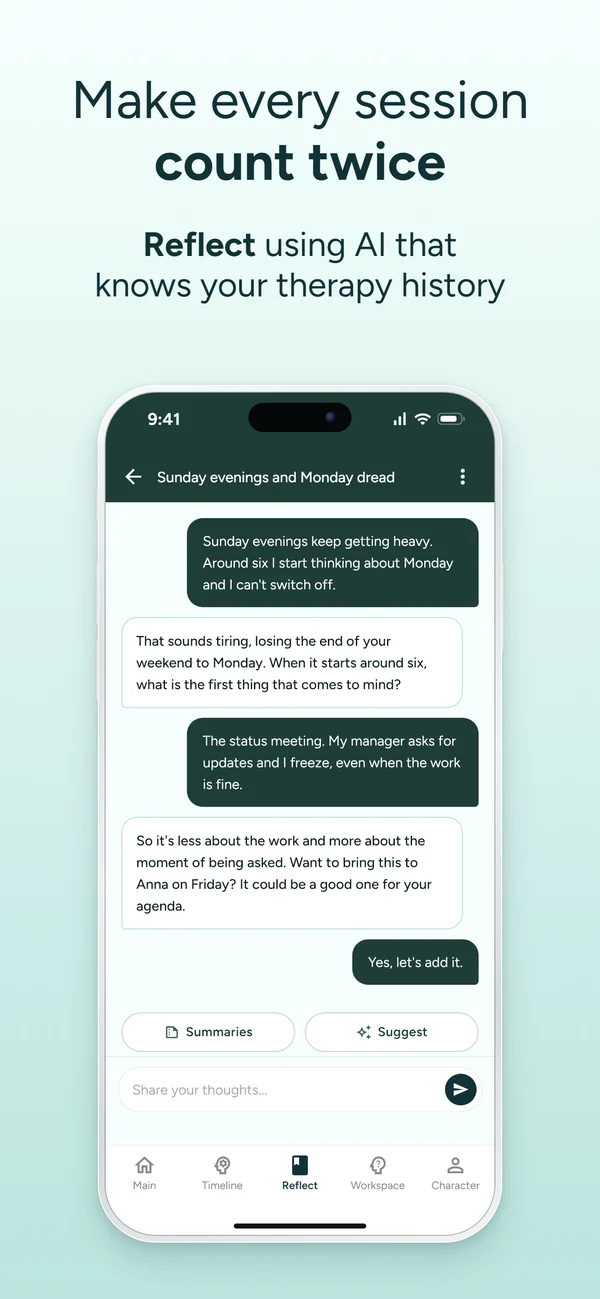
Reflect (AI journaling)
When a blank page gets you nowhere, talk it through with Jake, MindSync's therapy assistant. He asks the follow-up questions a journal never will, and the talk stays readable later. Try it free in MindSync →
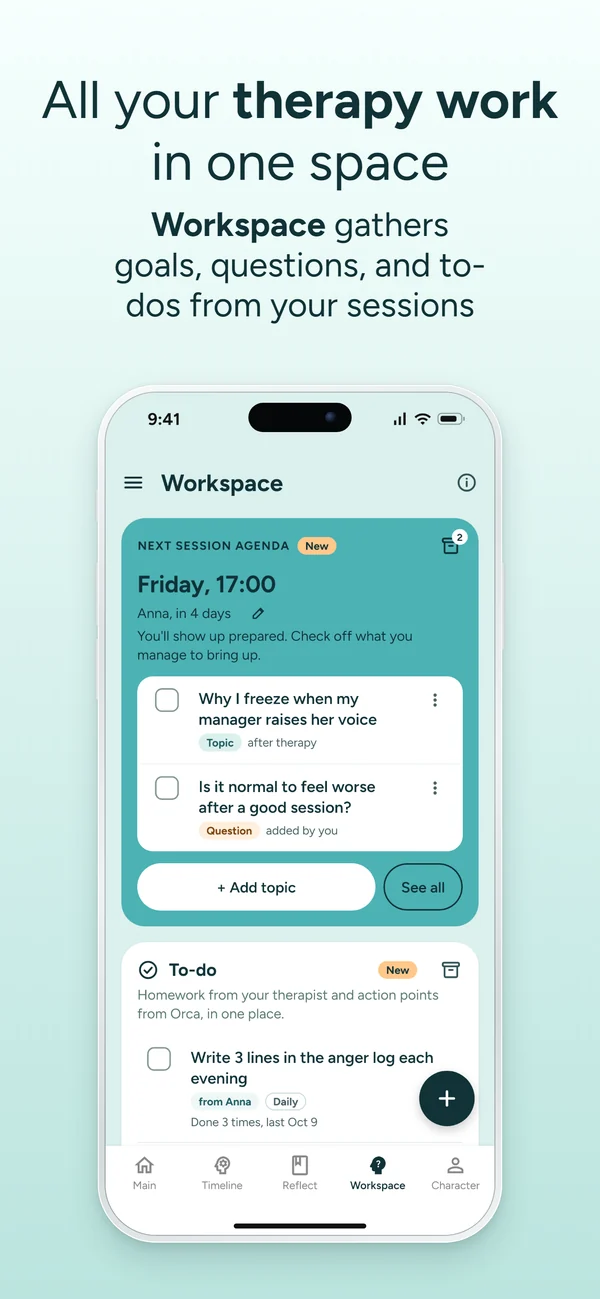
Workspace
Pin the one entry worth bringing to your agenda for next time, so it's there when your mind goes blank. Try it free in MindSync →
Write a few lines at three moments of your week, then bring one of them into your next session.


If you could bring only one line from this week into your next session, what would it say?
Frequently asked questions
What do you write in a therapy journal?
The things your next session will need: what stayed with you after the last one, the scenes from your week where the topic came back, and questions you want to ask. Keep entries short, with a date and one real scene instead of a summary of the day. If you're stuck, start with "The part I keep replaying is ___."
What to journal about for therapy?
Journal about what you're working on in therapy rather than everything that happened: moments when an old pattern came back, moments when it went differently, feelings you didn't say in the session, and anything your therapist asked you to try. If you don't know where to start, finish the sentence "It showed up today when ___." A specific task from your therapist always comes first.
How to journal for therapy sessions?
Write at three moments: a few minutes right after the session, briefly midweek when the topic shows up again, and the day before, when you pick one entry to bring in. It doesn't have to be long or polished. A notebook, the notes app on your phone or a voice note all work the same way.
Should I bring my journal to therapy?
You can, but one chosen entry usually works better than the whole notebook. Your journal is yours, nobody has to read it, and you decide what you read out loud. A simple way in: "I wrote something down this week. Can I read it to you?"
Keep more from every session
MindSync keeps your sessions and the week between them in one place, so your progress stops slipping away. The trial is free, no credit card needed.


Get the app