
MindSync Tips
How to Use MindSync: Your First Week, Step by Step

You downloaded MindSync on a Tuesday and your session is at six. Now you are looking at five tabs and one big button, wondering whether to start by recording, writing or rating something. Here is the order that works, from the first 10 minutes to the end of week two.
What MindSync is for (and what it is not)
MindSync is a mobile app that helps people in therapy keep more from every session. It records sessions with your therapist's permission, captures voice notes between them, tracks how you are doing on a simple scale, and turns all of it into weekly summaries and trends.
What it is not: a therapist, an assessment, or a substitute for treatment. It has no opinion about your diagnosis. It keeps the record of work you are already doing with a professional, so the hour you pay for carries into the rest of your week. It was built by someone who spent 10 years and around $130,000 on therapy and kept forgetting what happened in it. There is a licensed psychologist on the team. More on who MindSync is built for.
Day one: the 10 minutes that set everything up
Three steps, and none of them ask you to write anything long.
- Finish setup. It asks a few questions about your therapy and what you want to work on, then walks you through the consent screens.
- Pick two or three areas to track and rate them once. That first rating is your baseline.
- Put your next session date in the app, so prep and reminders know when to show up.
That is day one. Ten minutes, and you have not written a single paragraph.
Pick the two or three things you are actually working on
Setup asks what you want to work on and lets you say how heavy each thing feels right now. The temptation is to tick everything: sleep, anxiety, work stress, the relationship, the family thing. Resist it. Two or three areas that map to what you talk about in therapy will still be there in month two. Ten areas turn every check-in into a chore and you quit in week three. Areas can be added, renamed or removed later in settings, so nothing you pick today is locked in.
Do your first check-in
On the Main tab, add a check-in and rate those areas on a scale of 1 to 10. Under a minute. There is no free text to fill in unless you want there to be.
One rating tells you nothing, and that is fine. It is not supposed to mean anything yet. It is the first dot. The line only shows up once there are enough dots to argue with, which is roughly two weeks in.
Your first session with the app
The big button on the Main tab opens four things: Prepare for therapy, After therapy, Between sessions, and Record Session. Your first session uses three of them.
Before: the prep card
Open Prepare for therapy an hour or a day before you go. You get Your Prep Card: the topics that came up in your week, questions worth asking, and how your mood ran, which is rarely how you remember it running.
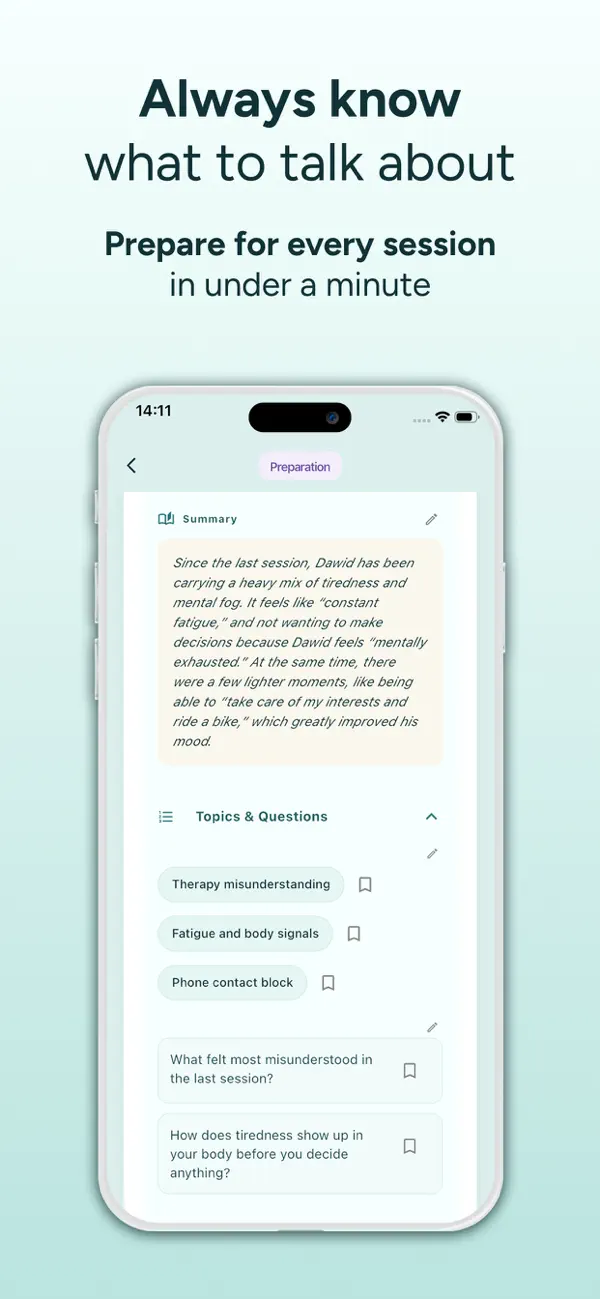
Your first one will be thin, because the app has known you for four days. Add two lines yourself. The thing you keep circling back to, and the thing you did not finish talking about last time. If your mind goes blank the second you sit down, that problem has its own fix: how to prepare for a therapy session when your mind goes blank.
During: recording (and asking your therapist first)
Ask first. Out loud, before you press anything. Something like: "I am trying an app that records sessions so I stop forgetting what we talked about. Would that be okay with you?" Most therapists have fielded this question before. Expect a follow-up about where the audio goes and who can hear it.
Two things before you ask. Recording rules differ between countries, and inside the United States they differ between states, some of which require consent from everyone in the conversation. That is a practical rule here, not legal advice, and the short version holds: if nobody agreed, you do not record. The other thing is that your therapist can say no. Some decline for reasons about how the room works rather than anything about you, and it costs you little, because the debrief below does most of the same job.
If they say yes, tap Record Session when the session starts. Afterwards you get the transcript, the takeaways, the topics, and the questions your therapist asked you. That last part is usually the most useful. Their questions are the first thing to go by Thursday.
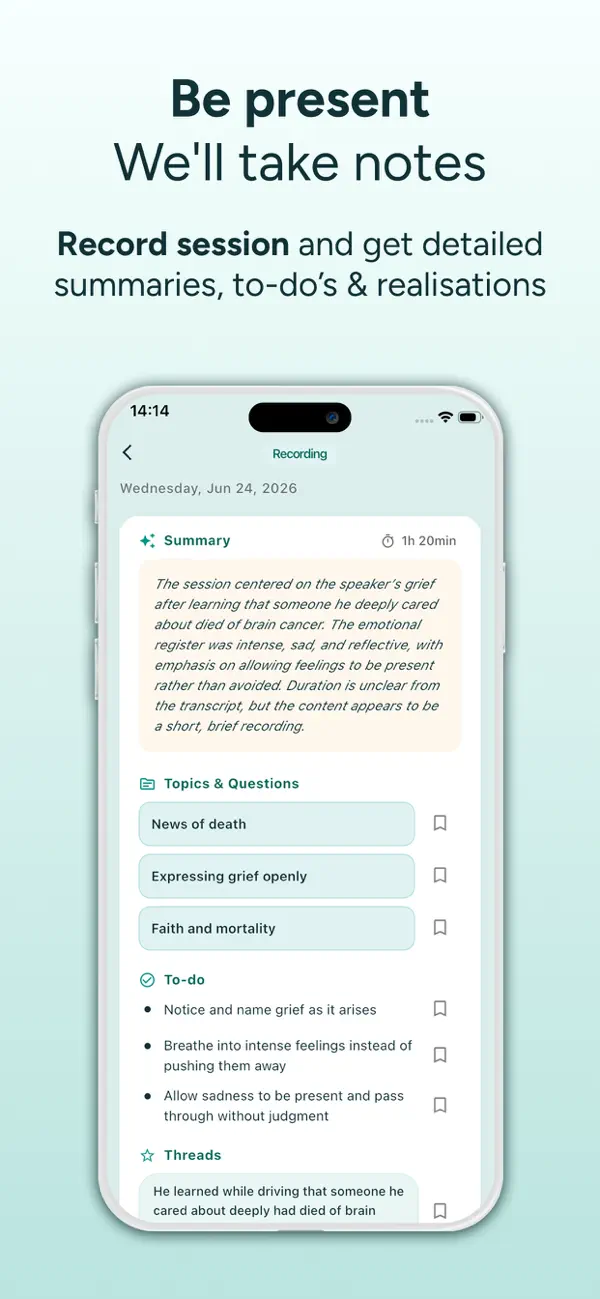
Session recording & summaries
Record the session with your therapist's permission and get the transcript, the takeaways and the questions they asked you. Try it free in MindSync →
After: the debrief while it is still fresh
Do this before you get back to your day. Open After therapy and answer in text or out loud: what landed, what you agreed to try, what you avoided saying. Five minutes in the car beats 40 minutes on Sunday, once the session has flattened into a general impression that something helpful happened.
The forgetting is not a personal failing, by the way, and it runs deeper than most people assume: why you forget most of what your therapist says.
The week between sessions
This is the part the app is built around. One hour of therapy sits inside a week of everything else, and the week is where most of the material comes from.
Voice notes when something comes up
When something happens, open Between sessions and say it out loud. Forty seconds, unedited. It gets transcribed, you check the text and accept it, and it is waiting for you next time you prepare.
Speaking beats typing here for one reason: you will actually do it. The note you record in a stairwell exists. The paragraph you plan to write tonight does not.
Between-session voice notes
Say it out loud when it happens: the note is transcribed and waiting for you before the next session. Try it free in MindSync →
Homework that lands on your home screen
Whatever your therapist suggested you try shows up as Homework on your Main tab, a to-do for today instead of something you remember guiltily in the waiting room. The full list lives in Workspace, next to your agenda for next time, topics, threads you keep pulling on, realizations and goals.
Anything you flag during the week lands on that agenda. By the day before your session, the list has written itself.
If you want to think something through rather than file it, Reflect is the tab for that. A conversation in text or voice that asks the follow-up questions a blank note never asks.
What you get after two weeks
Week one is mostly input with nothing coming back, and that is where people quit. It changes around day 10.
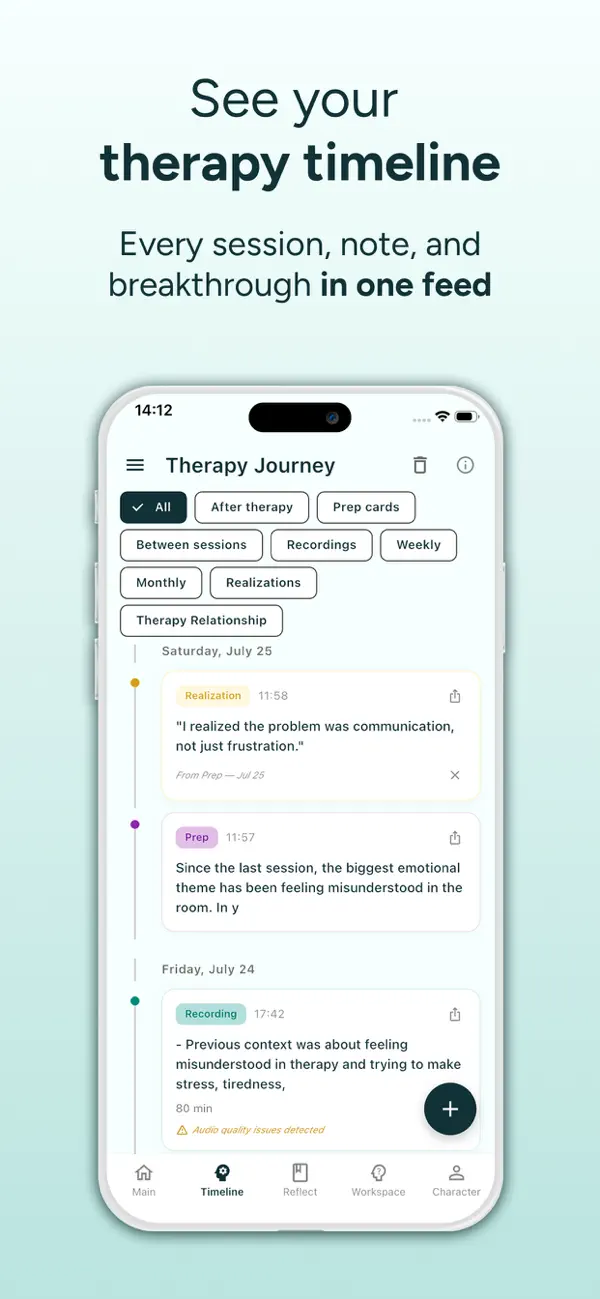
Your mood trend on the Main tab stops being a dot and starts being a shape. Your weekly summary appears in Timeline and reads your own entries back to you, with a Generate now button if you cannot wait for it. Timeline keeps every session, note, check-in and realization in one filterable place, which matters the first time your therapist asks when something started and you can actually answer.
Be careful what you read into it. Two weeks of ratings is a hint, not proof. One bad week is not a verdict on your therapy, and no app can tell you what caused what. What it can do is stop the conversation running on memory alone.
People usually want to know where all of this ends up. That answer lives on the FAQ page, under how your data is stored and who can see it.
Getting the app
MindSync is on the App Store and on Google Play. Onboarding is short: a brief profile, the consent screens, and you are in. The trial gives you full access and does not ask for a card, and the specifics are on the what the free trial includes page. If you would rather see the whole map before installing anything, you can see everything the app does.
What to set up in the first week
- Prep Card - A prep card so you never open a session with a blank mind.
- Wellbeing check-ins - A one-minute rating of what you are working on, which quietly becomes your trend line.
- Weekly & monthly summaries - A weekly summary that turns scattered notes into a readable story.
Frequently asked questions
What is MindSync used for?
It is used to keep more from therapy. You record sessions with your therapist's permission and get a transcript and a summary, capture voice notes between sessions, rate the areas you are working on, and walk into the next session with a prep card instead of a blank mind. It supports therapy and does not replace it.
Is MindSync free?
You start on a free trial with full access, and it does not ask for a card. After the trial, keeping the full feature set is a paid subscription. Pricing changes often enough that quoting it in an article would be wrong within a month, so the current numbers live on the membership page.
Can I record my therapy session with MindSync?
Yes, with your therapist's permission, which you ask for before the session rather than halfway through it. Recording rules vary between countries and between US states, and some require consent from everyone in the room. If your therapist says no, the after-therapy debrief captures most of the same material from your side.
Does MindSync work without a therapist?
Partly. Check-ins, voice notes, Reflect and the trends all work on their own, and some people use them while they wait for a therapist to have an opening. The prep card, the recording and the debrief only make sense with a therapist, because the app is built around the rhythm of sessions.
Do I have to journal every day for it to be useful?
No. The daily part is the check-in, which is a rating and takes under a minute. Notes are for when something happens, and in most weeks that is two or three moments rather than seven. Missing days does not break anything, and the trend is drawn from whatever is there.
Keep more from every session
MindSync keeps your sessions and the week between them in one place, so your progress stops slipping away. The trial is free, no credit card needed.


Get the app