
Therapy
What to Say in Your Last Therapy Session (and What to Ask Before You Go)

What to say in your last therapy session is simpler than the speech you've been rehearsing: one specific thank-you for what changed, three questions you'll want answered later, and the thing you never quite brought up. It's fine if it comes out a little awkward. A short note on your phone keeps the plan from disappearing.
Do any of these sound familiar?
- You've rehearsed the thank-you in the shower three times, and it keeps getting longer. Version three has an introduction, a middle section and a thank-you to your parents.
- You're standing in a flower shop wondering whether a plant for your therapist is a kind gesture or a strange one, since now somebody has to water it.
- You're fairly sure you won't feel a thing. We'll see.
This one is for when the last session is already booked, or your therapist has told you they're leaving. Still deciding whether it's time to stop? Need a planned break, not a goodbye? Those are other conversations.
Why the last session feels so strange:
Your therapist knows things about you that nobody else knows, and you know almost nothing about them. Goodbyes to a friend, a job or an ex all come with scripts, and none of them fits here. So your brain doesn't know which one to play, and it often tries a bit of each.
There's also very little practice to draw on. In adult life, things tend to end on their own or end badly: friendships fade out, jobs end with a resignation letter, relationships end with an argument. A planned, calm ending to something that's working is rare, so most of us have never done one.
And then there's the clock. You get 50 minutes to close something that took months or years. It's a bit like saying goodbye at the airport gate while the board is already flashing "boarding," and you hear yourself talking about the weather.
None of this means the relationship was unhealthy, or that you're "too attached." It means it was real.
What it can look like on the day:
- Small talk to the rescue. You spend 40 minutes on a parking ticket, because the important thing feels too big, and it finally comes out in the last five minutes with your hand on the door handle.
- Sad and relieved at once. You're glad to get your Tuesday evenings back, and you're sad to get your Tuesday evenings back. Both are true.
- Nothing, then everything. You're calm for the whole session, and then you cry in the car or on the walk to the bus stop.
- The awkward last minute. A handshake? A hug? "Well... bye, then"? Nobody knows, and sometimes therapists don't either.
- When it isn't your choice. Your therapist is moving, changing jobs or going on parental leave, or your insurance has run out of sessions. Then anger often joins in, or a feeling of being left, even when you understand the reasons.
If the ending leaves you feeling much worse, or you're having thoughts of harming yourself, don't wait: call or text 988 in the US, or call 911 in an emergency.
Feeling two opposite things at once is usually a sign it mattered.
What research turned up:
Between 1987 and 1992, several studies asked clients how the end of therapy felt, and the feelings that came up most often were pride, a sense of health and accomplishment, and independence. One of them was Marx and Gelso's 1987 study of clients finishing short-term counseling at a university counseling center. Most of those clients (69%) appreciated the chance to talk with their therapist about their reactions to the ending, and they put the good feelings down largely to those open conversations. So saying out loud what the ending stirs up is part of the work. (These studies are more than 30 years old, and we know them through a summary by Hardy and Woodhouse for the Society for the Advancement of Psychotherapy.)
In 2006, Roe and colleagues asked 84 people who had ended psychodynamic therapy in private practice how the ending felt. In their study in the Bulletin of the Menninger Clinic, people described a wide range of feelings, many of them positive, tied to feeling more independent, to the relationship itself and to what they had gained. The most common source of the hard feelings was losing a meaningful relationship. And the longer the therapy, the more positive people tended to feel about the ending. So sadness at the end is what an important relationship costs, and it usually shows up next to pride.
The honest caveat: there's very little research on how clients live through an ending they didn't choose, when a therapist moves, changes jobs or finishes their training, and most of it asks therapists, not clients. So that part of this piece leans on common sense, not numbers. The good news is that what helped in the research, talking about how the ending feels, stays in your hands even when the decision wasn't yours.
Pride and sadness tend to arrive together. Neither one cancels the other.
What to say in your last therapy session, step by step:
Five things, in this order, and none of them needs to be perfect.
- Make the thank-you specific. "Thanks for everything" is kind, and it doesn't say much. Name one thing that changed and one moment you still remember: "I wanted to tell you what actually changed: I can say no to my mother now without a three-day guilt spiral. And I still think about something you said in our second month." If the change is hard to name, it helps to know what progress in therapy looks like. If saying it out loud feels impossible, a short card or a goodbye letter to your therapist counts just as much.
- Ask the three questions you'll wish you had asked. While your therapist is still across the room: "What have you noticed change in me that I might not see myself?" "What should I watch for, the early signs that things are slipping?" "If I want to come back one day, how does that work with you?" Write the answers down the same day.
- Say the thing you never said. Sometimes something is left over: a comment that stung, a topic you kept steering around, or a plain "you mattered to me." The last session is the last safe place to say it: "There's something I never brought up, and I'd rather say it now than wonder about it later." You don't have to, if you'd rather not.
- Bring something to read from. Put the thank-you and the three questions in a note on your phone, because feelings in a last session like to wipe the plan clean, and even more so if your mind tends to go blank. It's not an Oscars speech, and nobody will start the music if you run over.
- Let the goodbye be a bit awkward. You don't have to wrap everything up in the last minute: "I don't really know how to say goodbye to this, so: thank you. Really." That evening, write down what you can, because it's much easier to remember what was said on the day than a week later.
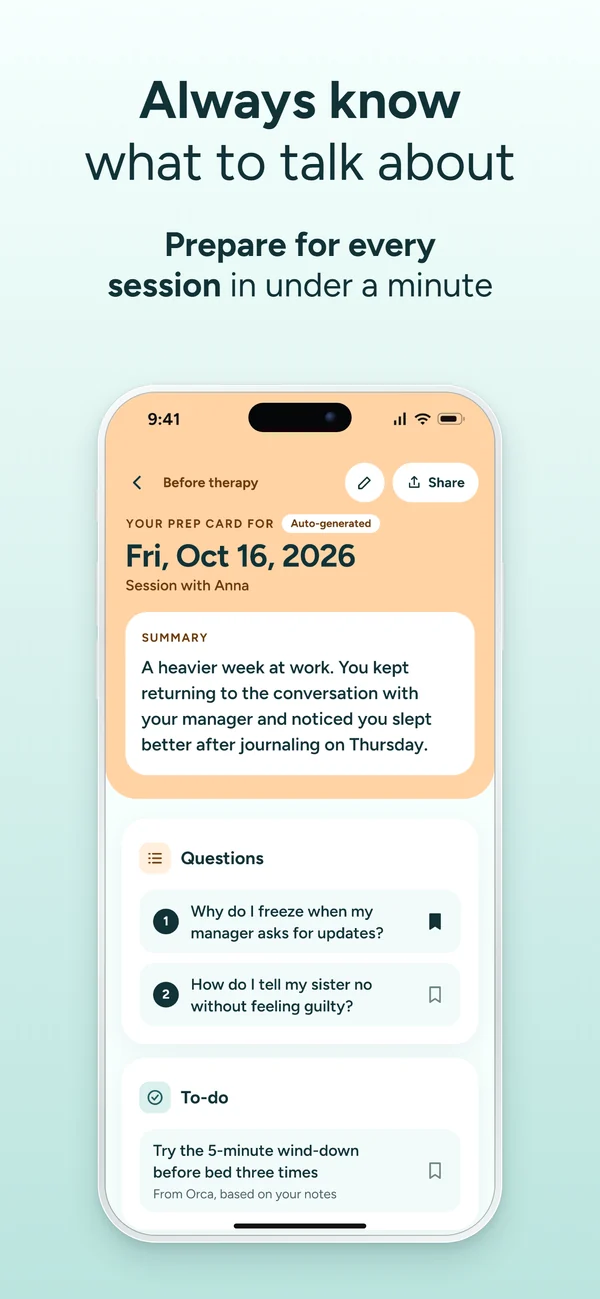
Before therapy card
Before your last session, the card gathers what came up since last time into a short summary and up to three questions, so the ones you'd regret skipping are already written down. Try it free in MindSync →
If you're not the one ending it
When your therapist is leaving, your insurance runs out or a training placement ends:
- You're allowed to say you're angry or sad. That belongs in the session too.
- Ask for a referral, and ask what would be useful to tell a new therapist. There's more on starting over with someone new.
- If session limits are what's ending it, ask your therapist what the options are.
- If it ended suddenly and you never got a last session, you can ask for one.
One sentence that works: "I'm not ready for this to end, and I'd like us to use the time we have to plan what comes next for me."
You don't need a perfect goodbye. You need the three answers and one honest sentence.
Where MindSync fits:
This is what MindSync's Before therapy card is for. In the weeks before your last session, log the change you want to name, the moment from month two you still think about, and the question you're a little scared to ask. Give it time, and the card turns what came up since your last session into a short summary and up to three questions to bring. Then read them out before the clock runs down, and once you're home, say what you remember as a voice note before the evening blurs it. MindSync is a journal for between therapy sessions, and it won't replace the room. It keeps your notes, so what you took from the last session doesn't fade by Friday.
Keeping what the last session gave you
- Between-session voice notes - Say what you remember once you're home, before it blurs; the note is transcribed and keeps its date.
- Therapy timeline - Scroll back to your first month, so the thank-you can name what actually changed.
Bring your questions to the last session, and keep what you hear there long after it.


If you only had time for one sentence at the end of your last session, what would it be?
Frequently asked questions
What questions should I ask in my last therapy session?
Ask your therapist three things before you go: what they've seen change in you, which early signs would mean things are slipping, and how coming back would work if you ever need it. Write the answers down the same day, while they're still clear. If there's something you never brought up, the last session is a good place for that too.
How do I say goodbye to my therapist?
Usually the simplest way works best: name one specific thing that changed, say thank you, and accept that the last minute may feel a bit awkward. Something like "I don't really know how to say goodbye to this, so: thank you" is enough. If saying it out loud feels impossible, a short letter or card is a real option.
Is it normal to cry in your last therapy session?
Yes. Crying in a last session, or afterwards in the car, is common, and research on how clients feel at the end of therapy describes sadness about losing an important relationship alongside pride in what changed. It doesn't mean the ending is a mistake. If the sadness turns into feeling much worse for days, or into thoughts of harming yourself, call or text 988 in the US.
Should I give my therapist a gift or card?
A card with a personal message is the safest choice. If you'd like to give a gift, keep it small and inexpensive, and don't take it personally if your therapist can't accept it, because many follow professional rules about gifts. In a 2009 study by Knox and colleagues, most clients who gave a gift chose something inexpensive, usually as a way to say thank you. In an earlier 2003 study by the same team, gifts were rare, but every one of the 12 therapists interviewed had accepted one at some point.
What do I do if my therapist is leaving?
It's okay to be upset, and it's worth saying so in the sessions you have left. Ask for a referral and what would be useful to tell a new therapist, and ask for a proper last session if one wasn't offered. The questions about what changed and what to watch for still apply.
Keep more from every session
MindSync keeps your sessions and the week between them in one place, so your progress stops slipping away. The trial is free, no credit card needed.


Get the app