
MindSync Tips
Voice Journaling for Mental Health, Without Talking in Circles

Do any of these sound familiar?
- Your phone holds 23 recordings, every one of them called "New Recording," and one of them lasts four seconds.
- After a rough day you talked into your phone for eleven minutes in the car and finished on exactly the sentence you started with, only louder.
- You press record, say "Okay, so..." and look at the timer. The timer looks back.
If one of these is yours, welcome. There are a lot of us. Talking things out really can help. It just works better when the recording is heading somewhere.
Why talking it out sometimes helps and sometimes just goes in circles:
Inside your head, everything happens at once. The argument, the thing you should have said, the email you haven't answered and a vague dread about Thursday all share one small room. Speaking at least puts them in a line. You can only say one sentence at a time, so the mess has to queue up, which is often why you feel lighter after you hit stop.
But talking can also replay a feeling instead of working through it. Same scene, same tone, a little louder every lap. It's like a GPS that keeps saying "recalculating" because nobody ever typed in a destination.
Going in circles doesn't mean you're doing it wrong, or that something is wrong with you. A brain does this with anything unfinished: it keeps picking the thing up to check whether it's done yet. Whether to talk or write is its own question, with its own post on whether to write it down or say it out loud.
A recording that doesn't go anywhere is just a feeling with a timestamp.
What useful voice journaling for mental health sounds like:
Voice journaling for mental health means talking through what happened out loud, usually into your phone, and listening back or reading the transcript later. It tends to help most when a recording moves from what happened, to how it felt, to what you make of it, instead of playing the same feeling on repeat.
Two recordings, same Tuesday evening.
The loop. "I just can't believe she said that, like, who even says that, I honestly can't believe it..." Eleven minutes, the same sentence three times, and it ends where it started.
The one that goes somewhere. Two sentences on what happened in the meeting. Then how it landed: a hot face, and the thought "so that's what they think of me." Then what you make of it, or what you still don't get. One last sentence about what happens next. Three minutes.
Both are normal, and sometimes the first has to come out before the second can. Just try not to end every night on the first one.
Same evening, same feelings. One of them has an ending.
What research turned up:
In 2006, Sonja Lyubomirsky and her colleagues ran three studies with something rare in this field: one condition was talking out loud (Journal of Personality and Social Psychology). Students spent 15 minutes a day, three days in a row, writing, talking into a tape recorder, or just thinking privately about their worst experience. Four weeks later, the ones who wrote or talked reported better life satisfaction and better mental and physical health than the ones who only thought about it. With happy memories the pattern flipped: picking apart their happiest moments left people worse off than simply replaying them in their heads. The honest caveat: these were college students, about a hundred per study, followed for a few weeks.
In 2002, Patricia Ullrich and Susan Lutgendorf had 122 students journal for a month (Annals of Behavioral Medicine). One group wrote only about emotions, one about emotions plus trying to make sense of a stressful event, and one about facts from the news. The "emotions plus thinking" group became more aware of the good that came out of the event. The "emotions only" group reported more illness symptoms during the study. So pouring feelings out only gets you partway, and the part that seems to count is trying to understand them.
Back in 1997, James Pennebaker, Tracy Mayne and Martha Francis went back to the words people had used in six earlier writing studies, 177 people in all (Journal of Personality and Social Psychology). People who used more insight and causal words over the days, like "because," "realize" and "understand," later had better physical health. That's a correlation, not a recipe. Still, a story that picks up a "because" and a "now I get it" from one recording to the next is a good sign.
Then, in 2011, Ethan Kross and Ozlem Ayduk pulled together the research on why making sense of a bad experience sometimes backfires (Current Directions in Psychological Science). Their review describes a common trap: when people relive a scene from the inside, as if it were happening again, reflection often slides into rumination and they feel worse. When they look at the same scene from a little distance, like an observer, reflecting on it tends to help. There's more on the distance part in our post on overthinking.
Here's where the research runs out. We couldn't find studies that test voice-note apps or voice journaling as a daily habit. Most of this work is about writing, so the steps below borrow its principles.
Saying it out loud helps when you're telling the story, not reliving it.
How to voice journal so it actually helps:
- Tell it in three parts. Start the recording with: "Here's what happened, here's how it landed, and here's what I think it means." For the middle part, try to name what you're feeling instead of stopping at "bad." Of all the voice journal prompts out there, it's probably the only one you need.
- Stop when the story ends, not when the feeling does. Two to five minutes usually covers one event. The feeling may hang around longer than the recording, and that's fine. If you record before bed, keep it short and then put the phone down (racing thoughts at night are a topic of their own).
- Listen for the third repeat. The moment you hear yourself say the same sentence for the third time, stop the recording. Start a fresh one with a single question from a little distance: "If this happened to a friend, what would I notice?" or "What would I want to ask in therapy about this?" Nobody needs another seven-minute recording whose only new information is that you missed your exit.
- Don't take your good days apart. When something good happens, describe it and enjoy it a second time. You don't have to run a post-mortem on a nice dinner.
- Keep one sentence for your session. Listen back or read the transcript once, right after or the next day, and pick the one sentence that surprised you. That's your opening line next time: "I recorded something on Tuesday and I'd like to start there." It's the simplest way to prepare for your next session.
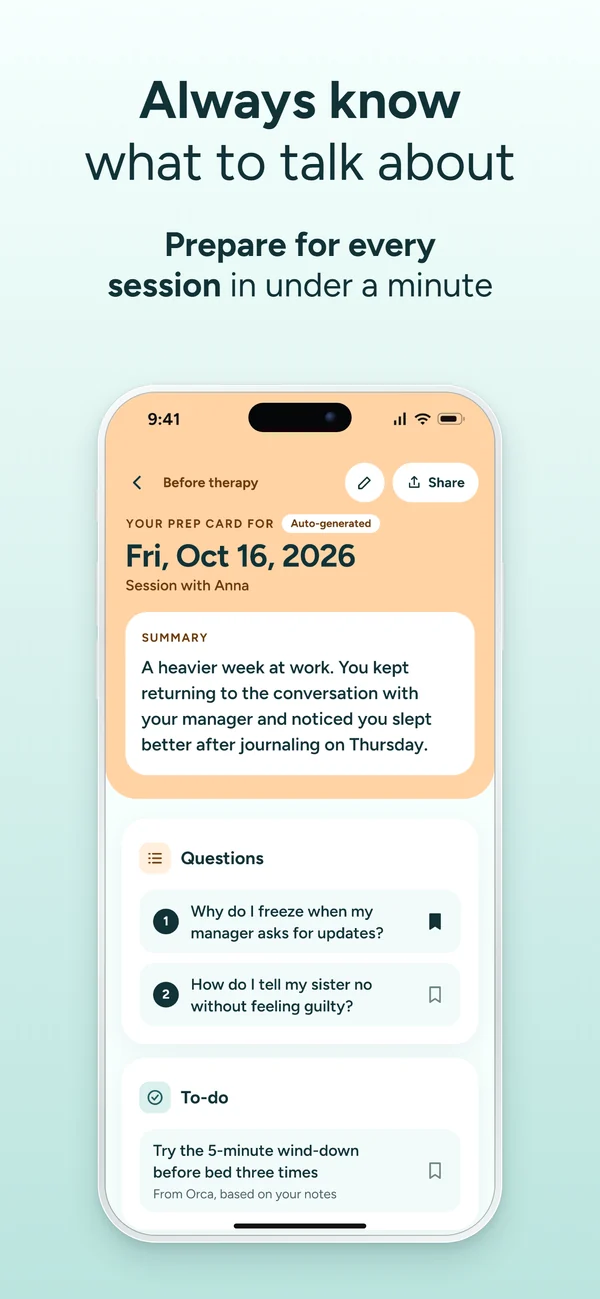
Before therapy card
This pulls what you've recorded since your last session into one short card with up to three questions, so you walk in knowing where to start. Try it free in MindSync →
If your recordings keep getting heavier from week to week, or you're having thoughts of harming yourself, don't keep it in your phone: tell your therapist, or call or text 988 in the US, or your local emergency number. A voice journal isn't built for that, and you shouldn't carry it alone.
Where MindSync fits:
This is what MindSync's between-session voice notes are for. Log the three-part version of a bad evening, the sentence you caught yourself saying a third time, the good dinner you described and didn't dissect. Give it time, and your Before therapy card turns what came up since your last session into a short summary and up to three questions to bring. Then open your session with the sentence you kept, read straight off your phone. Nothing goes to your therapist unless you say it in the room. If talking into silence is the hard part, Jake, MindSync's therapy assistant between sessions, can ask the first question. There's more on using the whole week in what to do between therapy sessions.
Between-session voice notes
Tell it in three parts while it's fresh. The note is transcribed, you check the text, and the sentence worth keeping is there when your session comes. Try it free in MindSync →
Your next voice note can be the first thing you say in your next session.


If you played back your last voice note, would you hear a story with an ending, or the same sentence three times?
Frequently asked questions
Do voice diaries help with mental health?
They can, especially when the recording goes somewhere. In a 2006 study, students who talked or wrote about a hard experience for three days felt better a month later than students who only thought about it. Replaying the same feeling without trying to make sense of it is more likely to keep you stuck, so try telling one event in three parts: what happened, how it landed and what you make of it.
What is voice-first journaling?
Voice-first journaling is journaling where you speak first and read or listen later, usually into a voice memo or an app that transcribes what you say. The point is lower friction, not a different kind of reflection: talking for three minutes is easier than sitting down to write a page. The same shape still works: what happened, how it landed, what you make of it.
Is talking out loud to yourself good for mental health?
Usually, yes, and it's far more common than people admit. It seems to help most when you tell the story from a little distance, like an observer, rather than reliving the scene from the inside, which a 2011 review by Kross and Ayduk links to rumination. If the way someone talks to themselves suddenly changes or becomes confused, that's worth mentioning to a doctor.
What should I talk about in a voice journal?
Talk about one event in three parts: what happened, how it landed, and what you make of it (or what you still don't understand). On good days, just describe what happened and enjoy it again, without analyzing it. You don't need a list of fifty prompts, because one shape covers most evenings.
Can talking about your problems make them worse?
Sometimes, yes. When talking turns into replaying the same moment from the inside, it can slide into rumination and leave you feeling worse. Watch for the same sentence on repeat and for feeling worse after every recording. When that happens, stop, ask yourself one question from a distance ("If this happened to a friend, what would I notice?"), and bring the pattern to your therapist.
Keep more from every session
MindSync keeps your sessions and the week between them in one place, so your progress stops slipping away. The trial is free, no credit card needed.


Get the app