
Therapy
The Room or the Laptop: Online vs In-Person Therapy, Honestly Compared

Somewhere around 2020, therapy moved into the same laptop as your spreadsheets. You talk about your childhood while a work chat notification blinks in the corner of the screen. The dog, who ignores you all day, walks in at the exact second you say something important and sits down to listen. Then the session ends with a click on "Leave meeting", and forty seconds later you're loading the dishwasher, still halfway inside whatever you just said out loud.
So does the laptop version count as much as the room? The research answer is shorter than you might expect. The rest of the answer is about everything that happens around the hour.
What changes when the room is a screen?
An office comes with a journey. You travel there, sit in the waiting room, and on the way home you walk, drive or stare out of a bus window while your head keeps working. That trip is a buffer. It gives your mind a few minutes to open up before the session and a few more to close things back down afterward. Online, the buffer disappears unless you build it yourself, and whatever the session stirred up follows you straight into your evening. If you know the heavy hour after a session, you know how much work that commute was doing without anyone noticing.
The second change is the mirror. On a video call you watch your own face for an hour, which nobody does in a therapist's office. In 2021, Stanford researcher Jeremy Bailenson argued in Technology, Mind, and Behavior that constant self-view is one of the reasons video calls feel so tiring, along with close-up eye contact and sitting frozen in front of a camera. That's a theoretical argument about video calls in general, not a study of therapy. Still, if you've ever cried on a video call, you may recognize it: part of your attention goes to how you look while you're doing it.
Fun fact: most video call apps let you hide your own picture, and plenty of people never find it. The other person still sees you. You just stop watching yourself.
The third change is privacy. In an office, the closed door is someone else's job. At home it's yours, along with the thin walls and the roommate who suddenly needs something from the drawer right behind you.
Online vs in-person therapy, side by side:
Neither format wins everywhere. Which one suits you comes down to your week and your home more than to the therapy itself.
Online tends to suit you when:
- Getting to an office would eat an hour you don't have, and that hour is exactly what makes you cancel.
- You live far from the kind of specialist you need, so the real choice is a screen or nobody.
- Leaving the house is hard right now, and waiting until it gets easier would mean waiting too long.
In-person tends to suit you when:
- There's no corner at home where you can talk without lowering your voice.
- You need a clear line between "this is where I do this work" and "this is where I live".
- Screens pull at your attention, and you catch yourself reading notifications mid-sentence.
Some people end up with a mix: most sessions online, and the occasional one in the room when something big is on the table. Some situations call for in-person care, and your therapist can tell you if yours is one. If price is part of the decision, there's a separate piece on what the cost difference really looks like.
What about privacy at home?
Start with headphones, so at least your therapist's half of the conversation stays in your ears. A closed door and a fan running in the hallway cover a lot of the rest. And if the only private place you have is a parked car, that's a real option. It isn't elegant. Nobody can hear you, though, and for that hour it's the only thing you need from a room.
What research turned up:
In 2024, Zandieh and colleagues pulled together 54 randomized controlled trials for a review in CMAJ, most of them pooled in a main analysis of more than 5,000 patients. They compared cognitive behavioral therapy guided by a therapist remotely (by video, by phone, or online with a therapist supporting the work) against the same therapy in person. They found little to no difference in results, and rated that evidence as moderate certainty. The trials covered anxiety, depression, insomnia, chronic pain and several other problems.
A year earlier, Hedman-Lagerlöf and colleagues ran a similar analysis in World Psychiatry: 31 trials and 3,053 participants, comparing internet-based CBT with a therapist's support against face-to-face CBT. The effects came out similar.
The screen isn't the weak link.
What about the relationship itself, the part people worry about most? In 2014, Simpson and Reid reviewed 23 studies of the therapeutic alliance in video therapy for the Australian Journal of Rural Health. Clients rated the bond with their therapist, and the sense that the therapist was really there, at least as strongly as clients in person. Therapists were sometimes a little less convinced early on. The bond, in other words, makes it through the camera.
The honest caveat: most of this research is about CBT and common problems like anxiety, low mood and insomnia. It doesn't cover every kind of therapy or every situation. Self-guided apps with no therapist involved are a different category, and these results say nothing about them.
How to choose, and how to make either one work:
- Pick the format you'll actually show up for. A good-enough session every week does more than a perfect one you keep canceling. The format is also a smaller decision than finding the right person first, so start there.
- Build a fake commute. Give yourself ten minutes before and after an online session with no screen: a walk around the block, a cup of tea by the window. Yes, you're walking to nowhere. Your brain still gets the message that therapy has started, and later that it has ended.
- Hide your own video if the mirror gets in the way. Tell your therapist you're doing it, so the change doesn't look like you've drifted off. One sentence is enough: "I'm going to turn off my self-view, it helps me focus on you."
- Keep the minutes after the session for yourself. Before you open your email, write down what stayed with you. Those first minutes after a call hold the most, and they're also the easiest to lose. If this is where things usually slip away, there's more on keeping more of what was said.
- Try the other format once before you rule it out. Some people find it easier to say hard things from their own sofa. Others only open up in a room. You won't know which one you are until you've tried both.
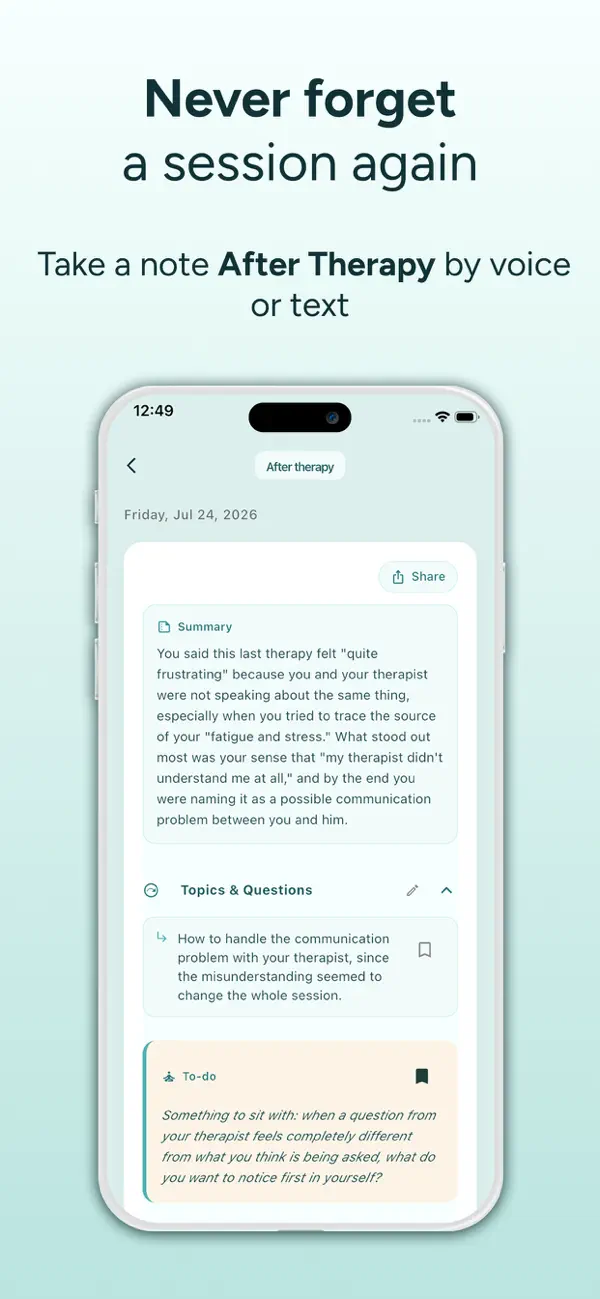
After-therapy debrief
The ten minutes after a video call are the easiest to lose, and the best place to write down what you want to keep. Try it free in MindSync →
One note if you're thinking about recording sessions so you keep more of them. Online or in the room, only do it with your therapist's permission. Ask at the start, before you switch anything on.
The format matters less than what you do with the ten minutes after.
This is what MindSync's After-therapy debrief is for. Log what surprised you, the sentence your therapist said that you want to keep, and what you felt when the call ended. Give it time, and your Therapy timeline turns those entries into something you can see: every session in one place, whichever room it happened in. Then open your Prep Card before the next one, so you pick up where you left off. MindSync works alongside your therapy and doesn't replace the person on the other side of the screen.
Where do you actually say the hard things out loud: in a room with someone, or in your own kitchen?
Whichever room you choose
- Session recording & summaries - With your therapist's permission, a transcript and key takeaways, so the session does not vanish with the call window.
- Prep Card - Walk in, or log in, with your topics already waiting instead of starting from how was your week.
- Therapy relationship check - A short check on how the working relationship feels, useful when you cannot tell whether it is the format or the fit.
Frequently asked questions
Is online therapy as effective as in-person?
For therapist-guided CBT, the research says it is. A 2024 review in CMAJ by Zandieh and colleagues looked at 54 randomized trials, most of them pooled in a main analysis of more than 5,000 patients, and found little to no difference between remote and in-person CBT, with moderate-certainty evidence. Most of those trials looked at anxiety, depression and insomnia, so the finding is strongest for CBT led by a therapist, not for every approach or for self-guided apps.
What are the disadvantages of online therapy?
The main disadvantages are practical rather than clinical. You lose the trip to and from the office, which gives your mind time to switch into the session and back out of it. Watching your own face can be distracting, and you need a private space at home. Technical problems can interrupt a session too. Most of these can be planned around once you know about them.
Is it harder to open up in online therapy?
Some people find it harder and some find it easier, and the research suggests the relationship itself holds up well on video. A 2014 review of 23 studies by Simpson and Reid found that clients rated the bond with their therapist at least as strongly as in person. If opening up feels harder on screen, tell your therapist. That's useful information for both of you.
Can you switch from online to in-person therapy?
Often you can, as long as your therapist offers both formats and works somewhere you can reach. Bring it up in a session and explain what's pushing you toward the change, because the reason itself can be worth talking about. If your therapist only works online, they can usually help you find someone local.
How do I prepare for an online therapy session?
Prepare the space as much as the topics. Find a room where you won't be overheard, use headphones, check your connection and close work apps. Leave ten minutes before and after the call with no screen, so there's a buffer on each side. For what to bring into the session itself, there's a separate guide.
Keep more from every session
MindSync keeps your sessions and the week between them in one place, so your progress stops slipping away. The trial is free, no credit card needed.


Get the app