


Therapy
How to Switch Therapists on BetterHelp: What to Save Before You Tap

To switch therapists on BetterHelp, log in, open your account settings, find My Therapist and request a new therapist. Depending on where you live, you may be able to pick someone from a list, or you can let BetterHelp match you again. According to BetterHelp, it costs nothing extra, and you don't have to tell your current therapist yourself.
Does any of this sound familiar?
- You've opened the My Therapist page four times this week and closed it every time, the way you close an ex's Instagram profile you're definitely not checking.
- Your therapist's last message came with a cheerful worksheet about gratitude, and you're in week six of thinking "maybe it's me".
- You're worried the new person will read everything you ever wrote to the old one. Or nothing, and you'll be back to "So, I'm 34 and I've got a sister."
Wanting a different match isn't a failure. On BetterHelp, switching is part of the service.
Why a few taps can feel so heavy:
On a platform, the whole relationship lives in one chat room: the messages, the worksheets, that one sentence in week three that changed how you see your mother. Leaving feels a bit like moving out without knowing whether the boxes are coming with you. And nobody wants to find out in the new place that the important box was the one labeled "misc".
There's a less obvious reason too. BetterHelp's matching starts with a questionnaire about your goals, what you're struggling with and what you'd like in a therapist. If you typed "anxiety, work stress" on a tired Tuesday, you got someone for anxiety and work stress. A mismatch often starts with vague answers going in, not with something wrong with you.
Then there's the guilt. Changing therapists is an ordinary part of therapy, and therapists know it. If you're unsure, look first at whether it's the fit or a rough patch. There's also a separate guide to deciding whether to switch at all, and switching isn't the same as stopping therapy on purpose.
The relationship lived in the chat. What you learned doesn't have to.
How to switch therapists on BetterHelp, step by step:
This is the route as BetterHelp's help article on changing therapists describes it, as of November 2026:
- Log in on the website or in the app.
- Tap your profile icon in the top right corner and open your account settings.
- Find My Therapist and request a new therapist.
- If it's offered where you live, browse the list and pick someone. Otherwise, let BetterHelp match you.
- Confirm, then wait. BetterHelp says you'll be notified once the new therapist accepts your request, and after that you can message them and book sessions.
Labels in the app can shift, so if a button looks different, look for My Therapist in your account settings. BetterHelp says a first match can take a few hours or a few days, depending on availability, so plan for a short gap.
What happens after you tap
So what happens when you change therapist on BetterHelp? Some of it is spelled out, some of it isn't:
- BetterHelp says switching is included with your account, at no extra cost.
- You don't need to tell your current therapist or explain why. BetterHelp can let them know if you prefer, and feedback about what didn't work is optional.
- BetterHelp's help pages don't say what stays visible from your old room, messages and worksheets included, or whether the new therapist sees it. Save what matters first, and assume you'll be telling the story yourself (here's what to tell a new therapist).
- If you have sessions booked, check them and ask support whether they move or get canceled.
The switch itself is quick. The handover is on you.
What research turned up:
In 2007, Baldwin, Wampold and Imel took apart a familiar pattern: people who have a good working relationship with their therapist tend to do better (Journal of Consulting and Clinical Psychology). Looking at 331 clients seen by 80 therapists, they asked whose side that relationship depends on. Differences between therapists in building it predicted outcomes. Differences between clients of the same therapist didn't. So part of the fit sits on the therapist's side of the room. Switching doesn't prove you're a difficult client.
In 2021, Constantino and colleagues ran a trial at six community mental health clinics in Cleveland (JAMA Psychiatry). They first rated therapists on how their past patients had done in specific areas, such as depression or panic. Then 288 patients were randomly assigned either to a therapist with a strong record in their main problems or to one assigned the usual way, and neither patients nor therapists knew which. The matched patients improved more, in symptoms and in getting through the day. It has clear limits. These were clinics, not an app, only 22% of eligible patients took part, the sample was mostly white and heterosexual, and the matching relied on outcome data no platform user gets to see. Still, it suggests fit can be concrete, about what a therapist is good at, as well as about chemistry.
For the wider picture, there's a 2025 trial on switching and more on why the relationship matters so much.
The honest caveat: research on switching comes from clinics and practices. We couldn't find studies on switching inside subscription platforms, or on whether carrying a chat history over helps. That's less bleak than it sounds. The most portable part of therapy is what you can put into words yourself, and that part is already yours.
Fit is partly luck. The rest is information.
Before you tap, do these four things:
- Save what this therapy gave you. Scroll back through the chat and copy out the lines that shifted something, the exercises that worked and the topics still open. BetterHelp's pages don't say what stays visible after a switch, and memory likes to judge a whole therapy by its last flat session. Screenshotting 40 weeks of chat at 1 a.m. is a valid hobby, but you only need the ten lines that mattered (more on keeping what each session gave you).
- Rewrite your preferences in specifics. "Someone better" gives the matching nothing to work with. Name the pace, the structure, the style, experience with your issue, and identity preferences if they matter to you. Try: "I'd like someone more structured, who gives homework and checks in on it, and who has worked with anxiety at work." Feedback is optional, but BetterHelp says it helps them find a better fit.
- Ask support the three logistics questions. These are the things the help pages don't cover, and an answer in writing beats guessing. Try: "Before I switch: will I still see my old messages and worksheets, will my new therapist see them, and what happens to the session I booked for Thursday?"
- Draft your first message to the new therapist. Keep it short: what helped before and what you want done differently. Try: "I switched from another therapist here. The breathing work helped. What I need now is more structure and someone who'll push back a bit." It beats pasting a 3,000-word life story into the first message, the director's cut nobody asked for yet. There's more on messaging your therapist between therapy sessions.
If waiting for a new match leaves you feeling unsafe, call or text 988 in the US, or 911 in an emergency.
You're not starting over. You're starting with notes.
Where MindSync fits:
This is what MindSync's Therapy relationship check is for. Answer it over a few sessions, before you decide anything: whether you feel understood, and whether you and your therapist are working on the same thing. Between therapy sessions, log the line from your therapist that helped, the exercise you'd keep and the thing you wish they'd done differently. Give it time, and your Before therapy card turns what came up into a short summary and up to three questions for your first session with someone new. Then read it out, or paste the gist into your first message. MindSync isn't therapy, and it isn't affiliated with BetterHelp. It's a journal that stays yours whichever therapist you work with.
Therapy relationship check
A few short questions about how therapy itself is going, answered over several sessions, so your next preferences rest on more than one bad week. Try it free in MindSync →
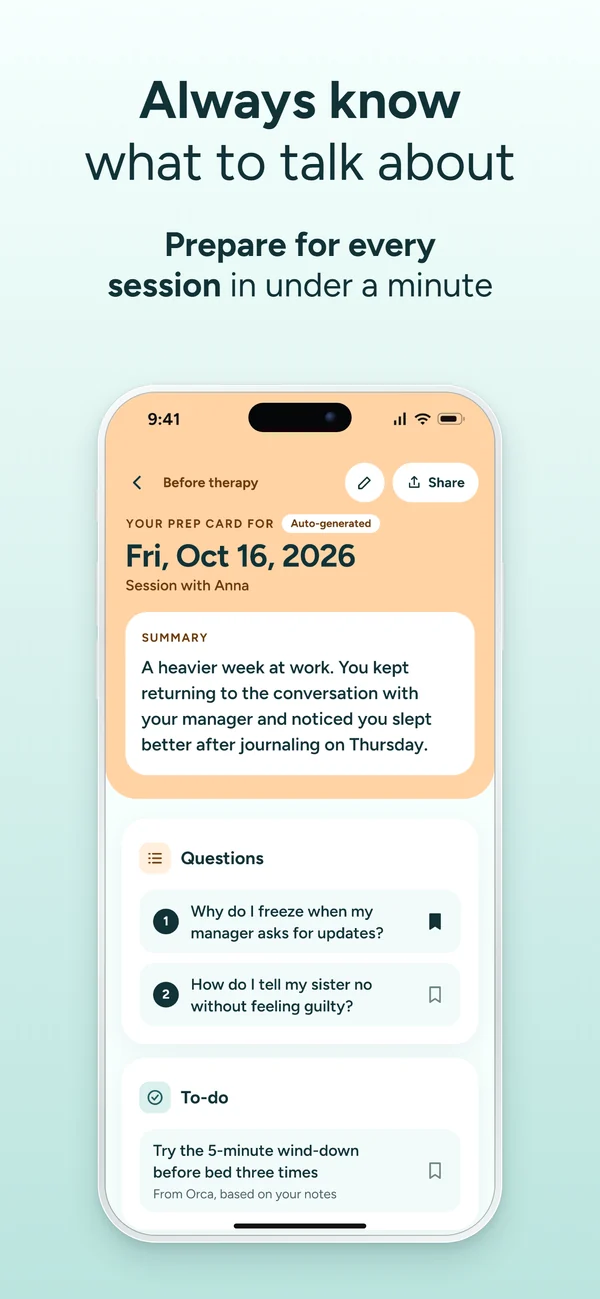
Before therapy card
Before your first session with someone new, a one-page card with a short summary of what came up and up to three questions to bring. Try it free in MindSync →
Keep the thread of your therapy in one place, whichever therapist you work with next.


What's the one thing you'd want your next therapist to know before you type hello?
Frequently asked questions
Can you switch therapists on BetterHelp?
Yes. BetterHelp says you can switch at any time at no extra cost, from My Therapist in your account settings. Depending on your location, you may be able to pick someone from a list, or BetterHelp matches you again. Before you do, write down what you'd like done differently.
What happens when you change therapist on BetterHelp?
On BetterHelp, you request a new therapist, then either choose one or get matched, and you're notified when the new therapist accepts. You don't have to tell your current therapist yourself. BetterHelp's help pages don't say whether your old messages stay visible or whether the new therapist sees them, so save what matters and ask support first.
Can you pick your therapist on BetterHelp?
Sometimes. BetterHelp says that, depending on your location, you may be able to browse therapists and select one, though that option isn't guaranteed. Otherwise it matches you from your answers to its questionnaire, so specific preferences give it more to work with.
Can I switch therapists under the same subscription plan?
On BetterHelp, yes: switching is included with your account, and BetterHelp says there's no extra cost. Its pages don't explain what happens to sessions you've already booked with your current therapist, so check those with support before you switch.
How do I change my therapist preferences on BetterHelp?
On BetterHelp, when you request a new therapist, you can answer the matching questions again and leave optional feedback about what didn't work. BetterHelp says that feedback helps it find a better fit. Write specifics, like pace, structure, experience with your issue or identity preferences, rather than just "someone better".
Keep more from every session
MindSync keeps your sessions and the week between them in one place, so your progress stops slipping away. The trial is free, no credit card needed.


Get the app