
Therapy
How Often Should You Go to Therapy? It Depends on the Gap

How often should you go to therapy? Most people start weekly, and every other week is common later on or when cost decides. There's no single right number. Frequency is a tool, not a score. The right rhythm is the one you and your therapist pick for where you are now and revisit when things change.
Do any of these sound familiar?
- Your therapist says, "I think we could try every other week," and you can't tell whether that means you're doing well or they just have too many clients.
- The first fifteen minutes of a session go to "so, where do I even start?", because it's been two weeks and three crises since last time. Two of them sorted themselves out. The third one you've already forgotten.
- You do the math in your head: copay times four a month. Then times two. Then you close the calculator.
Why there's no single right number:
How often you go isn't a measure of how much you "need" therapy. It's a tool, and a few things set it at once. The stage you're at (the start of therapy and rough patches tend to be denser, steadier stretches later on often space out). The type of therapy, since some approaches are built around a fixed rhythm, usually weekly. And everything that has nothing to do with psychology: what a session costs, how many sessions your plan allows, your work schedule, the forty-minute drive. Those are honest reasons, not excuses.
Every session opens with some catching up, and the longer the gap, the more you rebuild from memory. Memory is a biased editor. It keeps the last two days and the loudest moment, and cuts the rest (there's a whole piece on how to remember what was said in session).
Think of a series you watch one episode a week. The "previously on" takes thirty seconds. Switch to one episode every two weeks and the recap gets longer, and you still can't remember who the man in the gray coat is.
The number of sessions matters less than what happens to the thread in between.
How often should you go to therapy? What the usual rhythms look like:
In practice, the usual rhythms look like this:
- Weekly. The usual start in outpatient therapy, close enough together that the thread doesn't go cold. Most studies use it as the baseline.
- Every other week. Also called biweekly, a word that in American English can mean every two weeks or twice a week, which is a fun thing to find out at the front desk. It often comes after the first stretch of work, when things are steadier, or from day one because of cost. More life fits between therapy sessions, so you bring more in with you.
- Twice a week. Less common, usually during more intensive treatment or a hard period, sometimes only for a few weeks.
- Once a month, or "check-ins". More often a maintenance rhythm, or part of ending therapy well.
The rhythm usually changes along the way, and a change is neither a failure nor a promotion.
Every other week isn't half the therapy. It's twice the gap.
What research turned up:
In 2013, Cuijpers and colleagues pooled 70 studies of individual therapy for depression to see what predicts results better: the total number of sessions, or how close together they are (Journal of Affective Disorders). Sessions per week were strongly linked to bigger effects. The total number mattered little, and the link stopped being significant once other study features were accounted for. That's a comparison between studies, not proof of cause.
Two years later, Erekson, Lambert and Eggett went through real records of more than 21,000 university counseling clients (Journal of Consulting and Clinical Psychology). People seen weekly improved faster than people seen roughly every two weeks, but both groups were about as likely to reach meaningful change by the end. If you pay for every session, that's the useful part: a sparser rhythm may take more sessions to get to the same place, and in this data, there's no sign it gets you to a worse one.
In 2020, Bruijniks and colleagues ran a randomized trial, the kind where chance decides who gets which rhythm: 200 adults with depression in the Netherlands, CBT or interpersonal therapy, once or twice a week (British Journal of Psychiatry). At six months, the twice-weekly groups had a bigger drop in symptoms, and half as many people dropped out, 16 against 32. Fun fact: everyone filled in a mood questionnaire before each session, so the twice-weekly groups did it twice as often, and the researchers suggested this bit of self-reflection may have helped too (The Mental Elf picked up on it). That's a hypothesis, not a finding.
By 2024, the same team had the long view (Psychological Medicine): the twice-weekly advantage held until month 9, was gone by month 24, and relapse rates were no different. That same year, Ciharova and colleagues updated the 2013 analysis with 176 studies and 15,158 participants (reported by PsyPost). Frequency was linked to outcome again and total sessions weren't, but the link lost significance once differences between the studies were accounted for. So: probably, but hold it loosely.
The honest caveat: almost all of this is about depression, mostly CBT and interpersonal therapy, and the big real-world data comes from students. We know much less about other problems, and nobody has studied what people do with the gap between therapy sessions. Which is good news, in a way, because the gap is the part you can shape whatever your budget. If your question is how many sessions in total, that's how long therapy takes to work.
More often seems to get you there sooner. It doesn't seem to change where "there" is.
How to find your rhythm, and make the gap work:
- Ask your therapist what they'd suggest, and why. The right frequency is something to decide with your therapist, who knows what stage you're at. Try: "What frequency would you suggest for where I am right now, and when should we look at it again?"
- Do the honest math, and say it out loud. Cost and the session limit in your plan are legitimate reasons, and your therapist has heard them before. Check how many sessions insurance will pay for and look at ways to make therapy more affordable before you decide. Then try: "Weekly is more than I can afford right now. Can we plan for every other week and make it work?"
- Watch for signs the gap is too long. Half the session goes to catching up. You arrive with whatever happened yesterday, and the thing that mattered last week slips away. Between therapy sessions you feel like you're waiting rather than living. You remember last session's exercise in the waiting room. If a few of these sound like you, bring them to your next session: they say more about the schedule than about you.
- Give the gap a job. The sparser the rhythm, the more the gap has to carry the thread. Write things down when they happen, not on Sunday night from memory. Right after a session, note one sentence about what you're taking with you. The day before the next one, pick two or three things to bring. There's more on what to do between therapy sessions.
- Treat the rhythm as a decision you revisit, not a verdict. Agree to look at it again in a few weeks. If what you're really thinking about is a longer pause, that's a different conversation: taking a break from therapy.
A longer gap isn't a problem. An empty one is.
If the gap gets too hard to get through, you don't have to wait for your next session. Contact your therapist, and in a crisis in the US, call or text 988 (or 911 if your life is in danger).
Where MindSync fits:
This is what MindSync's Before therapy card is for. Between therapy sessions, log the argument you replayed on Thursday, the thing your therapist asked you to try, the day that went better than expected. Give it time, and the card turns what came up since your last session into a short summary and up to three questions to bring, so a two-week gap doesn't start with fifteen minutes of catching up. Then, on the way home, say what you took away as a voice note before it fades. The session still does the work; the app just keeps the thread until you get there. If you'd rather do it on paper, here's how to prepare for a therapy session.
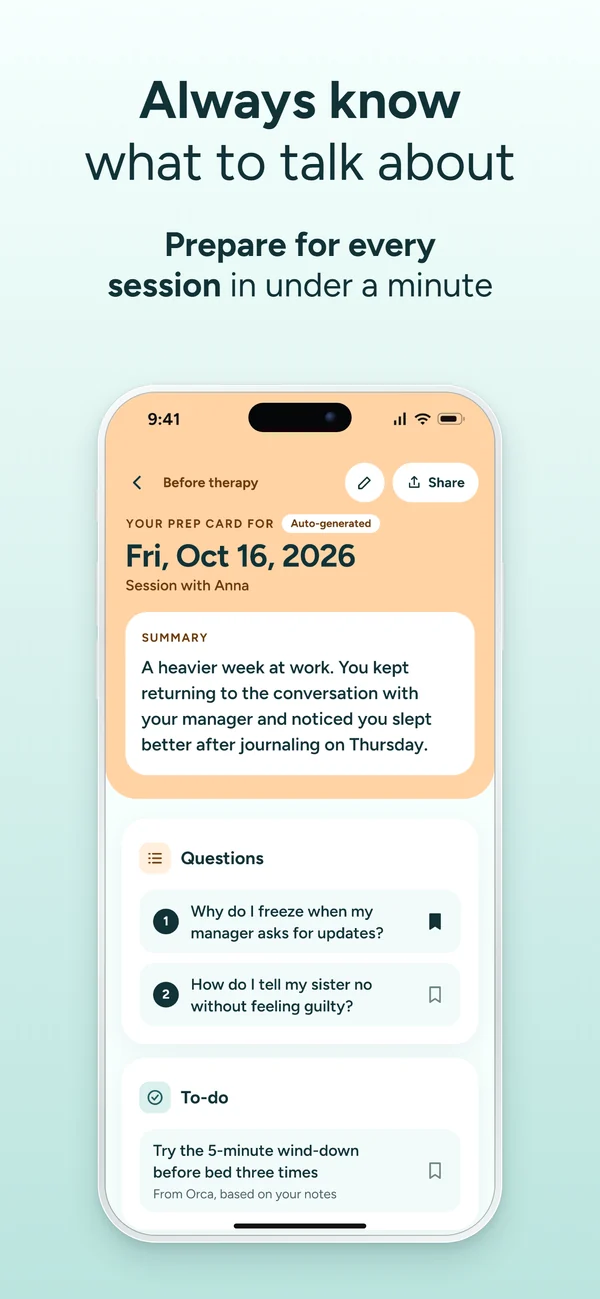
Before therapy card
Before each session, the card gathers what came up since last time into a short summary and up to three questions, so a longer gap doesn't start with catching up. Try it free in MindSync →
Keeping the thread between therapy sessions
- Weekly & monthly summaries - A weekly summary turns scattered entries into one readable page, so two weeks between therapy sessions still add up to a story.
- Voice notes between therapy sessions - Say what you took away on the way home: the note is transcribed and keeps its date for next time.
Keep the thread between therapy sessions, however far apart they are.


If your next session were two weeks away, what's the one thing you'd want to still remember when you walk in?
Frequently asked questions
How often should you go to therapy?
There's no single right number. Weekly is the most common place to start, and every other week is common later on or when cost decides. The right rhythm is the one you and your therapist choose for where you are now, and look at again as things change.
Is therapy every 2 weeks enough?
It can be. In a 2015 study of more than 21,000 university counseling clients, people seen about every two weeks improved more slowly than people seen weekly, but were about as likely to reach meaningful change by the end. A longer gap needs more help from you between therapy sessions, so ask your therapist whether it fits where you are.
Is therapy twice a week better than once a week?
It can be faster, at least for depression. A 2020 randomized trial of 200 adults found that twice-weekly sessions brought a bigger drop in symptoms at six months and half as many dropouts, but by 24 months the difference was gone. Whether the extra time and cost are worth it for you is a question for your therapist.
Is once a month therapy enough?
It depends on the stage you're at. Monthly sessions are usually a maintenance or wind-down rhythm rather than a starting one. The longer the gap, the more of the work happens without your therapist in the room, so talk it through with them before you switch.
Can I ask my therapist to see me less often?
Yes, it's a normal request. Say why (cost, your schedule, feeling steadier) and ask what they'd suggest, so the change is a plan rather than a drift. Then agree on when you'll look at it again.
Keep more from every session
MindSync keeps your sessions and the week between them in one place, so your progress stops slipping away. The trial is free, no credit card needed.


Get the app