


Therapy
Can AI Replace Therapy? What an AI Journal Can and Can't Do Between Therapy Sessions

No, AI can't replace therapy. A chatbot doesn't know your history and tends to agree with whoever is typing, while a good therapist is allowed to tell you you're wrong. Where an AI journal can help is between therapy sessions: it can bring back what you wrote three weeks ago and ask the follow-up question a blank page never does.
Does any of this sound familiar?
- It's 11 p.m. and you've just typed a long paragraph to a chatbot about the fight with your sister. It answers with five numbered steps and "It's completely understandable to feel that way," which reads a lot like a letter from HR.
- You have three journaling apps on your phone and a paper notebook with four entries, all from January.
- Tuesday, your therapist asks "So how was your week?" and you say "Fine, I think?" Last Thursday you wrote the AI two thousand words.
If you use AI to think things through, you're not doing therapy wrong. The question is what it's for.
What an AI journal actually does:
An AI journal is a journal that answers back. You write or speak (voice journaling counts too), and an AI model asks a follow-up question, sums up what you said, or connects it with something from an earlier entry. That's AI journaling in one sentence, and it's a lot plainer than the ads make it sound.
Underneath, it's less magical still. The model doesn't understand you the way a person does. It predicts a sensible reply from what you've written, and it knows you only from what you've given it. Think of a very attentive librarian who has read exactly one book in their life: your diary.
Within those limits, it's good at three things:
- Noticing patterns. It can bring back what you wrote three weeks ago and put it next to today, which is a big part of spotting your emotional triggers.
- Putting feelings into words. A question like "What exactly felt unfair?" gets you further than a blank page, and writing about what you feel has decades of research on writing about feelings behind it.
- Leaving you something for your session. There's a record afterward, and you can pick something out of it to bring in.
It's not smarter than a notebook. It just asks back.
Where it stops:
It won't replace your therapist. Your therapist knows your history, sees your face and hears your tone, notices the topic you keep steering around, and is allowed to disagree with you. An AI journal mostly follows your lead. Tell it everyone is against you, and it will often nod along. It agrees so readily that it would make a terrible sparring partner and a very polite yes-man.
It won't diagnose you, either. It can sound confident, but that isn't a clinical assessment. If it offers a name for what you're going through, treat it as a question for your therapist or doctor, not a result.
Disclaimer: an AI journal is the wrong place to bring a crisis. If you're thinking about hurting yourself or you feel unsafe, call or text the 988 Suicide & Crisis Lifeline in the US. If you're in immediate danger, call 911.
And if you've told an AI more than you've ever told your therapist, that's common. A machine has no face to react with. It's something worth bringing into the room, not a betrayal of your therapy.
It can help you find the words. It can't be the one who hears them.
Can AI replace therapy? What research turned up:
Researchers have started testing pieces of that question, and so far the answer is no, with a few interesting maybes.
In 2023, Li and colleagues gathered the evidence on conversational AI for mental health in npj Digital Medicine. They reviewed 35 studies and pooled 15 randomized trials. Chat-based agents reduced symptoms of depression and distress, but they didn't significantly improve overall psychological well-being, and most of the agents in those studies ran on scripted replies, not generative AI. So talking to a bot may ease some symptoms. That isn't the same as your life feeling better.
In 2025, a Dartmouth team led by Michael Heinz and Nicholas Jacobson published the first randomized trial of a generative AI therapy chatbot, Therabot, in NEJM AI. The trial included 210 adults with depression, anxiety or a risk of eating disorders, split between the bot and a control group with no access to it. Over eight weeks, people using Therabot saw depression symptoms drop by 51% on average and anxiety by 31%. The honest caveat: the bot was built with psychologists and psychiatrists, researchers reviewed the conversations and were ready to step in, and the comparison group got nothing at all. Heinz himself said that no generative AI agent is ready to operate fully autonomously in mental health. That is not evidence that a general chatbot or an AI journal can stand in for therapy.
Also in 2025, a Stanford team led by Jared Moore and Nick Haber presented a study at the ACM FAccT conference (Stanford HAI). They tested popular therapy chatbots on written scenarios against what therapy guidelines expect from a good therapist. The bots showed more stigma toward conditions like alcohol dependence and schizophrenia than toward depression, and some answered serious situations in ways a therapist shouldn't, including going along with delusional thinking, possibly because they tend to agree with whoever is talking. Newer, bigger models did no better. The limits: these were test scenarios, not real conversations, and the study didn't measure benefits. It's still the clearest reason a crisis belongs with people.
Here's where the research runs out: there's almost no work on AI journals used by people who are already in therapy. Most studies test chatbots instead of treatment, not next to it. That's good news, in a way. You don't have to pick one, and the part that's hardest to copy, a person who actually knows you, is the part you already have.
The evidence says helper. It doesn't say replacement.
How to use one so it feeds your therapy:
- Ask four privacy questions before you pour your heart out. AI journal privacy comes down to this: Is what I write used to train the model? Can I see and delete what it remembers? Who else can read it, and is anything shared for ads? Can I delete everything if I leave? Reading a privacy policy is the least romantic thing you'll do this year, and it still beats finding out later. For the longer version, here's whether it's safe to talk to AI about mental health and how private mental health apps really are.
- Use it to notice, not to decide. A pattern the AI spots is a question, not a conclusion. Bring it in like this: "I noticed this keeps coming up. I'm not sure what it means. Can we look at it?"
- Push back when it just agrees with you. Ask for the other side directly: "What might the other person say about this?" You'll get a more useful answer, and a fairer picture of that argument with your sister.
- Bring one thing, not the whole transcript. Before your session, pick one to three things that kept coming back. Forty printed pages of chatbot conversation dropped on your therapist's lap turns your session into a reading assignment, with you sitting there watching them turn pages. Here's more on how to prepare for a therapy session, and on what to do between therapy sessions in general.
- Tell your therapist you use it. Say it the way you'd mention anything else about your week: "I've been using an AI journal between therapy sessions to sort out my thoughts. Is there anything you'd want me to use it for, or stay away from?" Your therapist doesn't need to read anything. It helps them to know which tools you lean on.
A good AI journal shows up in your next session.
Where MindSync fits:
This is what MindSync's Reflect is for. Talk through the argument you replayed all evening, the thing you almost said on Tuesday, the pattern you keep circling back to, with Jake, MindSync's therapy assistant between therapy sessions, in writing or by voice on Premium. Give it time, and the Before therapy card turns what came up into a short summary and up to three questions to bring. Then take one of them into the room.
That's the idea behind MindSync as an AI therapy journal: it keeps what you'd otherwise lose between appointments. You can see every note Jake keeps on a page in Settings and delete any of it. MindSync isn't therapy and doesn't try to be. Here's how MindSync works day to day.
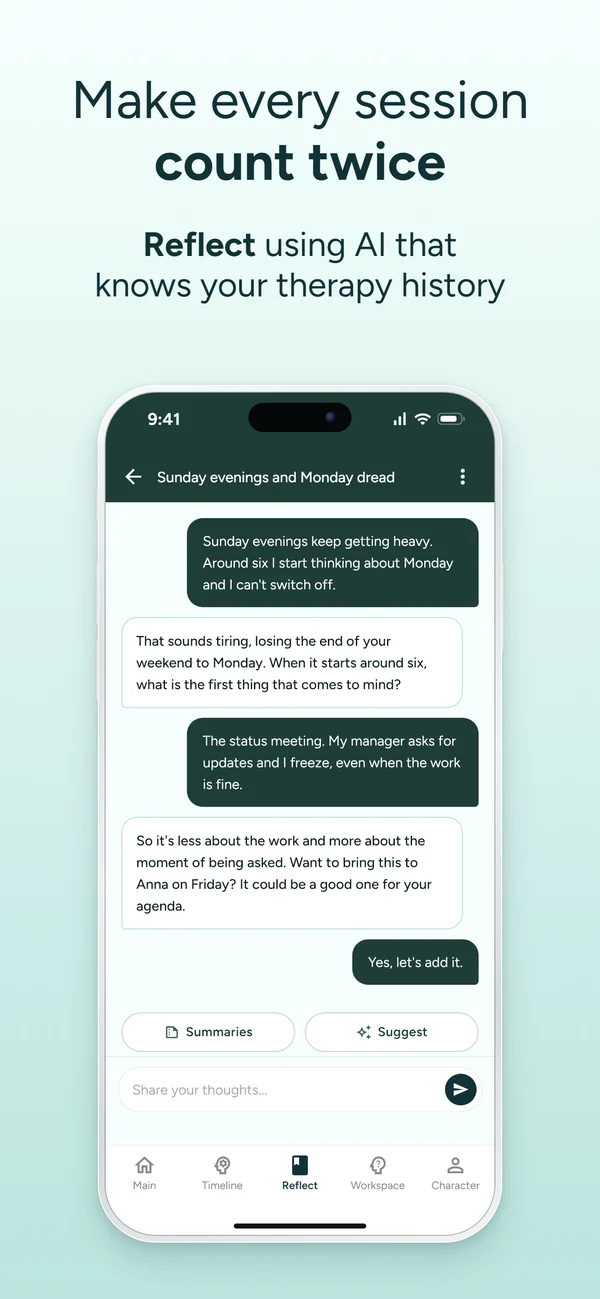
Reflect (AI journaling)
Talk it through with Jake, MindSync's therapy assistant between therapy sessions, in writing or by voice on Premium, and get the follow-up questions a blank journal never asks. Try it free in MindSync →
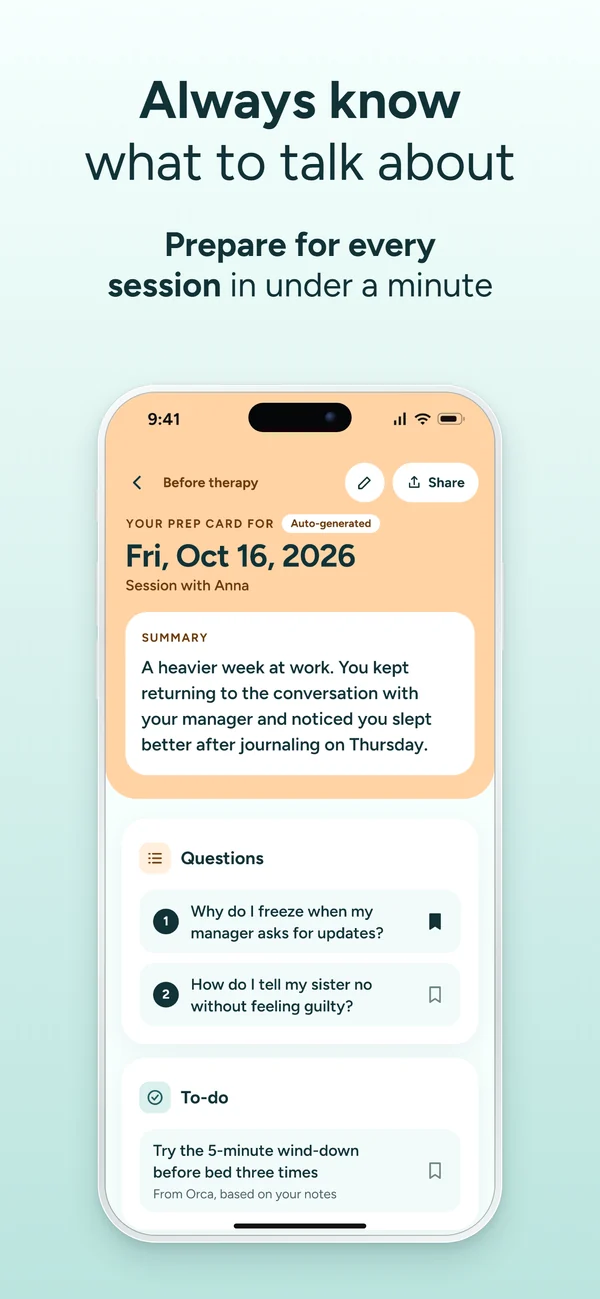
Before therapy card
Before each session, a one-page card sums up what came up since last time and lists up to three questions to bring. Try it free in MindSync →
Keep what comes up between therapy sessions, and bring it with you.


What's one thing you've told an AI that you haven't said out loud in therapy yet?
Frequently asked questions
Can AI replace therapy?
No. A general chatbot like ChatGPT can help you sort your thoughts, but it doesn't know your history, can't see your face or hear your tone, tends to agree with you, and isn't built for a crisis. A 2025 Stanford study found that popular therapy chatbots showed stigma toward some conditions and sometimes answered serious situations inappropriately. Use it as a notebook that asks back, and if you ever feel unsafe, call or text 988 in the US.
What is AI journaling?
AI journaling means keeping a journal that responds: you write or speak, and an AI model asks follow-up questions, sums up, or links what you said to earlier entries. It knows only what you've told it, so treat it as a tool for reflection, not an expert opinion. It's most useful when something from it makes it into your next therapy session.
Should I tell my therapist I use AI?
Usually, yes. Your therapist doesn't need to read anything, but knowing which tools you use lets them suggest how to use it well, or notice where it might be pulling you off track. One sentence is enough, for example: "I've been using an AI journal to sort out my thoughts before sessions."
Is AI journaling better than regular journaling?
Not better, just different. A paper journal leaves you alone with your thoughts, which some people need, while an AI journal asks questions and spots what repeats across weeks. Research on writing about feelings is far older and larger than research on AI journals, so pick the one you'll actually keep using.
Can I use ChatGPT as a journal?
You can. Check the privacy settings first, keep other people's names out of it, and remember it isn't built around your therapy. Whatever you use, bring one or two things from it to your next session instead of leaving them in the chat.
Keep more from every session
MindSync keeps your sessions and the week between them in one place, so your progress stops slipping away. The trial is free, no credit card needed.


Get the app