


Therapy
What Happens in a Therapy Session? Less Couch, More Conversation Than You'd Think

What happens in a therapy session is mostly conversation. A typical session runs about 50 minutes (often 45-60): a short check-in on how things went since last time, then the main work on whatever matters most, sometimes an exercise or a silence, and a few minutes to wrap up. Your first session is different, with more questions from your therapist.
Do any of these sound familiar?
- You picture a leather couch and a person with a notebook saying "hmm" at regular intervals, like a very calm metronome.
- You don't know who's supposed to talk first, so you've rehearsed an opening line that starts with "So, um."
- You've already decided which chair you'll take. You haven't picked a therapist yet.
Not knowing what goes on behind that door makes the first session feel like an exam you can't study for. So here's the hour from the inside, more or less minute by minute.
Why nobody tells you what therapy looks like from the inside:
Sessions are confidential, which is the whole point, but it also means almost nobody has seen one that wasn't their own. Movies and TV fill in the gaps: the couch, the long pause, the therapist who only ever says "and how does that make you feel?" before the credits roll. Real sessions are less dramatic. They feel more like a conversation with someone who's paying unusually close attention.
There's also no single standard session. The shape depends on the approach your therapist works in, on what you bring that week, and on the person across from you, so a CBT session and a psychodynamic one can feel surprisingly different.
Fun fact: in the US, the insurance billing code for a mid-length psychotherapy session covers 38 to 52 minutes, which helps explain why "the therapy hour" so often stops at around 50. The hour is short partly because of paperwork.
What happens in a therapy session, from hello to see you next week:
The first few minutes: the check-in
Most sessions open with some version of "So, how have things been?" You talk about the week, what changed, what happened with the thing you mentioned last time. In CBT this part is often more structured, with a quick mood rating and a short agenda you set together, so the hour doesn't drift.
The middle: the actual work
This is the bulk of the session. You talk about what feels most important, and your therapist asks questions, reflects back what they hear and points out things you might miss, like the third story this month that ended with "but it's fine." Sometimes there's an exercise or a worksheet. Sometimes there's a long silence, and nobody is doing anything wrong.
The last ten minutes: the wrap-up
Toward the end, things slow down. Your therapist may sum up what came up, ask what you're taking with you, and sometimes suggest something to try before next time. That's the homework you leave with, and it's usually small.
Your first session is a different animal
What happens at your first therapy session, often called an intake, looks more like a careful interview. There are forms to sign, and your therapist explains what stays confidential and the few exceptions. Then come the questions: what brings you in, your history, your health, your relationships, what you'd like to be different. Your therapist will talk more than usual, and walking out without a big realization is completely normal. The first session is for getting to know each other.
CBT vs psychodynamic: same hour, different shape
Judith Beck's standard CBT textbook (third edition, Guilford, 2020) gives a whole chapter to structuring sessions, and you'll feel it in the room: an agenda, a look at last week's practice, focused work, a summary. Psychodynamic sessions are more open. In 2010, Jonathan Shedler wrote about what sets them apart in American Psychologist, drawing on studies of real session recordings and transcripts. Two of the things on his list: a focus on feelings and how you express them, and a focus on your relationships. Here's how CBT and psychodynamic therapy differ in more detail.
What's normal in the room (and what isn't):
Silence is normal. So is crying, which is why there are tissues in the room. So are laughing, changing the subject halfway through a sentence and saying "I don't know." If you freeze completely, there's a whole piece on when your mind goes blank in therapy. Feeling tired or raw for a few hours afterwards happens too (more on feeling worse after therapy). If it lasts or keeps getting heavier, tell your therapist.
What your therapist usually does: listens, asks, notices, and now and then suggests an exercise. What they usually don't do: tell you what to do with your life, judge you, or spend long stretches talking about themselves. If yours regularly talks mostly about themselves, seems distracted most of the time, or crosses boundaries that make you uncomfortable, it's worth reading about when your therapist isn't the right fit.
The session is about you. That part doesn't change between approaches.
What research turned up:
In 2018, Christoph Flückiger and colleagues pooled 295 studies with more than 30,000 patients in a meta-analysis in Psychotherapy. Across many kinds of therapy, a stronger working relationship between client and therapist went with better outcomes, and the link held for therapy delivered online too. It's a correlation, so it can't prove the relationship causes the change. Still, it means how you feel with your therapist belongs in the session too.
In 2012, Joshua Swift and Roger Greenberg looked at 669 studies in the Journal of Consulting and Clinical Psychology and found that roughly one in five clients ends therapy early. The numbers don't say why each person left. But if the shape of your sessions isn't working, saying so is worth a try before you quietly stop booking.
In 2003, Clara Hill, Barbara Thompson and Nicholas Ladany surveyed 81 therapists about silence for the Journal of Clinical Psychology. They described using it on purpose, for example with clients who were actively working a problem out, and avoiding it with clients who were very distressed. That pause isn't you failing at therapy. Often it's room.
The honest caveat: these studies describe averages across thousands of people. Your sessions may look nothing like the textbook, and that's fine, as long as you feel heard.
How to get more out of the hour, in five steps:
- Ask about the shape at the start. Therapists don't always explain how they work unless you ask. Try: "Can you tell me how sessions usually go with you?" It saves you weeks of guessing.
- Bring one thing, not the whole list. One topic to start with is enough to steer the hour. Here's more on how to prepare for a therapy session.
- Use the last ten minutes. Ask: "What should I keep an eye on this week?" The answer is often the most useful sentence of the hour.
- Write down what you're taking with you within an hour. Sessions evaporate fast, like a dream you were sure you'd remember at breakfast. Three lines are enough: what came up, what clicked, what you want to try.
- Say it when the shape doesn't fit. "I think I'd do better with a bit more structure." Or the opposite: "Could we slow down and stay with this one?" Your therapist can't adjust to something they don't know.
The hour is short. The week around it is long.
If something you're carrying feels unsafe, like thoughts of hurting yourself, don't wait for the next session: contact your therapist, call or text 988 in the US, or call 911 in an emergency.
Where MindSync fits:
This is what MindSync's Before therapy card is for. Log them during the week, in Reflect or a quick voice note: the thing you noticed on Tuesday, the question you want to ask, the homework that didn't happen, and what your therapist told you to keep an eye on. Give it time, and the Before therapy card turns those entries into one page before your next session: a short summary of what came up since last time and up to three numbered questions to bring. Then the to-do from the wrap-up lands on your home screen as homework, so it gets done during the week instead of coming up guiltily at the next check-in. The work itself still happens in the room.
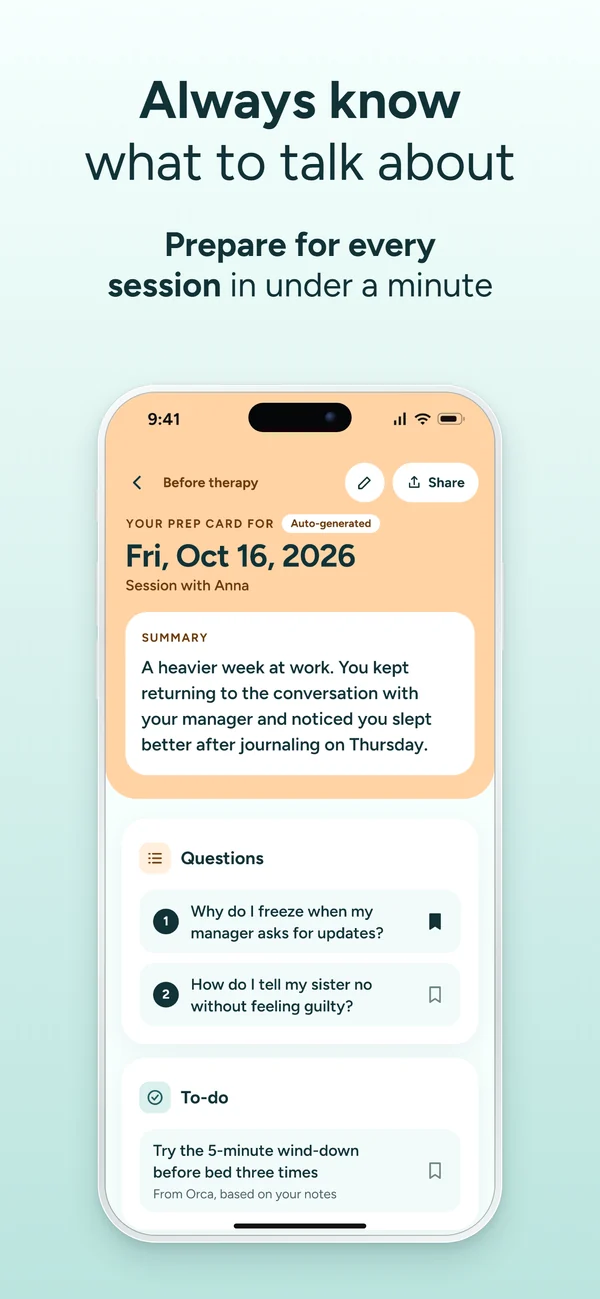
Before therapy card
One page before each session with what came up since last time and up to three questions to bring, so the check-in starts with something real. Try it free in MindSync →
Homework & to-dos
Whatever you agreed to try in the last ten minutes shows up on your home screen as a simple to-do for today. Try it free in MindSync →
Bring your week into the hour, then take the hour back into your week.


Which part of the session do you rush through: the first few minutes or the last ten?
Frequently asked questions
What happens at your first therapy session?
The first session, the intake, is mostly about getting to know each other. Expect forms, an explanation of confidentiality and its limits, and questions about what brings you in, your history and what you'd like to change. You can ask questions too: how they work, how often you'd meet, what a typical session looks like.
How does a typical therapy session go?
It usually runs about 50 minutes, sometimes 45 or 60. It opens with a check-in about your week, moves into the main conversation about what matters most right now, and ends with a few minutes to sum up and, sometimes, agree on something to try before next time.
What usually happens in a therapy session?
That depends a lot on the approach. CBT sessions tend to follow an agenda, with a mood check, a look at last week's practice and focused work on a specific problem. Psychodynamic sessions are more open, with more time on feelings, relationships and the patterns that keep coming back.
What should happen in a therapy session?
You should feel listened to, the session should be about you, and over time you should roughly understand what you're working on together. It won't feel good every week. If it regularly feels off, say so, and read more on when your therapist isn't the right fit.
Is the first therapy session free?
Usually not. Many therapists offer a short free consultation call, often 15-20 minutes, before you book, but the intake session itself is normally paid. Insurance may cover it depending on your plan, so ask about the cost first and check whether insurance covers therapy.
Keep more from every session
MindSync keeps your sessions and the week between them in one place, so your progress stops slipping away. The trial is free, no credit card needed.


Get the app