


Therapy
Should I Tell My Therapist About My Dreams? Yes, Before They Fade

Yes, you can tell your therapist about your dreams, especially the ones that stay with you or keep coming back. You don't need to know what a dream means to bring it in. Usually the useful part is the feeling it left and what was happening in your life that week, and your therapist can help with the rest.
Do any of these sound familiar?
- You wake up from a dream so vivid you're sure you'll remember it all day. By lunch it's three blurry pieces and a mood you can't explain.
- You almost mention it in session, then decide "that's not a real problem" and talk about work instead.
- The dream was about your therapist. You're taking that one to the grave.
Dreams in therapy can feel off-topic. Often they're the most on-topic thing you've got.
Why dreams feel like the wrong thing to bring:
Of everything that happens between therapy sessions, dreams are the easiest thing to leave out. For one, a dream didn't happen. Nobody really chased you through an airport, so does it even count? Then there's the movie version of therapy, the couch-and-Freud picture where you mention a staircase and someone writes down a diagnosis. And sometimes it's plain embarrassment, because the dream was strange, sexual or starred someone you'd rather not name.
So do therapists interpret dreams? Some work with them a lot, especially in psychodynamic approaches, and some rarely do. In most modern approaches, a dream isn't decoded like a riddle. It's treated like anything else from your week: something you felt, which came from somewhere.
There's also a practical reason: dreams fade fast after waking. It's a screenshot you meant to take. When you open your eyes the whole scene is on the screen, and a minute later the screen goes dark.
Fun fact: people who keep a dream diary report more dreams than people who are just asked how often they dream. One possible reason, discussed in a 2015 review by Denholm Aspy and colleagues in Consciousness and Cognition, is that the diary itself helps you remember.
If you've been editing dreams out of your sessions, you're not hiding anything. You just weren't sure they counted.
When the dream is about your therapist:
If you keep asking "why am I dreaming about my therapist?" (or worse, "why do I keep having dreams about my therapist?"), the answer is less dramatic than it feels at 6 a.m. Your therapist is someone you talk to about the most personal parts of your life, week after week. Important people show up in dreams, and your therapist has become one of them. It isn't a verdict about you.
You can bring it up like any other dream, and you decide how much detail to give. (No, you don't have to describe the outfit.) If it feels awkward, start with the awkward part:
"This is a little awkward, but I had a dream about you, and I think it's connected to what we've been talking about."
Having strong feelings about your therapist is a common topic in therapy too, and it can get its own conversation.
Of all the people to tell, this is the one who's trained for it.
What research turned up:
In 1996, psychologist Clara Hill of the University of Maryland described a cognitive-experiential model in her book Working with Dreams in Psychotherapy. First you explore the dream: what you felt, what each image reminds you of. Then you look at what it might say about your life now, and finally whether you want to do anything differently. The starting point is your own associations rather than a dictionary of symbols. If "dream therapy" means anything with research behind it, this is it.
In 2004, Nicholas Pesant and Antonio Zadra of the Université de Montréal reviewed the field in Clinical Psychology Review and argued that working with dreams is "accessible and potentially valuable" for clinicians, many of whom felt unprepared for it.
Then, in 2023, Patricia Spangler and Wonjin Sim pooled eight studies of Hill's model, with 514 clients, in the journal Psychotherapy. They found moderate gains in session depth and insight. For you, that means a dream is a perfectly good way into a session.
Nightmares have their own research. In 2001, Barry Krakow and colleagues reported in JAMA that three sessions of imagery rehearsal therapy reduced chronic nightmares in women with PTSD after sexual assault, compared with a waitlist. Later trials have been mixed, but structured methods for nightmares exist, and a therapist guides them.
In 2019, Michael Schredl and colleagues randomly assigned people to voice-record or write down their dreams (a small study in the International Journal of Dream Research). The recordings came out about three times longer, but the writers reported more dreams and more links to waking life. Whatever you use, keep a version you can read back.
The honest caveat: research on dreams in therapy is thin. The studies are small and often short, and there's no evidence that any symbol means the same thing for everyone. That's good news, in a way. You don't have to decode anything. You only have to bring the dream and the feeling.
If the research hands you anything, it's a conversation.
Should I tell my therapist about my dreams? How to bring one in:
Yes. Most of the work is getting a dream from Tuesday morning to Thursday's session in one piece.
- Catch it in the first few minutes. Before you open your messages, say or write down a couple of images, the feeling, and one odd detail. Skip the plot. If you've ever searched how to remember dreams in the morning, this is the unglamorous answer. Any dream journal works, paper or voice (more on what to write in a therapy journal). Your 7 a.m. self will insist this one is unforgettable. Your 11 a.m. self will remember a hallway and a vague sense of betrayal.
- Add the day before, not the meaning. Write one line about what was going on the day before and how you felt when you woke up. "Felt like being late for something" is more useful than "I think it means I'm scared of failure."
- Bring the one that stays. Bring the dream that keeps coming back, follows you around all day or leaves a strong feeling. If it's competing with three other things, here's how to decide what to talk about first.
- Ask how your therapist works with dreams. Approaches differ, and that's fine. Bring it up early, because a dream is exactly the kind of thing that vanishes the moment you sit down (it's also the moment your mind goes blank in therapy). Try: "I had a dream I'd like to bring in. Is that useful for how we work?" More on that in how to prepare for a therapy session.
- If it's a nightmare that keeps coming back, say so plainly. If you're asking "should I tell my therapist about my nightmares?", the answer is yes, especially if they repeat or started after something hard. Therapists have specific methods for recurring nightmares, and they guide that work. You don't have to retell it in detail. This is enough: "I keep having the same nightmare, and it's affecting my sleep."
Think of yourself as the courier. Your therapist helps you open the package.
A dream isn't a diagnosis, and it doesn't predict anything. If nightmares are frequent, wreck your sleep or keep returning after something traumatic, tell your therapist or doctor instead of trying techniques from the internet on your own. And if a dream brings back something that leaves you in crisis or thinking about hurting yourself, don't wait for your next session: call or text 988 in the US, or 911 in an emergency.
Where MindSync fits:
This is what Voice notes between therapy sessions are for. Log the dream out loud while you're still half asleep: the images, the feeling, the odd detail. MindSync transcribes it, and you read the text and accept it.
Voice notes between therapy sessions
Say the dream out loud before it fades. It's transcribed for you, and you read and accept the text. Try it free in MindSync →
Add one line about the day before. Give it a few days, then pin the dream to your agenda in Workspace, next to the topics you already planned. Before your session, the Before therapy card pulls together what came up since your last one. MindSync won't tell you what the dream means. That part is for you and your therapist.
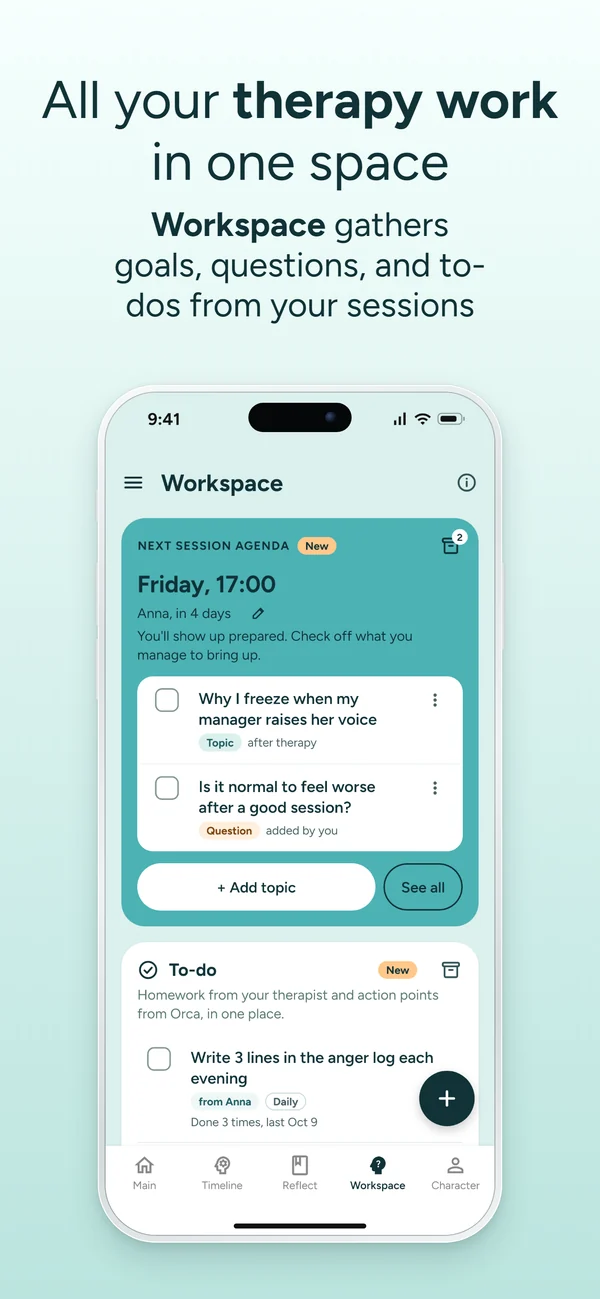
Workspace
Pin the dream to your agenda for next time, so it's still there when you sit down. Try it free in MindSync →
Catch the next dream before it fades, and bring it to your next therapy session.


Is there a dream you keep leaving out of your sessions?
Frequently asked questions
Should you tell your therapist about your dreams?
Yes, if the dream stayed with you, keeps coming back or left a strong feeling. You don't need to know what it means: a few images, the feeling and what was going on that week are enough to start. It also helps to ask your therapist how they like to work with dreams, since approaches differ.
Why am I dreaming about my therapist?
Your therapist is an important person in your week, someone you talk to about very personal things, so they can show up in dreams the way other close people do. A dream like that doesn't mean anything specific in advance. If it stays with you, you can bring it up in session like any other dream.
Do therapists interpret dreams?
It depends on the therapist and their approach. Some, for example psychodynamic therapists, work with dreams often, and others rarely do. Modern dream work usually starts from your own feelings and associations rather than a dictionary of symbols, and Clara Hill's cognitive-experiential model is the best-studied example. The simplest way to find out is to ask your therapist directly.
Should I tell my therapist about my nightmares?
Yes, especially if they repeat, disrupt your sleep or started after something difficult. Therapists have specific methods for recurring nightmares, such as imagery rehearsal therapy, and they guide that work in session. You don't need to describe the nightmare in detail. It's enough to say that it keeps coming back and how it affects your sleep. If a nightmare leaves you in crisis, call or text 988, or 911 in an emergency.
Is dream therapy real?
There isn't one separate treatment called dream therapy. Dream work happens inside psychotherapy, for example with Clara Hill's cognitive-experiential model or with treatments for nightmares, and it has research behind it, although the studies are few and small. Be wary of dream interpretation that promises ready-made meanings for symbols.
Keep more from every session
MindSync keeps your sessions and the week between them in one place, so your progress stops slipping away. The trial is free, no credit card needed.


Get the app