
Therapy
Loneliness in Adulthood Isn't About Having No One

Do any of these sound familiar?
- Your group chat has 47 unread messages, all of them memes, and there's nobody in it you'd call at two in the morning.
- "We should totally catch up soon" has been said for three months straight, by both of you, and you both know nobody is going to send an actual date.
- You say "I'm fine, just busy" so often that your phone suggests it after the first letter.
If one of these landed a little too close, nothing is wrong with you. Adult loneliness is common, and it usually has less to do with who you are than with how adult life is put together.
Where it comes from (and why it's not a character flaw):
Loneliness researchers Louise Hawkley and John Cacioppo describe it as the social cousin of hunger, thirst and physical pain. It's a signal. Your brain is telling you that something you need, in this case other people, is running low. Think of the low-battery warning on your phone: it doesn't mean the phone is broken, it means it needs plugging in.
The trouble is that adulthood took the charger away without asking. School and university put you in the same rooms with the same people every day, and nobody had to organize anything. Then come moves, remote work, partners, kids and friends who now live three time zones away. Friendship stops happening by itself and moves into your calendar, somewhere between the dentist and the car insurance renewal.
For some people, there's more to it than adult logistics. Earlier experiences (a home where feelings often went unanswered, for example) can make closeness feel risky, so letting anyone in takes longer.
None of this makes you "too much" or hard to like. You need connection, like everyone else does.
Hunger doesn't mean you're bad at eating.
What loneliness in adulthood looks like:
Loneliness in adulthood is the gap between the connection you have and the connection you need. People often mix up loneliness and being alone, though they're different things. Being alone is a physical state, and it can be restful: a Saturday morning when nobody needs anything from you is a small gift. Loneliness is the feeling that nobody really knows you, and it shows up in full rooms too. In everyday life it tends to look like this:
- You're in every meeting at work, and nobody there knows you had an awful week.
- You lie next to your partner after the same argument on repeat, and the quiet afterward feels louder than the argument did.
- Your calendar is full all week, and Sunday evening still hits hardest, because that's when nothing is scheduled to drown it out.
- What you don't feel during the day comes back when the lights go off.
You can be surrounded and still be unseen.
What research turned up:
In 2010, Hawkley and Cacioppo reviewed what loneliness does to people (Annals of Behavioral Medicine). Loneliness puts the brain on quiet alert for social threat. Lonely people tend to expect rejection, remember the negative moments more easily and pull back, then read the distance as coming from other people. The people around them react to that pulling back, which seems to confirm the fear. The authors call this the loneliness loop. The loop is a mechanism, and a mechanism is something you can learn to notice.
In 2011, Christopher Masi, Cacioppo and colleagues compared studies of four ways to reduce loneliness (Personality and Social Psychology Review): building social skills, offering support, creating more chances to meet people, and working on the thoughts people have about relationships. In the randomized studies, working on those thoughts did best, often with tools from cognitive behavioral therapy. The honest caveat: the effects were small, and there weren't many studies of this kind. Still, it suggests that more events in your calendar won't do much if the loop in your head keeps saying "they don't really want me there."
In 2015, Julianne Holt-Lunstad and colleagues pooled studies from 1980 to 2014 (Perspectives on Psychological Science). After accounting for other factors, loneliness was linked to about a 26% higher likelihood of death over the study periods, social isolation to 29% and living alone to 32%. Feeling lonely and being objectively isolated mattered about equally, and the link was stronger in samples where the average age was under 65. This shows a link, not proof that loneliness causes anything. Still, it's not a "soft" problem, and it deserves the attention you'd give sleep or exercise.
And you're far from the only one. In 2023, the U.S. Surgeon General's advisory noted that about one in two adults in America reported measurable loneliness even before the pandemic.
This is where the research runs thin. It says a lot about how loneliness works and what it costs, and much less about what will help one particular person. With effects this small, expect weeks and months, not a weekend. That's good news, though: you don't have to find "your people" by Friday.
The loop is real. So is the way out. It's just slower than a group chat.
Five places to start (none of them is "just put yourself out there"):
- Name which kind of lonely it is. Are there no people around? Are there people, but nobody who really knows you? Or is one specific person missing, after a breakup or a loss? Each version needs something different, so name what you're feeling before you try to fix it.
- Catch the first thought of the loop. When an invitation arrives, or a message goes unanswered, write down the very first thought ("they only invited me to be polite"). Notice when it comes back. Working on these thoughts is what did best in the Masi review, and it starts with learning to spot what sets it off.
- Pick one boring, repeating thing. Same place, same day, same people: a class, a running club, board games every Wednesday. In 2018, Jeffrey Hall looked at how many hours it takes to make a friend (Journal of Social and Personal Relationships). His answer: dozens of hours just to get past acquaintance, and more than 200 hours together for a close friend, mostly time spent hanging out rather than working side by side. At three hours a game night, that's more than 65 Wednesdays, so pace yourself. If you're wondering how to make friends as an adult, repetition is most of the answer, and play as an adult counts too.
- Send the low-stakes message. Try: "Saw this and thought of you. Coffee next week, Tuesday or Thursday?" A real day beats "we should catch up." And if the answer is "can't this week," that's a schedule, not a rejection.
- Bring it to therapy, by name. It's not too small for a session. You can open with: "I've been feeling lonely lately, and I'm not sure why." During the week, note two or three moments when it was strongest and bring them, which is a good use of the time between therapy sessions. If you're not in therapy and it has lasted for weeks, especially with hopelessness or when everyday life gets hard to manage, talk to a therapist or a doctor. If it ever turns into thoughts of not wanting to be here, call or text 988 in the US, or your local emergency number.
Between-session voice notes
When it hits on a Sunday night, say it out loud: your voice note is transcribed, and it's still there when your next session comes around. Try it free in MindSync →
Where MindSync fits (and where it doesn't):
This is what MindSync's between-session voice notes are for. Log the Sunday evening it hit hardest, the first thought when nobody replied, the coffee you finally booked. Give it time, and your Before therapy card turns what came up since your last session into a short summary and up to three questions to bring. Then say the first one out loud in your next session. MindSync isn't a friend, and it won't replace one or your therapist. It's where you keep the notes, so the loneliness gets talked about with a person.
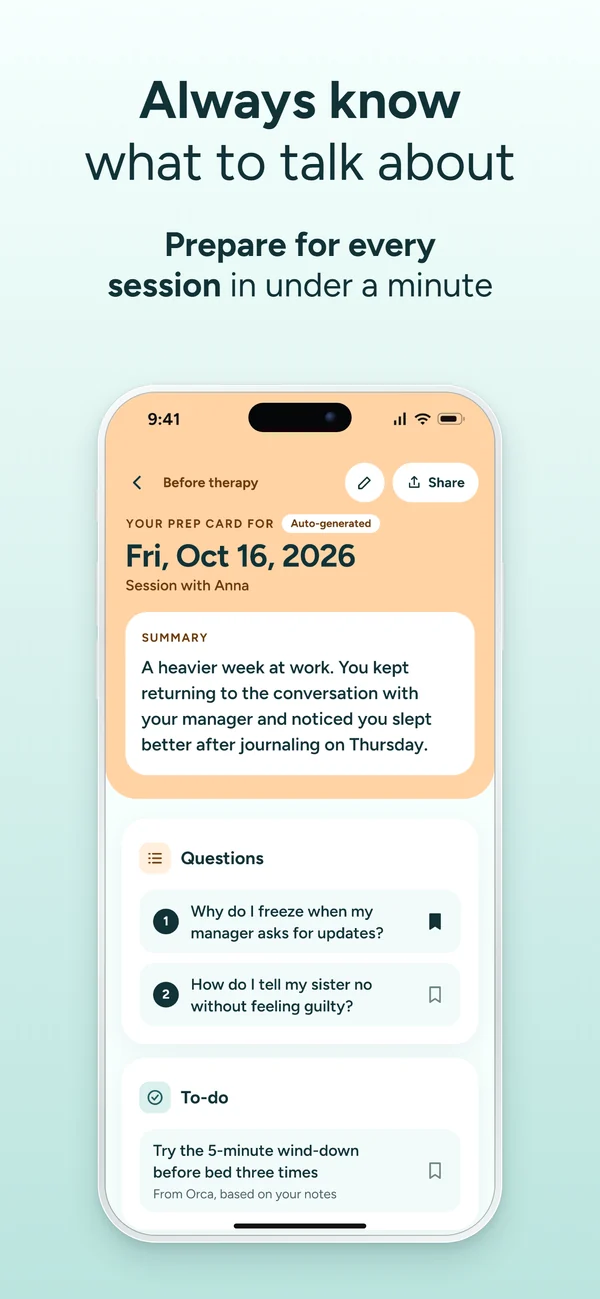
Before therapy card
Before your next session, the card gathers what came up since last time into a short summary and up to three questions, so "I've been lonely" becomes something you can talk through. Try it free in MindSync →
MindSync is free to download on iPhone and Android.


Who's the last person you thought "I should text them" about, and what stopped you?
Frequently asked questions
Why am I so lonely as an adult?
Usually it isn't a personal failing. Adult life removes the daily contact school used to provide, close friendships take hundreds of hours to build, and loneliness itself makes people expect rejection and pull back. It's a sign that you need more connection, not that something is wrong with you, and one small plan you repeat with the same people is a good place to start.
Is it normal to feel lonely in your 30s?
Yes, it's common. Even before the pandemic, about one in two adults in the US reported measurable loneliness, according to the U.S. Surgeon General's 2023 advisory. Your 30s tend to reshuffle friendships through moves, new jobs, partners and kids, so it helps to treat friendship as something you schedule on purpose instead of waiting for it to happen.
Why do I feel so alone even though I have friends?
It's usually about feeling known, not about how many friends you have. You can have plenty of people around and nobody you'd tell the hard stuff to, which is why loneliness shows up in full rooms. One deeper conversation with someone you already trust often helps more than three more plans.
What is the difference between loneliness and being alone?
It's the difference between a situation and a feeling. Being alone is a physical state, and it can feel restful. Loneliness is the feeling that your connections fall short of what you need, and it can show up when you're surrounded by people, so you can be alone and content, or in a crowd and lonely.
How long does it take to make a friend as an adult?
Usually longer than people expect. In a 2018 study, Jeffrey Hall found it took dozens of hours just to get past acquaintance and more than 200 hours together to become close friends, mostly time spent hanging out rather than working together. Seeing the same people in the same place, again and again, is the closest thing to a shortcut.
Keep more from every session
MindSync keeps your sessions and the week between them in one place, so your progress stops slipping away. The trial is free, no credit card needed.


Get the app