
Therapy
In-Network vs Out-of-Network Therapy: What's the Difference? Two Deals, Not Two Prices

The difference between in-network and out-of-network therapy is who sets the price. An in-network therapist accepts your insurer's rate, and once your deductible is met, you pay a copay or coinsurance. Out of network, you pay the therapist's full fee, and your plan pays back a percentage of its allowed amount, if you have out-of-network benefits.
Do any of these sound familiar?
- After a consultation with a therapist who finally sounded like she got it, you hear "I'm out of network, but I can give you a superbill." You nod like you know what that means, then google it in the parking lot.
- Your plan's directory lists twelve names within five miles. You call four, and nobody is taking new clients.
- Seven weeks after you mailed the paperwork, a check from your insurer arrives. For $38.
Not sure yet whether your plan covers therapy at all? Start there.
Why the same hour can cost you $25 or $200:
In network means there's a contract. The therapist accepts your insurer's rate, which HealthCare.gov calls the allowed amount. You pay your share (all of it until your deductible is met, then a copay or coinsurance), and the insurer pays the rest.
Out of network means there's no contract. The therapist sets the fee, and you pay all of it at the session. If your plan has out-of-network benefits, the insurer pays back a percentage of its own allowed amount, not of the bill, usually after a separate and often higher deductible. The gap between the fee and the allowed amount is yours. In network, charging you that gap would be balance billing, which HealthCare.gov says a preferred provider may not do for covered services.
It's like a friend who promised to chip in for dinner, but only up to the price of the dish they would have ordered. You picked the steak. They're paying for pasta.
Fun fact: HealthCare.gov defines the allowed amount as "the maximum amount a plan will pay for a covered health care service." Your reimbursement is calculated from that number, which nobody usually shows you.
In network, the insurer sets the price. Out of network, the therapist does, and the insurer decides how much of that price it believes.
In network vs out of network therapy, side by side:
In network vs out of network therapy comes down to who sets the price and who waits for the money.
In network, it usually looks like this:
- On many plans, you pay the allowed amount until your deductible is met, then a copay or coinsurance.
- The therapist bills the insurer for you.
- Costs are predictable, but your choice is limited, and directories can be out of date (more below).
- Every claim carries a diagnosis code, and some plans also require prior authorization.
Out of network, it usually looks like this:
- You pay the full fee at each visit.
- You submit a superbill and a claim yourself, unless someone does it for you.
- Many plans keep a separate out-of-network deductible and out-of-pocket maximum, and some don't cap those costs at all.
- Reimbursement is a percentage of the allowed amount, often with a deadline for claims.
- Your claim usually includes a diagnosis code, so your insurer sees your diagnosis either way.
- You get a wider choice and, often, an earlier appointment.
A made-up example, with round numbers: your therapist charges $180, your plan's allowed amount is $120, and your plan pays 60% out of network once your deductible is met. You get back $72 and pay $108 a session. Before the deductible is met, you get back nothing.
Your plan type decides whether there's an out-of-network side at all
According to HealthCare.gov, an HMO "generally won't cover out-of-network care except in an emergency," and an EPO covers only in-network care, emergencies aside. A PPO covers out-of-network care at an additional cost. POS plans vary. Your plan documents say which type you have.
The fee is the price of the session. The allowed amount is the price your insurer thinks it should have been.
What research turned up:
In 2020, Nicole Benson and Zirui Song published an analysis in Health Affairs of psychotherapy claims from a large, commercially insured US population, covering 2007 to 2017. For adults, what patients paid per in-network visit fell from $25.22 to $21.33, while out-of-network cost sharing rose from $43.23 to $60.15 (in 2016 dollars). So the gap you feel is real, and it kept widening for ten years. The honest caveat: these are averages, and the data stops in 2017.
The same year, Susan Busch and Kelly Kyanko, also in Health Affairs, surveyed privately insured adults who had received specialty mental health care. In the 2018 survey, 44% had used a mental health provider directory, and 53% of those ran into inaccurate information. People who hit a wrong listing were twice as likely to be treated out of network (40% vs 20%) and four times as likely to get a surprise out-of-network bill for outpatient care (16% vs 4%). The answers are self-reported, and the survey came before the No Surprises Act took effect in 2022. So treat the directory as a list of people to call, not a list of people who can see you.
I couldn't find research comparing how well therapy works in network versus out of network; the data covers prices and access. Good news, in a way: you're choosing between two deals you can price before the first session.
Five ways to choose a side without guessing:
- Ask your insurer for the out-of-network numbers, not just a yes. Call member services and ask: "What's my out-of-network deductible, and how much of it have I met?", "What percentage do you pay after that, and what's the allowed amount for the code my therapist bills?" (often 90837 for a full-hour session) and "Do out-of-network costs count toward my out-of-pocket maximum?" Note the call reference number.
- Do the math for twelve sessions, not one. Deductible first, then the fee minus the reimbursement for every session after it. Compare the total with your in-network copay times twelve. Your phone calculator will briefly know more about your finances than your bank.
- Ask the therapist how they handle the paperwork. Try: "Do you provide a monthly superbill, and do clients with my plan usually get reimbursed?" If you skip insurance entirely, providers generally have to give you a good faith estimate (here's what a good faith estimate protects).
- If no one in network can see you, ask for an exception. If no in-network provider treats what you need within a reasonable time, ask your insurer for a network gap exception (out of network at the in-network rate) or a single case agreement, a one-time contract between your insurer and one therapist (Triage Cancer explains both). Try: "I couldn't find an in-network provider who treats this and is taking new patients. Can I request a network gap exception or a single case agreement?" It's a request, not a right to the therapist you'd prefer, so keep a list of who you called and when. Federal parity rules generally bar stricter limits on mental health benefits than on medical ones. Or consider switching to a therapist in your network.
- Submit on a rhythm, and keep a running total. Once a month, same day: superbill, claim, a note of what came back. Miss your plan's deadline and the money can be gone, and an envelope "waiting for the right moment" for six weeks has never once filed itself. If a claim is denied, ask why and how to appeal.
This is general information, not financial or legal advice; your plan and your state's rules decide the details. If you're struggling right now, don't wait for the paperwork: call or text 988 in the US, or 911 in an emergency.
You don't need to love the math. You just need to do it before the sixth session, not after.
Where MindSync fits:
Whichever side you pick, you pay for every session, so it's fair to care about getting your money's worth from therapy. This is what MindSync's Before therapy card is for. Between therapy sessions, log the moment you almost canceled because of the cost, the thing from last week you didn't get to, the question you keep forgetting to ask. Give it time, and the card turns what came up since your last session into a short summary and up to three questions to bring, so the hour you paid for starts where you actually are. Then walk in with it. MindSync doesn't touch your insurance or your claims; it lives in the days between therapy sessions.
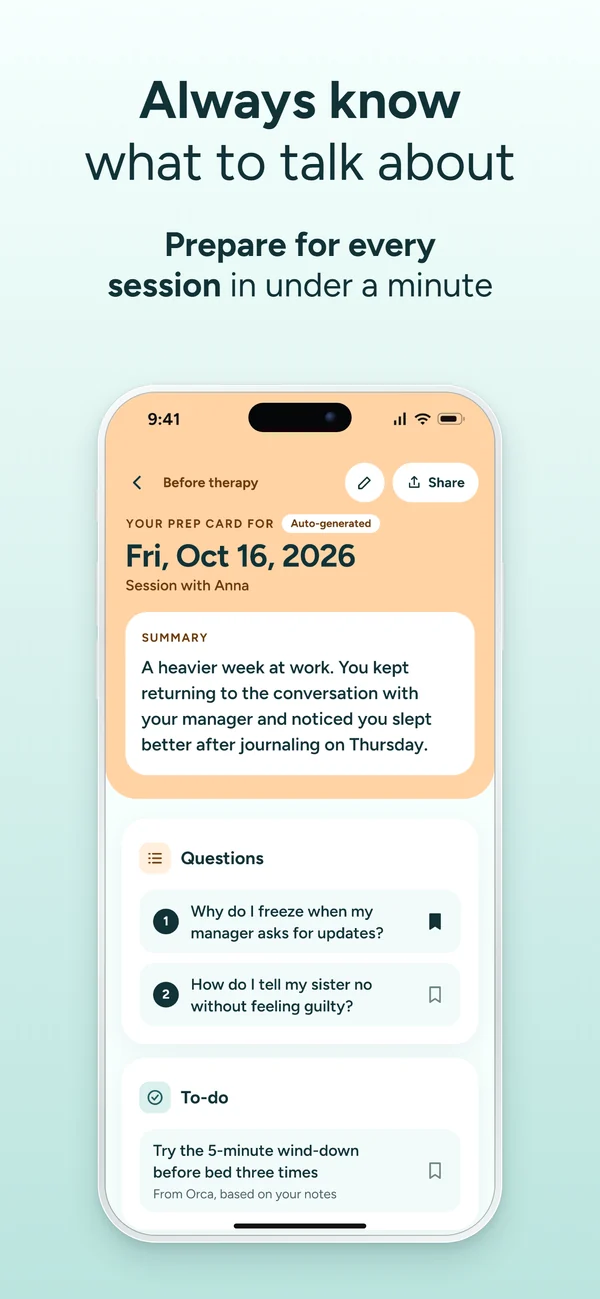
Before therapy card
Before each session, the card turns what came up since last time into a short summary and up to three questions to bring. Try it free in MindSync →
In network or out, make the hour you pay for count.


If you knew exactly what each session cost you, what would you make sure to say in the next one?
Frequently asked questions
What is the difference between in-network and out-of-network therapy?
An in-network therapist has a contract with your insurer, accepts its rate and bills it directly, so you pay a copay or coinsurance once your deductible is met. An out-of-network therapist sets their own fee, you pay it in full, and your plan pays back part of it only if you have out-of-network benefits, usually after a separate deductible. Your Summary of Benefits and Coverage shows which kind of benefits you have.
How much do you get reimbursed for out-of-network therapy?
It depends on your plan. Insurers pay a percentage of their own allowed amount, not of your therapist's fee, and usually only after your out-of-network deductible is met, so the difference between the fee and the allowed amount stays with you. Ask your insurer for the allowed amount for the code your therapist bills and the percentage they pay, then do the math before the first session.
Is out-of-network therapy worth it?
It can be, when the out-of-network therapist is a much better fit or nobody in network can see you in a reasonable time. Test it with the math over a few months rather than one session, and ask yourself whether you can keep going at that price. If fit is the reason you're looking, here's what to do when a therapist isn't the right fit.
What is a single case agreement for therapy?
A single case agreement is a one-time contract between your insurer and a specific out-of-network therapist that lets you pay in-network cost sharing, usually for a set period or number of sessions. Insurers tend to consider one when the care you need isn't reasonably available in network, not because you prefer someone. Ask member services how to request it, and keep notes of who you tried in network.
Does the out-of-network deductible count toward the in-network deductible?
Often not. Many plans with out-of-network benefits keep a separate deductible and out-of-pocket maximum for each side, and some don't cap out-of-network costs at all. Your Summary of Benefits and Coverage shows how yours works, and member services can confirm it.
Can therapist directories verify insurance?
Not reliably. A directory shows who has a contract with your plan, but listings can be out of date: in a 2018 national survey published in Health Affairs, more than half of people who used their plan's mental health directory found inaccurate information. Confirm with the therapist's office and your insurer before the first session, and note the call reference number.
Keep more from every session
MindSync keeps your sessions and the week between them in one place, so your progress stops slipping away. The trial is free, no credit card needed.


Get the app