
Therapy
Does FSA Cover Therapy? The Fine Print Before Your Money Runs Out

Does FSA cover therapy? Usually, yes, when it's medical treatment from a licensed therapist, psychologist or psychiatrist, and that includes your copay. Couples therapy, coaching and wellness apps often don't qualify, and some plans want a diagnosis or a letter of medical necessity. Check your plan and keep itemized receipts. And mind the deadline: unused money usually expires.
Do any of these sound familiar?
- It's mid-November, your benefits app shows an FSA balance, and you're pacing the pharmacy aisles for anything eligible. A third box of bandages. Reading glasses you don't need yet, just in case.
- Your FSA card went through when you paid for a session, and three weeks later the plan administrator emails to ask for "documentation."
- At open enrollment, you type in next year's amount by feel. Bold.
This piece is about FSAs and HSAs. For what your health plan itself pays, start with the bigger picture of what insurance covers.
Why your FSA cares what kind of therapy it is:
An FSA is a tax arrangement first and a pot of money second. The money leaves your paycheck before tax, so the IRS gets a say in what it buys.
The general rule sits in IRS Publication 502: medical care expenses must be primarily to alleviate or prevent a physical or mental disability or illness. On therapy, it names psychiatric care, amounts you pay to a psychologist for medical care, psychoanalysis (unless it's part of training to become a psychoanalyst) and therapy received as medical treatment. Medical care, medical treatment: that's where the question about a diagnosis comes from.
Then there's your plan. IRS Publication 969 says qualified medical expenses are "those specified in the plan," so your employer and its administrator can be stricter than the IRS. Picture a club with a guest list: the IRS writes the list, and the administrator stands at the door checking ID.
Fun fact: Publication 502 won't let you count health club dues, however much that spin class is holding your week together. Feeling better in general isn't treatment, and the same logic shuts out most wellness apps.
This is general information, not tax advice. Your plan's rules decide what it accepts.
The IRS doesn't ask whether therapy helps. It asks whether it treats something.
Does FSA cover therapy? What usually gets approved, and what doesn't:
Here's how it usually plays out in practice:
- Usually approved: sessions with a licensed provider as part of treatment, and the therapy copay for them, since it's your share of a medical expense. Online therapy usually counts too when it's the same treatment, though your plan has the final word.
- Often needs extra paperwork: therapy with no diagnosis on the receipt, and couples or family therapy. Benefits administrators such as Lively say counseling without a medical purpose, like marriage or family counseling, generally isn't eligible.
- Usually rejected: life coaching, meditation and journaling apps, and spa days. Therapy also won't go through a dependent care FSA (that one's for dependent care, like childcare) or, usually, a limited-purpose FSA, which normally covers only dental and vision.
And whatever your FSA already reimbursed can't be counted again as a medical expense on your tax return (Publication 502 again).
What a letter of medical necessity is, and when you need one
A letter of medical necessity (LMN) is a short note from your therapist or doctor saying a service is needed to treat a specific condition. Lively says an administrator may require one for therapy, and it comes up most with couples or family therapy and anything close to wellness. An LMN, and often the itemized receipt too, names a diagnosis that goes to your plan administrator. Whether you're comfortable with that is your call.
The session is usually fine. The receipt is where it falls apart.
What the rules and the numbers say:
Publication 969 doesn't soften the deadline: "FSAs are generally 'use-it-or-lose-it' plans." A plan can offer a grace period of up to two and a half months after the plan year ends, or a carryover of part of the balance, but never both, and it doesn't have to offer either.
The same publication has some good news, called uniform coverage: you must be able to get the full amount you elected for the year at any time during the coverage period, regardless of how much has come out of your paycheck so far. If your hardest months of therapy land in February, you don't wait for the money to pile up.
The 2026 numbers, which your employer can set lower: up to $3,400 in health FSA contributions (IRS Publication 15-B) and a carryover of up to $680 if your plan offers one (IRS inflation adjustments for 2026). Publication 969 puts the 2026 HSA limits at $4,400 for self-only coverage and $8,750 for family coverage.
In May 2024, the Employee Benefit Research Institute published an analysis of roughly 3.2 million FSAs from 2022, reported by InvestmentNews. About half of account holders, 52%, forfeited some of their money to their employer. The average loss was $441, up from $369 in 2019.
The honest caveat: we couldn't find research on how often people pay for therapy with an FSA, since EBRI's numbers cover every kind of expense. Which is good news, in a way, because whether your money expires comes down to your plan type, your deadline and your paperwork, and you can check all three in fifteen minutes.
Half of the people with an FSA lose some of it. For a lot of them, December probably just arrived first.
How to pay for therapy with your FSA without the paperwork drama:
- Ask your plan administrator three questions before you pay. That's the FSA or HSA administrator, often a different company from your insurer, and the number is usually on your card or in your benefits portal. Ask: "Is outpatient therapy with a licensed therapist an eligible expense under my plan?", "Do you need a letter of medical necessity or a diagnosis on the receipt?" and "Does my plan have a grace period or a carryover, and what's the last day to submit claims?" Note the date and who you spoke to.
- Ask your therapist for the right receipt. Publication 969 says reimbursement needs a written statement from an independent third party showing the expense and its amount. For therapy, that's an itemized receipt or a superbill with the date, the type of service, the amount and your therapist's details (here's what a superbill is). Try: "Could you give me an itemized receipt for each session, the kind my FSA will accept?"
- Keep the receipt, even if you paid by card. The FSA card pays on the spot, but the administrator can still ask for proof later unless the purchase was verified automatically. Keep one folder, paper or on your phone, for receipts, any LMN and emails from the administrator. Nobody likes that folder. Everybody goes looking for it in March.
- Put the deadline in your calendar now. Add the end of your plan year (not always December 31), any grace period, and the claims deadline if your plan has one. If you're already in therapy, the sessions before the deadline are money you'd have spent anyway. Don't book extra sessions just to empty the account: how often you go is between you and your therapist.
- Plan next year's amount from this year's sessions. At open enrollment, this year's session count times your share of the cost (copay or full fee) beats a guess. If the total comes out too high, here are other ways to pay less for therapy.
FSA or HSA: what changes for therapy
According to Publication 969, an HSA only comes with a high-deductible health plan. The money is yours, it rolls over from year to year, and it goes with you when you change jobs. An FSA usually comes through your employer and runs on the use-it-or-lose-it clock. What counts as medical care is the same idea in both, and the proof is up to your administrator. Which one makes sense for you depends on your situation, so ask HR, your administrator or a tax professional.
The money is real, and so is the deadline. A receipt and a calendar reminder handle most of it.
Where MindSync fits:
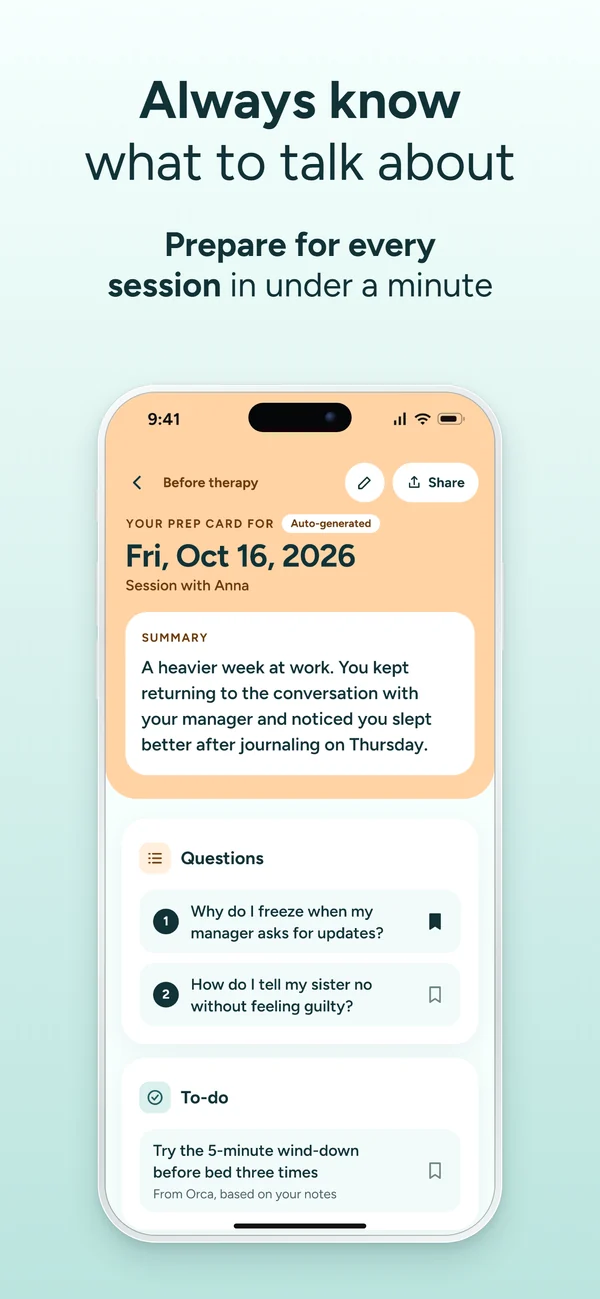
You pay for every session, sometimes with money that's about to expire, so it's fair to want your money's worth from therapy. This is what MindSync's Before therapy card is for. Between therapy sessions, log the moment at work you replayed all week, the question you keep forgetting to ask, the thing that went better than expected. Give it time, and the card turns what came up since your last session into a short summary and up to three questions to bring, so the fifty minutes you paid for start where you actually are. Then, on the way home, say what you took away as a voice note before it fades. Your FSA pays for the session, not for MindSync. If you'd rather do it on paper, here's how to prepare for a therapy session.
Before therapy card
Before each session, the card gathers what came up since last time into a short summary and up to three questions to bring. Try it free in MindSync →
Getting more from every paid session
- Voice notes between therapy sessions - Say what you took away on the way home: the note is transcribed and keeps its date, so it's still there next week.
- Mood & focus-area trends - Your check-in ratings for each Focus Area charted over time, with the trend in plain words, so you can see how the weeks between therapy sessions are going.
Make every session you pay for count: bring your questions, keep what you hear.


If every session came out of money with an expiry date, what would you want to walk in with next time?
Frequently asked questions
Does FSA cover therapy?
Usually, when it's therapy received as medical treatment from a licensed provider. IRS Publication 502 counts amounts paid to a psychologist for medical care and therapy received as medical treatment as medical expenses, which in practice often means a diagnosis. Your plan still decides what it accepts and what proof it wants, so ask your plan administrator before you pay. This is general information, not tax advice.
Does FSA cover therapy copays?
Usually, yes. A copay for an eligible therapy session is your share of a medical expense, so most plans accept it with an itemized receipt. Keep that receipt even if you paid with your FSA card, because the administrator can ask for it later, and check with your plan if you're not sure.
Do I need a letter of medical necessity for therapy?
Often not for individual therapy with a licensed provider, but your administrator can ask for one for any kind of therapy, and is more likely to for couples or family therapy. Your therapist or the doctor treating you writes it, and it usually names a diagnosis. Ask your plan administrator whether you'll need one before your first claim.
Can I use my FSA for couples therapy?
Sometimes. Benefits administrators generally accept couples therapy only when it treats a diagnosed condition in at least one partner, not when it's general relationship advice. Ask your plan before you pay, and ask whether it wants a letter of medical necessity.
Is online therapy eligible for HSA/FSA?
Usually, if it's the same kind of treatment from a licensed provider. The format doesn't change the rule, but coaching, wellness programs and wellness apps often don't qualify. Check with your plan administrator what the receipt needs to show.
Keep more from every session
MindSync keeps your sessions and the week between them in one place, so your progress stops slipping away. The trial is free, no credit card needed.


Get the app