
Therapy
Imposter Syndrome Isn't a Lack of Proof

Do any of these sound familiar?
- You get the promotion, and your first thought isn't "yes!", it's "okay, now they'll notice."
- Someone praises your presentation, and before they've finished the sentence you're already explaining that a colleague made the slides and the questions were easy.
- A calendar invite says "1:1 with manager," no description. By Thursday you've written the whole firing scene in your head, including who gets the plant on your desk.
If one of these landed, you're in good company. On paper you're probably doing fine, and the gap between that and how it feels has a name.
Where imposter syndrome comes from (and why the proof doesn't stick):
People with imposter feelings usually have plenty of evidence that they're good at what they do. The evidence just has to get past a filter first. Successes get credited to luck, to timing, or to someone who "must have made a mistake" when they hired you. Mistakes get credited to you, personally, with interest. Picture a spam filter that sends every compliment straight to a folder called "probably a mistake," while every bit of criticism lands in your inbox flagged as urgent.
That's why the next win doesn't help. It goes through the same filter. There's often a loop behind it: a task makes you anxious, so you either over-prepare or put it off. The task goes fine. And the conclusion is "I stayed up all night" or "I got lucky," never "I can do this." The next task starts from zero.
The filter usually has a history. Maybe you grew up as "the smart one" or "the hardworking one," or in a home where praise depended on results. Clance and Imes, who first described this, pointed to family dynamics. New places turn the volume up: a new job, being the first in your family at university, being the only person "like you" on a team.
None of this makes you falsely modest, or weak, or bad at your job: your brain is just keeping careful books with the wrong rules.
You can't out-achieve a filter.
What it looks like day to day:
Imposter syndrome is the persistent feeling that you haven't earned your success and that people will eventually find out, even when the evidence says you have. It tends to look like this:
- A compliment bounces off before it lands: "oh, it was nothing," "the team did it."
- You prepare for a routine meeting like it's a dissertation defense, then spend the evening replaying it in your head.
- You keep saying yes to everything, because extra work feels like rent you pay for your seat.
- Sunday evening becomes a countdown to being found out, which gives the Sunday scaries a very specific plot.
- It shows up in therapy, too: "I'm probably not doing this right," "other people have real problems," "my therapist must be bored of me."
In 2011, Valerie Young sorted imposter feelings into "competence types," like the perfectionist, the expert and the soloist. Most people recognize a mix.
It follows you into rooms where you're doing well, which is the strange part.
What research turned up:
In 1978, psychologists Pauline Clance and Suzanne Imes published a paper in Psychotherapy: Theory, Research & Practice. Over about five years they had worked with more than 150 high-achieving women: students, faculty, professionals. Roughly a third were in individual therapy, the rest in groups and classes the authors ran. Despite degrees and honors, these women believed they weren't really intelligent and had fooled everyone. Clance and Imes called it the "impostor phenomenon." Not a syndrome. Their impression that it was rarer in men hasn't held up well: in later studies, men report it too, often at similar rates.
In 2020, Bravata and colleagues pulled together 62 studies with 14,161 participants in a systematic review in the Journal of General Internal Medicine. Depending on the questionnaire and the cutoff, rates ranged from 9% to 82%. It showed up in men and women and in every kind of job they looked at, often alongside depression and anxiety, and it was linked to worse job performance and burnout. A range that wide mostly tells you the definition is slippery. And they couldn't find a single published study that tested a treatment.
In 2024, Para and colleagues mapped 31 papers on interventions in a scoping review in Frontiers in Psychology. Only four were randomized trials. The approaches that came up most were coaching, supervision and support groups, and what seemed to matter most was learning how it shows up and having a group to talk to. The honest caveat: the evidence is weak, and the samples are small and mostly female students.
It isn't a diagnosis, either: you won't find it in the DSM or the ICD. Science describes imposter feelings well and says very little about what helps. That's less bleak than it sounds, because the two directions that look best so far, understanding how it works and saying it out loud to someone, are open to you today, including between sessions.
It was named in a therapy room. That's still a good place to take it.
Five things to try between sessions:
- Catch the "they'll find out" moment. Write down the exact thought, where you were and what happened right before. After a week you'll see when it tends to arrive: a new person on the team, a review, a message from your boss that just says "got a minute?" Here's how to spot what sets it off.
- Write down how you explained the win away. Next to each success, note the sentence you used to cancel it: "luck," "the deadline was easy," "anyone could have done it." The filter is much easier to see on paper than in your head. Next time someone compliments you, try "Thank you, I worked hard on that," and then stop talking.
- Keep an evidence log, and read it on bad days. Facts, not feelings: what you did, how people reacted, what came of it. Call the folder "Proof I'm not a fraud": the name can be silly, it just has to exist. A log won't switch the feeling off, but it tends to turn it down.
- Say it out loud to one person. Learning how it works and talking it through with others are what the Para review pointed to most, and Clance and Imes recommended groups too. Try: "Do you ever feel like you're winging it and everyone's about to notice?" The answer is usually "all the time."
- Bring it to your next session, with examples. It's a real therapy topic, even when it shows up in therapy itself. You can open with: "I keep feeling like I'm about to be found out. Here are three times it happened this week." A few notes from the week help you prepare for your next session. If feeling like a fraud comes with low mood or anxiety that doesn't lift, or everyday life is getting hard to manage, talk to a therapist or a doctor.
Between-session voice notes
When the "they'll find out" thought hits, say it out loud: your voice note is transcribed, and it's still there when your next session comes. Try it free in MindSync →
Where MindSync fits:
This is what MindSync's between-session voice notes are for. Log the thought you had when the 1:1 invite landed, the compliment you brushed off, the win you called luck. Give it time, and your Before therapy card turns what came up since your last session into a short summary and up to three questions to bring. Then read the first one out loud in your next session. MindSync won't hand you confidence, and it doesn't replace your therapist. It just keeps the examples until you're in the room with someone who can help.
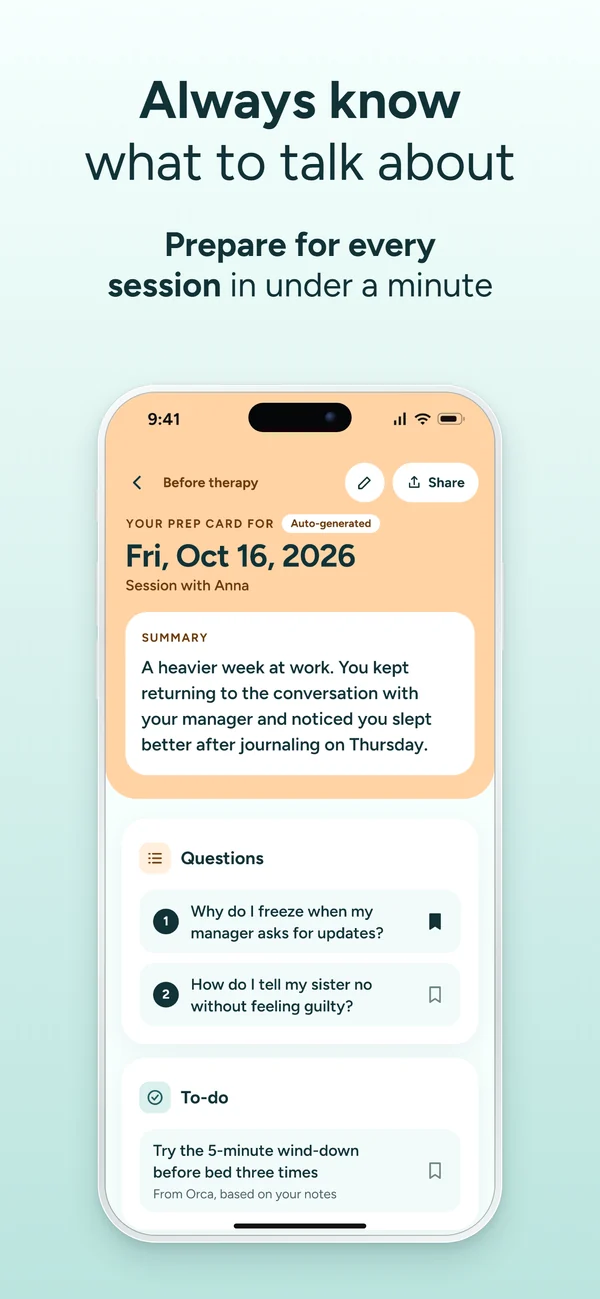
Before therapy card
Before your next session, the card gathers what came up since last time into a short summary and up to three questions, so "I feel like a fraud" arrives with examples you can actually work on. Try it free in MindSync →
Catch the "they'll find out" moments on your phone, and have them ready for your next session.


What's the last thing you did well and immediately explained away?
Frequently asked questions
What is imposter syndrome?
It's the persistent feeling that you haven't earned your success and that people will eventually find out, even when the evidence says otherwise. Psychologists Pauline Clance and Suzanne Imes first described it in 1978 as the "impostor phenomenon," based on women they worked with in therapy and in groups. It works like a filter: wins get credited to luck or timing, mistakes get credited to you, so new proof rarely changes the feeling.
Is imposter syndrome a mental illness?
No. It isn't a diagnosis, and it isn't listed in the DSM or the ICD. It's an experience, though research links it with anxiety, depression and burnout, so if it comes with low mood or anxiety that doesn't lift, that's worth raising with a therapist or a doctor.
What triggers imposter syndrome?
Usually new or visible moments: a new job, a promotion, a review, a presentation, a room where you're the only person like you. Comparing yourself with others turns it up, too. Noting when it shows up for a week or two is the quickest way to see your own pattern.
Does imposter syndrome ever go away?
For many people it gets quieter rather than disappearing completely. It can flare up again with each new role or step up. Noticing the thought earlier and naming it ("there's the filter again") tends to shrink how much of your week it runs.
Can therapy help with imposter syndrome?
It can be a good place to work on it, since the beliefs underneath, about worth, success and failure, are classic therapy material. Research on specific treatments is thin, though: a 2020 review by Bravata and colleagues found no published treatment studies, and a 2024 review by Para and colleagues found mostly small ones. Bringing real examples from your week makes the work concrete.
Keep more from every session
MindSync keeps your sessions and the week between them in one place, so your progress stops slipping away. The trial is free, no credit card needed.


Get the app