
Therapy
The Sunday Scaries: Why Sunday Evening Feels Like That, and What Shortens It

It is half past seven on Sunday evening. You have four hours of weekend left, technically, and you cannot use any of them. The film is on. You are not watching it. Something about Tuesday has settled in your chest and you could not name it if someone asked you to.
What the Sunday scaries actually are
The Sunday scaries are anticipatory anxiety on a schedule. It is not a diagnosis. It is the ordinary experience of dreading something that has not happened yet, and it arrives at the same hour every week because that is the hour the week stops being yours.
The percentages you see quoted come from company surveys and deserve to be read as such. SleepFoundation.org commissioned a Pollfish poll of 1,250 US adults in August 2022, and 31% named Sunday as the hardest night of the week to fall asleep. Among people reporting trouble sleeping on Sundays, 61.6% put it down to stress and anxiety and 57.2% to worry about the next day. That is consumer research rather than a peer-reviewed study. It tells you the experience is common and nothing about what is driving yours.
That second question is the one worth answering, because the answer changes what helps.
Three different things wearing the same name
Sunday dread gets treated as one problem with one solution, usually some version of "plan something nice for Sunday evening". It is at least three problems, and they do not respond to the same move.
A specific dread
Most of the time there is one item in the week ahead doing most of the work. A conversation with your manager. A number you have to present on Wednesday. An email you have been not-answering since Thursday, which has now sat there long enough to become its own separate problem. The feeling arrives as weather, a general grey, but underneath the weather there is usually a single appointment with a time attached to it.
You can test that in about a minute. Ask what would have to vanish from the calendar for the feeling to lift, then keep asking until you reach something with a name. Then notice how much smaller the named thing is than the mood was.
A recovery problem
Some Sundays nothing in the week is unusual and the evening is heavy anyway. That is often a sign the weekend never switched you off. You answered one message on Saturday morning. You kept the laptop on the table where you could see it. You did not work, exactly, but you stayed available, and staying available is not the same as being off.
A signal about the job
Sometimes the dread is simply accurate. If Sunday has felt like this for months, if it does not clear by Monday afternoon, if the specific worry changes every week while the feeling stays identical, then the feeling may be describing the work rather than distorting it. That is worth taking seriously, and worth taking to someone: a therapist, a mentor, somebody who knows your field. It is not a decision an article can make for you, and this one will not try.
Why recovery matters more than relaxing
The research that fits Sunday evening best is not about Sundays at all. It is about what makes time off restore anything.
Sonnentag and Fritz, writing in the Journal of Occupational Health Psychology in 2007, separated four things people can get from non-work time: psychological detachment, relaxation, mastery, and control. Detachment is the one that matters here, and it means not thinking about work. That is a different achievement from not doing work.
Wendsche and Lohmann-Haislah pooled that literature in Frontiers in Psychology in 2016, across 86 publications, 91 independent samples and 38,124 employees. Detachment during non-work time correlated with wellbeing at r = .32, with exhaustion at r = -.36 and with sleep at r = .30. Small to moderate associations. Most of those studies were cross-sectional, though, so the direction is not settled. People who are less exhausted may simply find switching off easier.
The awkward finding came later. Sonnentag called it the recovery paradox in a 2018 paper in Research in Organizational Behavior: the weeks that most need recovery are the weeks that make recovery hardest. The Friday that wrecked you is exactly the Friday you spend Saturday replaying.
Which is why a relaxing Sunday and a restorative Sunday are not the same object. Ryan, Bernstein and Brown reported in the Journal of Social and Clinical Psychology in 2010 that the weekend lift in mood and vitality tracked autonomy and closeness to other people rather than the mere absence of work. Lying on the sofa in a state of readiness does not qualify. That is unpaid standby with a blanket on it.
What shortens the dread on Sunday evening
Name the actual item
Write the sentence out. Not "work is a lot right now", but "I have to tell Marta on Tuesday that the deadline is not happening." The named version is nearly always smaller than the cloud, and it is the only version you can plan around. It also tends to be the version you have been carefully not looking at, which is why the mood stayed vague.
If it will not come when you ask directly, ask sideways. What did you avoid opening on Friday afternoon? Whose name makes your stomach drop when it turns up on a screen?
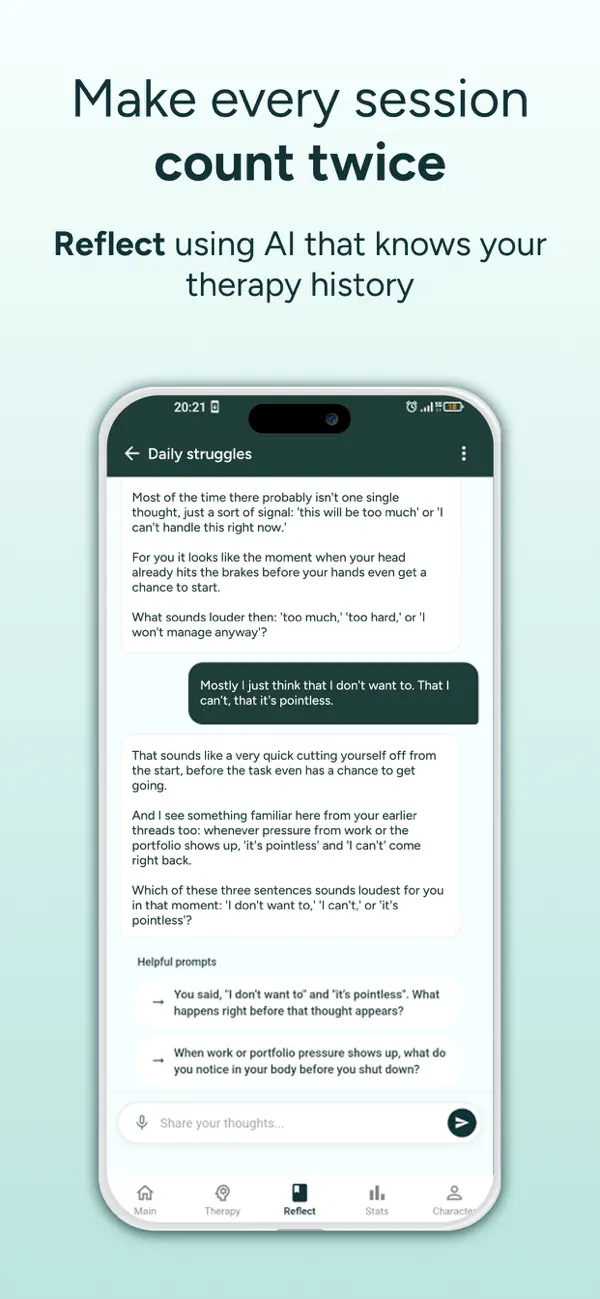
Reflect (AI journaling)
A guided reflection walks you from a heavy Sunday feeling to the one specific thing underneath it, which is usually smaller than the mood suggested. Try it free in MindSync →
Friday's fifteen minutes
Casper and Sonnentag ran a diary study with 112 employees, three measurements a day across two working weeks, published in the Journal of Occupational and Organizational Psychology in 2020. Work-related worry during the evening predicted exhaustion the next morning. On days when worry was high, anticipating a heavy workload predicted more morning exhaustion still.
The same paper is honest about what planning did not do: evening planning was not related to next-morning vigor. Writing Monday down will not make you wake up full of energy. What it can do is give the worry a place to stop, which is the more useful claim. Fifteen minutes before you leave on Friday: what is actually on Monday, what you will touch first, what can wait until Wednesday. Then close the laptop.
The study measured ordinary workday evenings rather than Sunday nights, so treating Friday as the lever is a reasonable extension of the finding rather than something anybody has tested directly.
A Sunday that starts in the morning
Most advice puts the good part of Sunday in the evening, which is the hour the dread is already loudest and has a head start on you. Move it earlier. The thing you actually want to do, the one that involves choosing rather than recovering, works better at eleven in the morning than at eight at night. It changes what the whole day was rather than rescuing the end of it.
That is roughly where the weekend research points: autonomy and other people, not rest by itself.
The two hour buffer
Leave a couple of hours between the last piece of week-shaped thinking and lights out. Do the Sunday admin, the calendar look, the bag, the forms, before dinner rather than after. Then stop. If the loop follows you to bed anyway, it has its own mechanics and its own fixes, and they are worth reading about when it follows you to bed.
If the dread lands in your body first, a tight chest and a jaw you only notice at midnight, settle the body when the dread is physical before you try to argue with the thoughts.
When it is not the Sunday scaries
Some of this sits outside what an article can do. If the feeling does not lift by Monday lunchtime, if it runs the whole week rather than visiting on Sunday, if you have not slept properly in weeks, or if it comes with physical symptoms that worry you, that belongs in a conversation with a professional. Nothing here is a diagnosis and nothing here replaces working with a therapist or a doctor. A weekly dread that has become a daily one deserves a proper assessment rather than a better Sunday routine.
Tracking it for a month, because you will not remember
Sunday evenings have a strange property. Each one feels definitive and none of them are memorable. By Wednesday the detail has gone, and by the following Sunday you are back to "it is always like this", which is a claim you have no evidence for in either direction.
So keep it small. Once a week, rate Sunday evening on the same scale, and write one line about what drove it. One line. "Presentation Wednesday." "Worked Saturday." "Nothing specific, just tired." After four or five weeks you can read them in a row, and the pattern tends to be obvious in a way it never is in the moment. Sometimes it is the job. More often it is the weekend in front of it.
Wellbeing check-ins
Rate Sunday evening the same way every week, and after a month you can see whether it is the job, the week or the weekend. Try it free in MindSync →
If the same trigger keeps turning up in those lines, you are looking at the pattern underneath the dread rather than a run of bad weeks. If the flatness has spread past Sunday and taken the rest of the week with it, that is the wider version of this, when the whole week feels flat.
MindSync comes out of one person's 10 years and $130,000 of therapy, and the weeks that kept blurring into each other between appointments. You can see what the app does, though a note on your phone works too. What does not work is trying to compare this Sunday against a Sunday in March from memory.
Making Sunday evening readable
- Mood & focus-area trends - Weeks side by side, so you can tell a rough patch from a pattern.
- Between-session voice notes - Say the thing you are dreading out loud on the walk, before it gets bigger.
- Workspace - Whatever this turns into, waiting for your next session.
Frequently asked questions
What are the Sunday scaries?
The Sunday scaries are the anxiety and low mood that show up on Sunday afternoon or evening as the working week gets closer. It is a common experience rather than a clinical category. It usually combines dread about something specific in the week ahead with a weekend that never fully disconnected you from work, and for most people it fades within a few hours of Monday starting.
Why do I get anxious on Sunday nights?
Usually because Sunday evening is the first quiet moment in which the coming week becomes real. Anticipatory anxiety runs ahead of events, so the dread arrives before anything has happened. A weekend spent partly available to work adds to it. Research on recovery, including Sonnentag and Fritz in 2007, points to psychological detachment as the ingredient that makes time off restorative.
How do I stop the Sunday scaries?
Work backwards through the week. On Friday, spend fifteen minutes writing down what Monday actually holds and what you will touch first. Across the weekend, protect a few hours where work is genuinely unreachable. On Sunday, put the thing you want to do in the morning rather than the evening. On Sunday night, name the one item you are dreading instead of carrying the whole week at once.
Do the Sunday scaries mean I hate my job?
Not on their own. One dreaded meeting, an unresolved conversation or a weekend that never switched off will produce the same Sunday feeling in a job you like. The signal worth attention is the pattern: dread that has lasted months, that does not lift on Monday afternoon, and that stays constant while the specific worries rotate. That is a question for you and possibly for a therapist, not for a checklist.
Is it normal to feel sick on Sunday evening?
Physical sensations are a common part of anticipatory anxiety, and nausea, a tight chest or a churning stomach on Sunday evening are all things people report. An article cannot tell you what your symptoms are, though. If they are persistent, severe, or worrying you, see a doctor rather than assuming the calendar explains them.
Keep more from every session
MindSync keeps your sessions and the week between them in one place, so your progress stops slipping away. The trial is free, no credit card needed.


Get the app