
Therapy
How to Stop Doomscrolling (Without Deleting Everything)

You picked up the phone to check the time. Forty minutes later you know the casualty figures, the three worst replies under the article, and what a stranger in another country thinks about all of it. You did not decide to spend forty minutes that way. You are also not deleting the app, and nothing here will ask you to.
What doomscrolling actually is
Doomscrolling is carrying on through negative news and content well past the point where you meant to stop. It is not a diagnosis and it is not the same thing as being informed. The distinguishing feature is that you did not choose the length of it.
Prevalence numbers come from polls rather than laboratories. Morning Consult surveyed 2,200 US adults between 17 and 19 February 2024 and found 31% of social media users saying they doomscroll "a lot" or "some", rising to 53% among Gen Z adults and 46% among millennials. That is a commercial poll with self-reported answers. It is useful for scale and for nothing else.
Why the loop is stickier than other phone habits
None of it is about willpower, which is the part most advice gets wrong.
Bad news wins attention
Soroka, Fournier and Nir ran an experiment across 17 countries on six continents, published in PNAS in 2019, measuring skin conductance and heart rate while people watched real television news. On average, reactions to negative content were stronger than reactions to positive content.
The authors are careful about something most summaries drop. Individual variation was considerable, and plenty of participants did not show the average pattern at all. So this is a tendency across people rather than a law about you. What it does mean is that a feed tuned for whatever holds attention will keep serving you the worst available version of the day.
Reading on feels like resolving something
This is the mechanism that explains why scrolling feels productive while it is happening. Uncertainty is uncomfortable, and reading the next article has the shape of resolution without any of the substance. A feed has nothing to resolve, so the discomfort renews itself and hands you another reason to keep going.
Kaya and Griffiths surveyed 432 adults aged 18 to 55, published in Behaviour and Information Technology in 2024, and found intolerance of uncertainty linked both to doomscrolling and to lower mental wellbeing, with doomscrolling carrying part of the association. It is a cross-sectional survey, measured at one moment in time, so it cannot show what causes what. As a description of the loop from the inside, it is still the most recognizable thing in the literature.
The feed has no edges
A newspaper ends. A bulletin ends. A feed does not, and it refills faster than you can empty it. Reviewers of this literature describe doomscrolling as a habitual, compulsive behavior reinforced by design features such as infinite scrolling and algorithmic content delivery.
You are not losing an argument with yourself here. You are losing to a system built without a stopping point, which means the stopping point has to come from somewhere else.
What the research links it to
Sharpe, Tyndall, Poulus, Obine and Sharpe published a scoping review in Mental Health and Digital Technologies in 2026, covering 17 empirical studies. Associations with anxiety, depression, stress and lower resilience turned up fairly consistently across them.
The authors are direct about the limits, and so is this article. Nearly all of that evidence is cross-sectional and self-reported, with a single experimental study in the whole set. Nobody can yet say whether doomscrolling makes people feel worse or whether people who already feel worse scroll more. Both are plausible, and they probably feed each other.
Shabahang and colleagues, writing in Computers in Human Behavior Reports in 2024, surveyed student samples in Iran and the United States and found doomscrolling associated with existential anxiety in both. That is correlational too, which makes it worth knowing rather than worth panicking about.
What none of this supports is the scarier framing you will find elsewhere, the one about rewired brains and cortisol damage. The attention side of heavy digital input has its own evidence and its own article, and that is what constant input does to attention.
Why app limits alone rarely hold
Radtke, Apel, Schenkel, Keller and von Lindern reviewed the digital detox research in Mobile Media and Communication in 2022: 21 studies, 3,625 participants, 12 of them randomized trials. Effects on wellbeing, social relationships, self-control and performance were inconsistent across the set. Some interventions helped, some did nothing, and the review asks for work on mechanisms instead of more blanket detoxes.
There is a simpler reason a screen-time limit is a weak lever. The limit argues with you at the wrong moment. By the time a banner appears telling you the 15 minutes are up, the scroll has already delivered half of what you came for and the feeling that sent you there is sitting exactly where it was. You tap "ignore limit" because the banner is talking to your thumb and the problem is somewhere else entirely.
The swap, not the ban
Removing a behavior leaves a hole shaped exactly like it. Replacing one gives the hole something to do. The first step below is the one people skip, and it decides whether the rest of it works.
Name the trigger moment
For one week, notice when the scroll starts rather than how long it lasts. Most people find two or three reliable entry points, and they are usually unglamorous. The gap between finishing work and starting dinner. Lying down before sleep. A conversation that went badly. Waiting for someone who is late.
You are not trying to stop yourself during that week. You are collecting the list, because a swap aimed at the wrong moment does nothing at all.
Pick a competing behavior that uses the same hand
The replacement has to be available in the same five seconds and ask about as little of you. A book across the room loses to a phone in your hand every single time. Something on the phone, or something within reach of the chair you are already sitting in, has a chance.
Then write it as an if-then plan, because that format has better evidence behind it than good intentions do. Gollwitzer and Sheeran pooled 94 independent studies in Advances in Experimental Social Psychology in 2006 and found a medium to large effect on goal attainment, d = 0.65. The format is plain enough: if I pick up my phone in bed, then I open the reflection I started instead of the feed.
Give the feeling somewhere else to go
Underneath most scrolling sessions there is a feeling with nowhere to be. Restlessness after a bad meeting. Loneliness at eleven at night. The feed absorbs it without processing any of it, which is why you come out the other side flatter than you went in.
Two minutes of naming it usually beats forty minutes of not naming it, and the naming can be as blunt as one sentence typed with your thumbs.
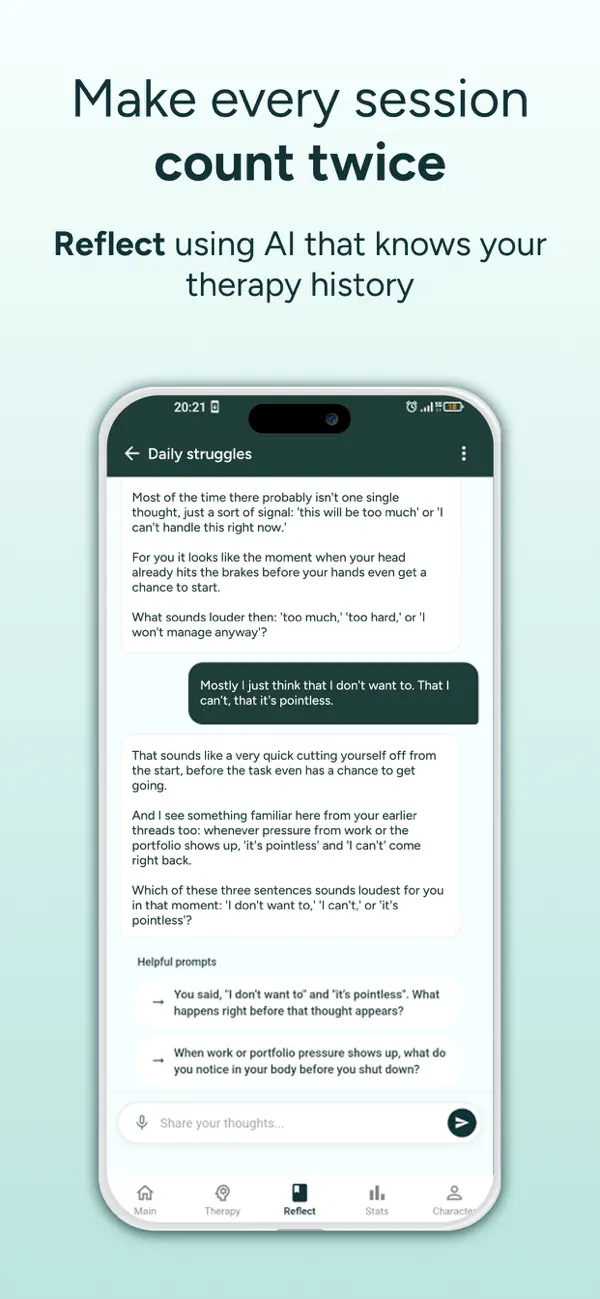
Reflect (AI journaling)
Two minutes of guided reflection uses the same hand and the same phone, and it gives the restlessness a target instead of a feed. Try it free in MindSync →
Keep one deliberate news window
Cutting news entirely tends to fail, and it is not the goal anyway. Pick one window a day, at a time when you have somewhere to be afterwards, which builds in the ending the feed refuses to provide. Read then. When the window closes, the day's news is done, and the version waiting at midnight will not be meaningfully different from the version at seven.
Run it as a two week test
Most attempts fall apart here. People change four things at once, feel vaguely better for three days, then drift back and conclude that nothing works.
Change one thing. Take your single most reliable trigger moment and swap that one. Then pick two measures you can rate in under a minute and rate them at the same time every day: how you slept, and how the evening felt. Fourteen days is long enough to show you something and short enough that you will actually finish it.
The method, including how to tell a real change from a good week, is set out properly in how to run a two week test, so this piece will not repeat it. If the swap is happening in bed, the loop it competes with is described in scrolling in bed, and what replaces it. And if the longest scroll of your week reliably lands on Sunday evening, when the scroll gets longest, the trigger is the week ahead rather than the phone.
Wellbeing check-ins
Rate the two things you expect to change, at the same time every day, so the result is something you can read rather than argue about. Try it free in MindSync →
Two weeks in, read the ratings back instead of asking yourself how it went. Memory will hand you whichever answer matches today's mood. A column of numbers will not. The rest of the toolkit sits on the features page, though a paper list does this job too.
Seeing whether the swap works
- Mood & focus-area trends - Two weeks next to each other, so a good day stops passing for progress.
- Weekly & monthly summaries - The week read back to you, instead of recalled on a Sunday.
- Between-session voice notes - Say what set it off, in the moment, before it turns into an hour.
Frequently asked questions
What is doomscrolling?
Doomscrolling is continuing to scroll through negative news and content past the point you meant to stop, usually on social media or a news feed. It is a behavior pattern rather than a clinical diagnosis. The defining feature is losing control of the length of the session, not the fact that you read distressing news at all.
Why do I doomscroll?
Three things overlap. Negative content holds attention more strongly on average, which a 17-country study by Soroka and colleagues in 2019 showed at the level of physiological arousal. Reading on feels like resolving uncertainty, even though a feed has no resolution to offer. And feeds are designed without a natural ending, so nothing stops the session except you.
How do I stop doomscrolling at night?
Replace the moment rather than banning the app. Decide in advance what your hand does when you get into bed, keep the replacement on the same device so it wins on convenience, and give the underlying feeling two minutes of attention instead of forty minutes of feed. Charging the phone across the room helps some people and irritates others, so treat it as one option rather than the answer.
Is doomscrolling bad for your mental health?
The research points that way but cannot prove it. A 2026 scoping review in Mental Health and Digital Technologies by Sharpe and colleagues found fairly consistent associations with anxiety, depression and stress across 17 studies, while noting that almost all of them were cross-sectional and self-reported. Association is not causation here, and the arrow may well run in both directions.
How long does it take to break the doomscrolling habit?
Longer than the popular figure suggests, and it varies enormously between people. Lally and colleagues followed 96 volunteers building a new daily habit over 12 weeks, publishing in the European Journal of Social Psychology in 2010, and found times to automaticity ranging from 18 to 254 days, with a median of 66. Expect weeks rather than days, and judge the first fortnight on whether the swap happened at all.
Keep more from every session
MindSync keeps your sessions and the week between them in one place, so your progress stops slipping away. The trial is free, no credit card needed.


Get the app