
Therapy
'I'm Fine, I'll Handle It': Understanding an Avoidant Attachment Style

Do any of these sound familiar?
- The date went really well. You laughed, you stayed out later than planned, and the strongest feeling on the way home is relief that you're going back to an empty apartment.
- Someone asks how you're doing, and "I'm fine" is out before you've actually checked. You've said it so many times it says itself.
- You're very independent. It's even in your dating profile.
We consider independence sexy enough to advertise, so it's easy to miss when it turns into a wall. That pattern has a name in psychology, and the research on it is kinder than the internet's version.
Where avoidant attachment comes from:
It usually starts with a very reasonable conclusion drawn by a very small person. When a child's need for closeness keeps meeting coolness, impatience or a quick "you're fine, stop crying", the child learns to stop showing the need. If asking doesn't work, stop asking. In the 1970s, Mary Ainsworth saw a version of this in babies: when their mothers came back after a short separation, some infants looked away and busied themselves with toys, as if nothing much had happened.
The strategy makes sense. If you don't lean on anyone, nobody can let you down. The price is maintenance. Keeping needs out of sight is work, even once it has become so automatic that you no longer notice you're doing it.
Fun fact: those calm-looking babies weren't as calm as they looked. In 1993, Spangler and Grossmann measured what was happening inside babies during the same procedure and published it in Child Development. The avoidant infants showed less distress on the outside, yet their heart rates during separation looked much like those of the secure babies. Stress hormones added a second clue. The secure babies showed no cortisol response at all. In the insecure groups as a whole, avoidant babies among them, a stress response kept turning up, though not every time.
One more thing the quizzes leave out. In research terms, an avoidant attachment style means scoring high on attachment avoidance: discomfort with closeness and with depending on other people, handled by turning the need down rather than reaching out. It's measured as a dimension that everyone sits somewhere on, not a box you're either in or out of. What's described here is sometimes called dismissive avoidant, high on avoidance and lower on anxiety. Someone high on both is often described as fearful avoidant, which is a story of its own. And if you've read about the anxious side of the same pattern, this is the other half of the picture.
Signs of an avoidant attachment style in adult life:
Day to day, it tends to look like this:
- You pull back when things get serious. The third month is lovely, and the conversation about moving in is when you suddenly get very busy at work.
- Helping comes easier than asking for help. People sometimes call this hyper-independence, which is a description, not a diagnosis.
- In an argument, you leave the room before the topic is finished, because leaving feels like the only way to keep things from getting worse.
- You remember your exes' flaws in more detail than anything you miss about them.
- After a whole weekend together, you need a day of quiet to feel like yourself again.
If people-pleasing is the opposite reflex, saying yes to everyone, hyper-independence is a polite no before anyone has even offered to help. It can look efficient for years, which is what makes handling everything alone until it runs out such a familiar story.
None of this makes you cold, or selfish, or difficult. It's a strategy that once kept you safe, still doing its job in places where it's no longer needed.
What research turned up:
In 1992, Mary Dozier and Roger Kobak interviewed 50 college students about their childhoods while measuring their skin conductance, a signal that rises with emotional arousal, and published the results in Child Development. Students whose way of talking about the past played attachment down ("deactivating", in the researchers' term) showed marked rises in skin conductance when the questions turned to separation, rejection and threat from their parents. Their words stayed calm. Their bodies didn't.
Calm words, busy body. You can show very little and still feel plenty.
The same year, Simpson, Rholes and Nelligan unobtrusively videotaped 83 dating couples in a waiting room while the woman waited for an activity she'd been told would make most people anxious (Journal of Personality and Social Psychology). The more anxious the avoidant women became, the less support they sought from their partners. The harder it got, the more "I'll handle it" took over.
Then, in 2004, Mikulincer, Dolev and Shaver looked at what happens when avoidant people push away thoughts about a breakup, again in the Journal of Personality and Social Psychology. Under normal conditions it worked: the thoughts stayed away, and people kept a positive view of themselves. When the researchers added a task that loaded their memory, the suppression failed. Thoughts about separation came back, and so did a more negative picture of the self.
The strategy works as long as you have the energy for it. Tiredness switches it off.
Avoidance is also where the research runs out of answers. A 2015 review by Taylor and colleagues in Psychotherapy Research found that attachment security tended to rise during therapy, but the results for avoidance were inconclusive. On a more hopeful note, a 2019 analysis of three long-running studies by Chopik, Edelstein and Grimm in the Journal of Personality and Social Psychology found that avoidance declined steadily across the lifespan, on average. That's a group trend, not a promise about any one person.
Here's how to start, without bolting for the door:
- Notice the exit before you take it. The exit has a feeling: the urge to leave the room, change the subject, check your phone, or develop a sudden, urgent need to do laundry in the middle of a conversation about feelings. You don't have to stop yourself yet. Just catch the moment you reach for the door.
- Stay 10% longer. Not the whole conversation, just a little longer than usual. That's small enough to manage and big enough to show your body that staying doesn't end in disaster. If you can't tell what you're feeling when you want to leave, putting a word on what you would rather not feel is a good place to start, even if that word stays private for now.
- Say the need in its smallest form. You don't have to explain your childhood. One sentence covers it: "I need an hour to myself, and then I want to come back to this." The second half is the part that changes things, because it tells the other person you're coming back.
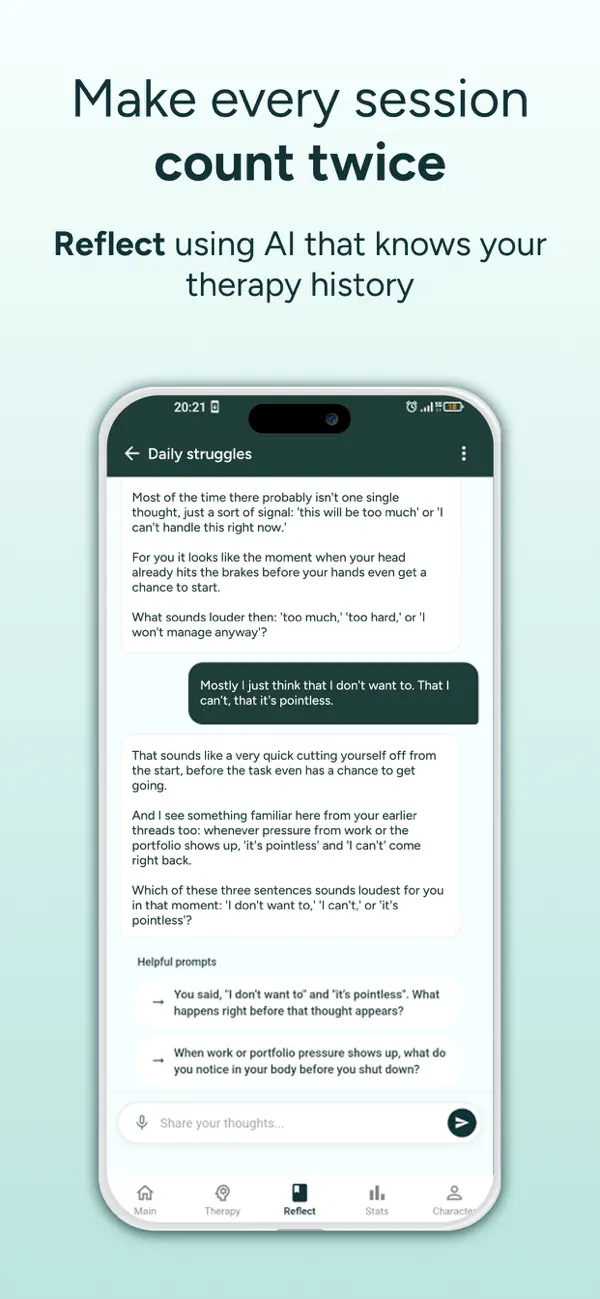
Reflect (AI journaling)
A private conversation that asks one gentle follow-up question, for the things you would rather not say to a person yet. Try it free in MindSync →
These steps won't rewrite the pattern on their own. The deeper work belongs with a therapist, and it takes time.
One thing for the people who love someone avoidant
You can't pull someone closer by pulling harder, and chasing usually makes the exit look even more urgent. What helps is quieter. Don't answer distance with punishment or a silence of your own. Agree on when you'll come back to a conversation, then actually come back to it. Space that's given without a price attached is evidence too, the kind therapists call a corrective emotional experience. One evening of it proves very little. A long run of them is what starts to shift things.
MindSync works alongside therapy, not instead of it. There's also a pre-order page for a deeper tool aimed at what sits under "I'm fine", if you want to see what it will do.
This is what MindSync's Between-session voice notes are for. Log the moment you wanted to leave the room, the message you left unanswered, and what you told yourself about why. Give it time, and your Weekly & monthly summaries turn those entries into something you can read: the same exit, showing up in different places. Then flag the one worth unpacking into your Workspace and bring it to your next session.
What's the moment you usually decide you'd rather handle it alone?
Seeing the exit before you take it
- Between-session voice notes - Thirty seconds after you pulled back, while you still remember what the pull felt like.
- Weekly & monthly summaries - A weekly read of your own entries, where the same retreat stops looking like a coincidence.
- Workspace - Set aside the moment worth unpacking, so it is waiting when the session starts and not only when you feel ready.
Frequently asked questions
What are the signs of avoidant attachment?
Common signs include pulling back when a relationship gets serious, finding it easier to help than to ask for help, leaving arguments before they're finished, and needing time alone after a lot of closeness. Recognizing yourself in that list isn't a diagnosis. It describes a pattern that can shift over time, and a therapist can help you look at it properly.
What causes avoidant attachment?
Avoidant attachment is thought to develop when a child's need for closeness is repeatedly met with coolness or impatience, so hiding the need starts to work better than showing it. Early experience shapes the pattern without fixing it for life, and later relationships keep editing it. It doesn't mean any particular person was neglected or traumatized.
Can avoidant attachment change?
Avoidant attachment can change, though the evidence is thinner than for anxious attachment. A 2019 study by Chopik and colleagues found that avoidance declined steadily with age on average, across three long-running samples. A 2015 review of therapy studies by Taylor and colleagues found clearer change in attachment anxiety, while the results for avoidance were inconclusive. Change is possible, and it's usually slow.
How do you love someone with avoidant attachment?
Give space without punishing it, and agree on when you'll come back to a hard conversation. Chasing tends to make pulling away more urgent, while calm, predictable follow-through builds trust over time. You can't do someone else's inner work for them, and your own needs still count. Couples therapy can help when the same pattern keeps repeating.
Is hyper-independence a trauma response?
Not necessarily. Hyper-independence isn't a diagnosis, and while it can be linked to difficult early experiences, not every kind of self-reliance comes from there. Be careful about assigning yourself trauma based on one trait. If relying on others feels impossible rather than just unfamiliar, that's worth exploring with a therapist.
Keep more from every session
MindSync keeps your sessions and the week between them in one place, so your progress stops slipping away. The trial is free, no credit card needed.


Get the app